Lee Sang Min, Im Jung Ho, Shin Hyun Soo, Lew Helen
Department of Ophthalmology, CHA Bundang Medical Center, CHA University School of Medicine, Seongnam, Republic of Korea.
Depratment of Radiation Oncology, CHA Bundang Medical Center, CHA University School of Medicine, Seongnam, Republic of Korea.
BJR Open. 2020 Sep 2;2(1):20200013. doi: 10.1259/bjro.20200013. eCollection 2020.
To evaluate the safety and effectiveness of hypofractionated orbital radiotherapy applied in the treatment of thyroid-associated ophthalmopathy (TAO) patients.
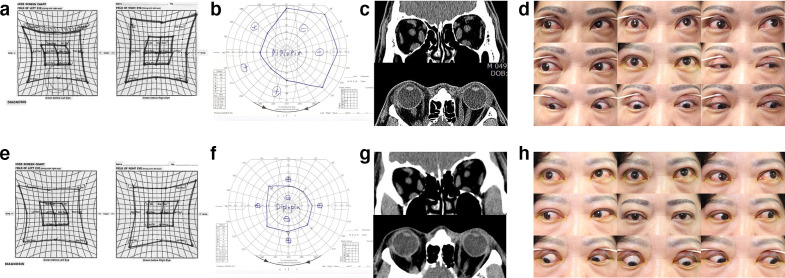
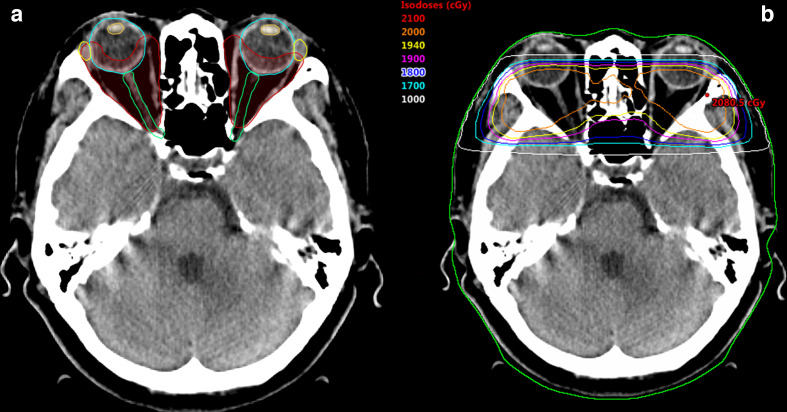
Between 2014 and 2018, we retrospectively reviewed the cases of 28 patients with TAO. All patients underwent radiotherapy on both retroocular tissues and received an oral steroid. Patients were divided into two treatment groups: 14 patients received conventional fractionated radiotherapy (20 Gy in 10 fractions), and the second group of 14 patients received hypofractionated radiotherapy (20 Gy in five fractions). The clinical activity score (CAS), NOSPECS (No physical signs or symptoms, Only signs, Soft tissue involvement, Proptosis, Extraocular muscle signs, Corneal involvement, and Sight loss) classification, Hess screen test and binocular single vision (BSV) were evaluated to determine the response to treatment before and at 1 month after radiotherapy.
There were no significant differences in any of the variables between the two treatment groups. In both groups, the CAS and NOSPECS score decreased significantly, and the range of extraocular muscle motility in Hess screen test and BSV improved significantly after radiotherapy ( < 0.05). There were no significant differences in CAS, NOSPECS score, Hess screen test or BSV between the two groups. No radiation-related, acute severe toxicity was observed.
Hypofractionated radiotherapy for TAO produced a comparable clinical outcome to that of conventional fractionated radiotherapy. Further case accumulation and long-term follow-up are required to determine if late toxicity occurs and to confirm efficacy.
This is the first study to show that the efficacy and risk of adverse events are comparable between hypofractionated radiotherapy and conventional radiotherapy in the treatment of TAO.
评估短程分割眼眶放射治疗应用于甲状腺相关性眼病(TAO)患者的安全性和有效性。
回顾性分析2014年至2018年期间28例TAO患者的病例。所有患者均接受双侧眼球后组织放射治疗并口服类固醇药物。患者分为两个治疗组:14例患者接受常规分割放射治疗(10次分割,共20 Gy),另一组14例患者接受短程分割放射治疗(5次分割,共20 Gy)。评估临床活动评分(CAS)、NOSPECS(无体征或症状、仅有体征、软组织受累、眼球突出、眼外肌体征、角膜受累和视力丧失)分级、Hess屏试验和双眼单视(BSV),以确定放疗前及放疗后1个月的治疗反应。
两个治疗组在任何变量上均无显著差异。两组患者的CAS和NOSPECS评分均显著降低,放疗后Hess屏试验中眼外肌活动范围和BSV均显著改善(<0.05)。两组在CAS、NOSPECS评分、Hess屏试验或BSV方面均无显著差异。未观察到与放射相关的急性严重毒性反应。
TAO的短程分割放射治疗产生的临床结果与常规分割放射治疗相当。需要进一步积累病例并进行长期随访,以确定是否会出现晚期毒性反应并确认疗效。
这是第一项表明短程分割放射治疗和常规放射治疗在TAO治疗中疗效和不良事件风险相当的研究。