Department of Global Health, Boston University School of Public Health, Boston, Massachusetts.
The Pulmonary Center, Boston University School of Medicine, Boston, Massachusetts.
JAMA Netw Open. 2020 Nov 2;3(11):e2020816. doi: 10.1001/jamanetworkopen.2020.20816.
Generating robust and timely evidence about the respiratory health risks of electronic cigarettes (e-cigarettes) is critical for informing state and federal regulatory standards for product safety.
To examine the association of e-cigarette use with incident respiratory conditions, including chronic obstructive pulmonary disease (COPD), emphysema, chronic bronchitis, and asthma.
DESIGN, SETTING, AND PARTICIPANTS: This prospective cohort study used data from the nationally representative cohort of US adults from the Population Assessment of Tobacco and Health (PATH) study, including wave 1 from 2013 to 2014, wave 2 from 2014 to 2015, wave 3 from 2015 to 2016, and wave 4 from 2016 to 2018. Individuals aged 18 years and older at baseline with no prevalent respiratory conditions were included in the analyses. Analyses were conducted from February to July 2020.
e-Cigarette use was assessed by self-reported current use status (never, former, or current) at baseline.
Incident respiratory conditions, including COPD, emphysema, chronic bronchitis, and asthma, as well as a composite respiratory disease encompassing all 4 conditions.
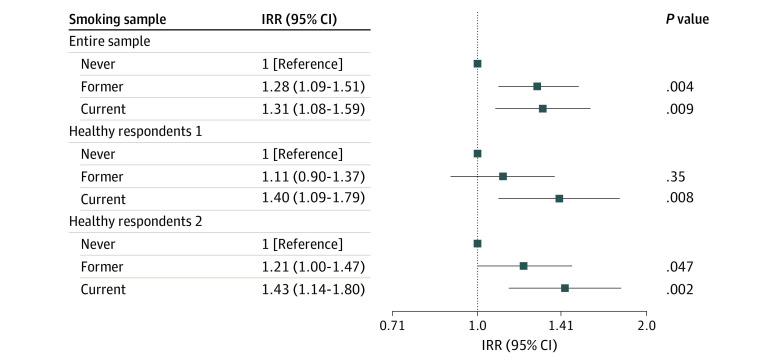
Among 21 618 respondents included in the analyses, 11 017 (491%) were men and 12 969 (65.2%) were non-Hispanic White. A total of 14 213 respondents were never e-cigarette users, 5076 respondents (11.6%) were former e-cigarette users, and 2329 respondents (5.2%) were current e-cigarette users. Adjusted for cigarette and other combustible tobacco product use, demographic characteristics, and chronic health conditions, there was an increased risk of respiratory disease among former e-cigarette uses (incidence rate ratio [IRR], 1.28; 95% CI, 1.09-1.50) and current e-cigarette users (IRR, 1.31; 95% CI, 1.08-1.59). Among respondents with good self-rated health, the IRR for former e-cigarette users was 1.21 (95%CI, 1.00-1.46) and the IRR for current e-cigarette users was 1.43 (95% CI, 1.14-1.79). For specific respiratory diseases among current e-cigarette users, the IRR was 1.33 (95% CI, 1.06-1.67) for chronic bronchitis, 1.69 (95% CI, 1.15-2.49) for emphysema, 1.57 (95% CI, 1.15-2.13) for COPD, and 1.31 (95% CI, 1.01-1.71) for asthma.
This cohort study found that e-cigarette use was associated with an increased risk of developing respiratory disease independent of cigarette smoking. These findings add important evidence on the risk profile of novel tobacco products.
生成关于电子烟(电子烟)对呼吸道健康风险的有力且及时的证据,对于为电子烟产品安全的州和联邦监管标准提供信息至关重要。
研究电子烟使用与包括慢性阻塞性肺疾病(COPD)、肺气肿、慢性支气管炎和哮喘在内的呼吸道疾病发病的相关性。
设计、地点和参与者:这项前瞻性队列研究使用了来自美国成年人全国代表性队列的人群评估烟草和健康(PATH)研究的数据,包括 2013 年至 2014 年的第 1 波、2014 年至 2015 年的第 2 波、2015 年至 2016 年的第 3 波和 2016 年至 2018 年的第 4 波。基线时无现有呼吸道疾病且年龄在 18 岁及以上的个体被纳入分析。分析于 2020 年 2 月至 7 月进行。
电子烟使用情况通过自我报告的当前使用状态(从未、曾经或当前)在基线时进行评估。
包括 COPD、肺气肿、慢性支气管炎和哮喘在内的新发生呼吸道疾病,以及包含所有 4 种疾病的综合呼吸道疾病。
在纳入分析的 21618 名受访者中,11017 名(49.1%)为男性,12969 名(65.2%)为非西班牙裔白人。共有 14213 名受访者从未使用过电子烟,5076 名(11.6%)为前电子烟使用者,2329 名(5.2%)为当前电子烟使用者。在调整了香烟和其他可燃烟草制品的使用、人口统计学特征和慢性健康状况后,前电子烟使用者(发病率比[IRR],1.28;95%CI,1.09-1.50)和当前电子烟使用者(IRR,1.31;95%CI,1.08-1.59)患呼吸道疾病的风险增加。在自我报告健康状况良好的受访者中,前电子烟使用者的 IRR 为 1.21(95%CI,1.00-1.46),当前电子烟使用者的 IRR 为 1.43(95%CI,1.14-1.79)。在当前电子烟使用者中,特定呼吸道疾病的 IRR 为慢性支气管炎 1.33(95%CI,1.06-1.67)、肺气肿 1.69(95%CI,1.15-2.49)、COPD 1.57(95%CI,1.15-2.13)和哮喘 1.31(95%CI,1.01-1.71)。
这项队列研究发现,电子烟使用与呼吸道疾病发病风险增加相关,独立于吸烟。这些发现为新型烟草产品的风险状况增加了重要证据。