Chen Yingyan, Wang Hongze, Wu Yi, Wang Haowei
State Key Laboratory of Metal Matrix Composites, Shanghai Jiao Tong University, No. 800 Dongchuan Road, Shanghai 200240, China.
School of Materials Science and Engineering, Shanghai Jiao Tong University, No. 800 Dongchuan Road, Shanghai 200240, China.
Materials (Basel). 2020 Nov 10;13(22):5063. doi: 10.3390/ma13225063.
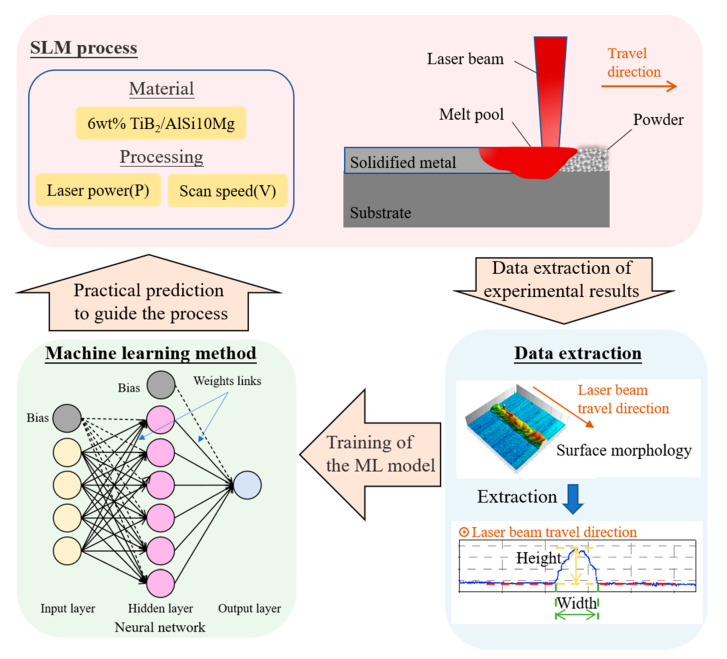
Though selective laser melting (SLM) has a rapidly increasing market these years, the quality of the SLM-fabricated part is extremely dependent on the process parameters. However, the current metallographic examination method to find the parameter window is time-consuming and involves subjective assessments of the experimenters. Here, we proposed a supervised machine learning (ML) method to detect the track defect and predict the printability of material in SLM intelligently. The printed tracks were classified into five types based on the measured surface morphologies and characteristics. The classification results were used as the target output of the ML model. Four indicators had been calculated to evaluate the quality of the tracks quantitatively, serving as input variables of the model. The data-driven model can determine the defect-free process parameter combination, which significantly improves the efficiency in searching the process parameter window and has great potential for the application in the unmanned factory in the future.
尽管近年来选择性激光熔化(SLM)市场增长迅速,但SLM制造零件的质量极度依赖于工艺参数。然而,当前用于寻找参数窗口的金相检验方法耗时且涉及实验者的主观评估。在此,我们提出了一种监督式机器学习(ML)方法,用于智能检测SLM中的轨迹缺陷并预测材料的可打印性。根据测量的表面形貌和特征,将打印轨迹分为五种类型。分类结果用作ML模型的目标输出。计算了四个指标以定量评估轨迹质量,作为模型的输入变量。数据驱动模型可以确定无缺陷的工艺参数组合,这显著提高了搜索工艺参数窗口的效率,并且在未来无人工厂应用中具有巨大潜力。