Jaśkiewicz Marek, Frej Damian, Tarnapowicz Dariusz, Poliak Milos
Department of Automotive Engineering and Transport, Kielce University of Technology, 25-340 Kielce, Poland.
Faculty of Mechatronics and Electrical Engineering, Maritime University of Szczecin, 70-500 Szczecin, Poland.
Polymers (Basel). 2020 Nov 10;12(11):2641. doi: 10.3390/polym12112641.
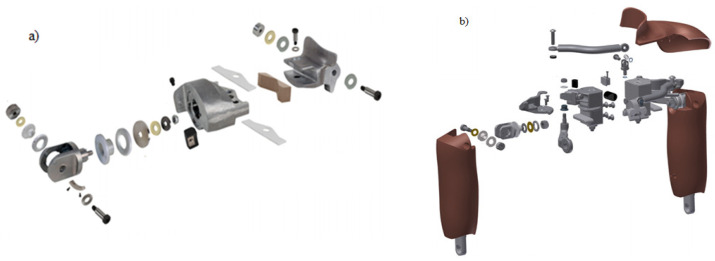
The article presents the design of the upper limb joints of an anthropometric dummy intended for rear crash tests for low impact speeds. These joints represent the connection of the hand to the forearm, the forearm to the arm, and the arm to the shoulder. The designed joint is adapted to the construction of a dummy representing the 50th percentile male. The joints currently used on Hybrid III dummies require calibration after each crash test. The construction of the new joint ensures the appropriate strength of individual joint elements and the repeatable value of the joint characteristics without the need for frequent calibrations. The designed joints have the ability to set a variable stiffness characteristic, thanks to which it is possible to use this joint universally in dummies representing populations of other percentile sizes. The range of movement of the joints has been selected to reflect the range of mobility of the upper limb of an adult. The characteristics of the joints were compared with those used in the joints of the Hybrid III 50 percentile male dummy. Moreover, it should be noted that the constructed joints of the upper limb are made by hand; therefore, their comparison with the Hybrid III dummy shows some deviations in the moments of resistance. Making the joints with a 3D printer, taking into account the appropriate material, will ensure greater accuracy and will also result in joining the individual elements of the joint into a whole. The obtained results show slight differences between the moment of resistance in the joints of the constructed anthropometric dummy compared to the hybrid III dummy.
本文介绍了一种用于低碰撞速度后碰撞测试的人体测量假人上肢关节的设计。这些关节代表了手与前臂、前臂与上臂以及上臂与肩部的连接。所设计的关节适用于代表第50百分位男性的假人的构造。目前在Hybrid III假人上使用的关节在每次碰撞测试后都需要校准。新关节的构造确保了各个关节元件的适当强度以及关节特性的可重复值,而无需频繁校准。所设计的关节能够设置可变刚度特性,因此可以在代表其他百分位尺寸人群的假人中通用。关节的运动范围已被选定以反映成年人上肢的活动范围。将这些关节的特性与Hybrid III第50百分位男性假人关节中使用的特性进行了比较。此外,应该注意的是,所构建的上肢关节是手工制作的;因此,它们与Hybrid III假人的比较在阻力矩方面显示出一些偏差。考虑到合适的材料,用3D打印机制作关节将确保更高的精度,并且还将导致关节的各个元件连接成一个整体。所获得的结果表明,与Hybrid III假人相比,所构建的人体测量假人关节的阻力矩存在细微差异。