Department of Biochemistry and Molecular Biology, Medical University of Lublin, 20-093 Lublin, Poland.
Department of Pharmacognosy, Medical University of Lublin, 20-093 Lublin, Poland.
Biomolecules. 2020 Nov 10;10(11):1532. doi: 10.3390/biom10111532.
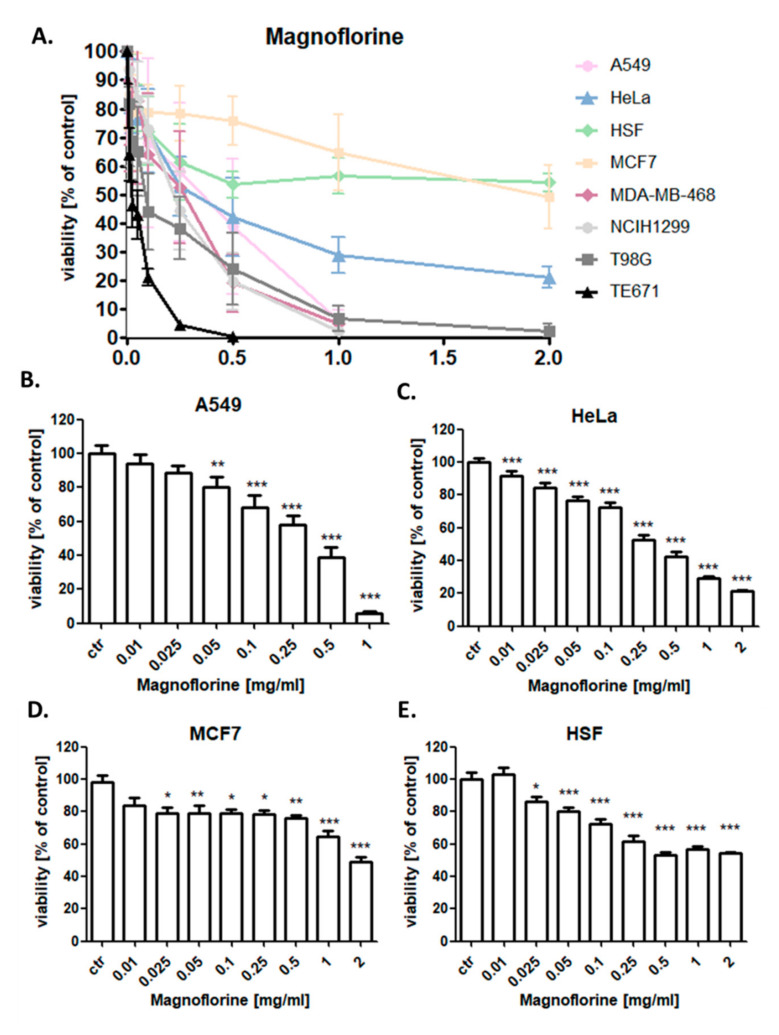
Magnoflorine (MGN) is a quaternary aporphine alkaloid that exhibits numerous therapeutic properties, including neuropsychopharmacological, anti-anxiety, immunomodulatory, anti-inflammatory, antioxidant, or antifungal activities. The aim of the present study was an investigation of the influence of MGN on viability, proliferation, induction of apoptosis, and cell cycle arrest in NCI-H1299 lung, MDA-MB-468 breast, T98G glioma, and TE671 rhabdomyosarcoma cancer cells. MGN was isolated from the roots of L. by counter-current partition chromatography (CPC). Cell viability and proliferation assessments were performed by means of MTT (3-(4,5-dimethylthiazol-2-yl)-2,5-diphenyltetrazolium bromide) and 5-bromo-2'-deoxyuridine (BrDU) assays, respectively. The induction of apoptosis and cell cycle progression was measured using fluorescence-activated cell sorting analysis. MGN in high doses inhibits proliferation, induces apoptosis, and inhibits cell cycle in S/G2 phases in a dose-dependent manner. MGN seems to be a promising anti-cancer compound in therapy of some types of lung, breast, glioma, and rhabdomyosarcoma cancers, for which current standard therapies are limited or have severe strong side effects.
厚朴碱(MGN)是一种季铵型阿朴啡生物碱,具有多种治疗特性,包括神经精神药理学、抗焦虑、免疫调节、抗炎、抗氧化或抗真菌活性。本研究旨在研究 MGN 对 NCI-H1299 肺癌、MDA-MB-468 乳腺癌、T98G 神经胶质瘤和 TE671 横纹肌肉瘤癌细胞活力、增殖、诱导细胞凋亡和细胞周期停滞的影响。MGN 从 根部分离出来,采用逆流分配色谱法(CPC)。通过 MTT(3-(4,5-二甲基噻唑-2-基)-2,5-二苯基四唑溴盐)和 5-溴-2'-脱氧尿苷(BrDU)测定分别评估细胞活力和增殖。使用荧光激活细胞分选分析测量细胞凋亡的诱导和细胞周期进程。高剂量的 MGN 以剂量依赖的方式抑制增殖、诱导细胞凋亡并抑制 S/G2 期的细胞周期。MGN 似乎是一种有前途的抗癌化合物,可用于治疗某些类型的肺癌、乳腺癌、神经胶质瘤和横纹肌肉瘤,这些癌症的当前标准疗法有限或具有严重的强烈副作用。