Department of Applied Economics, Public Economics and Political Economy, School of Economics & Business, University Complutense of Madrid, Campus de Somosaguas, 28223, Pozuelo de Alarcón, Madrid, Spain.
Int J Equity Health. 2020 Nov 12;19(1):207. doi: 10.1186/s12939-020-01317-x.
Dental health is an important component of general health. Socioeconomic inequalities in unmet dental care needs have been identified in the literature, but some knowledge gaps persist. This paper tries to identify the determinants of income-related inequality in unmet need for dental care and the reasons for its recent evolution in Spain, and it inquires about the traces left by the Great Recession.
Data from the EU-SILC forming a decade (2007-2017) were used. Income-related inequalities for three years were measured by calculating corrected concentration indices (CCI), which were further decomposed in order to compute the contribution of different factors to inequality. An Oaxaca-type decomposition approach was also used to analyze the origin of changes over time. Men and women were analyzed separately.
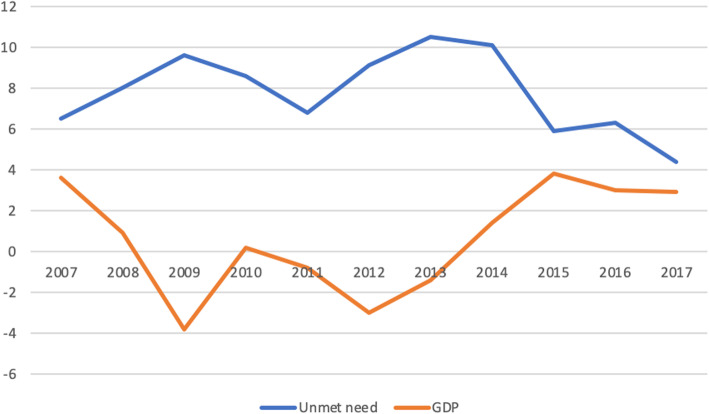
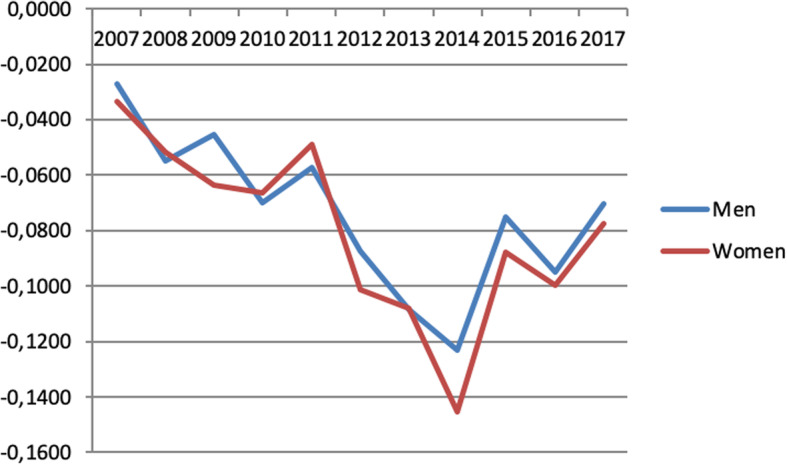
Pro-rich inequality in unmet dental care needs significantly increased over time (CCI 2007: - 0.0272 and - 0.0334 for males and females, respectively; CCI 2017: - 0.0704 and - 0.0776; p < 0.001). Inequality showed a clear "pro-cycle" pattern, growing during the Great Recession and starting to decrease just after the economic recovery began. Gender differences only were significant for 2009 (p = 0.004) and 2014 (p = 0.063). Income was the main determinant of inequality and of its variation along time -particularly for women-, followed by far by unemployment -particularly for men-; the contributions of both were mainly due to changes in elasticites.
The Great Recession left its trace in form of a higher inequality in the access to dental care. Also, unmet need for dental care, as well as its inequality, became more sensitive to the ability to pay and to unemployment along recent years. To broaden public coverage of dental care for vulnerable groups, such as low-income/unemployed people with high oral health needs, would help to prevent further growth of inequality.
口腔健康是总体健康的一个重要组成部分。文献中已经确定了未满足的牙科护理需求方面存在社会经济不平等,但仍存在一些知识空白。本文试图确定收入相关的牙科护理未满足需求不平等的决定因素及其在西班牙近期演变的原因,并探讨大衰退留下的痕迹。
使用欧盟-社会融合调查(EU-SILC)的数据,该数据构成了十年(2007-2017 年)的数据。通过计算修正的集中指数(CCI)来衡量三年内与收入相关的不平等,进一步分解以计算不同因素对不平等的贡献。还使用了一种类似于奥克萨卡的分解方法来分析随时间变化的起源。分别对男性和女性进行分析。
男性和女性未满足的牙科护理需求呈明显的“有利于富人”的不平等现象,且这种不平等随着时间的推移而显著增加(2007 年 CCI 分别为-0.0272 和-0.0334,2017 年 CCI 分别为-0.0704 和-0.0776;p<0.001)。不平等现象呈现出明显的“顺周期”模式,在大衰退期间增长,并在经济复苏开始后开始下降。2009 年(p=0.004)和 2014 年(p=0.063)性别差异具有统计学意义。收入是不平等及其随时间变化的主要决定因素-尤其是对女性而言-,其次是失业-尤其是对男性而言-;两者的贡献主要归因于弹性的变化。
大衰退以牙科护理获取方面更高的不平等为特征留下了痕迹。此外,近年来,未满足的牙科护理需求及其不平等现象对支付能力和失业变得更加敏感。扩大弱势群体(如高口腔健康需求的低收入/失业人群)的牙科保健公共覆盖面将有助于防止不平等进一步扩大。