Department of Neuroanaesthesiology, The Neuroscience Centre, Rigshospitalet, University of Copenhagen, Blegdamsvej 3, 2100, Copenhagen Ø, Denmark.
Section of Biostatistics, Department of Public Health, Faculty of Health and Medical Sciences, University of Copenhagen, Copenhagen, Denmark.
J Neuroinflammation. 2020 Nov 12;17(1):338. doi: 10.1186/s12974-020-01979-y.
This exploratory study investigated the time-course of lectin complement pathway (LCP) initiators in cerebrospinal fluid (CSF) and plasma in patients with subarachnoid hemorrhage (SAH), as well as their relationship to delayed cerebral ischemia (DCI) and functional outcome.
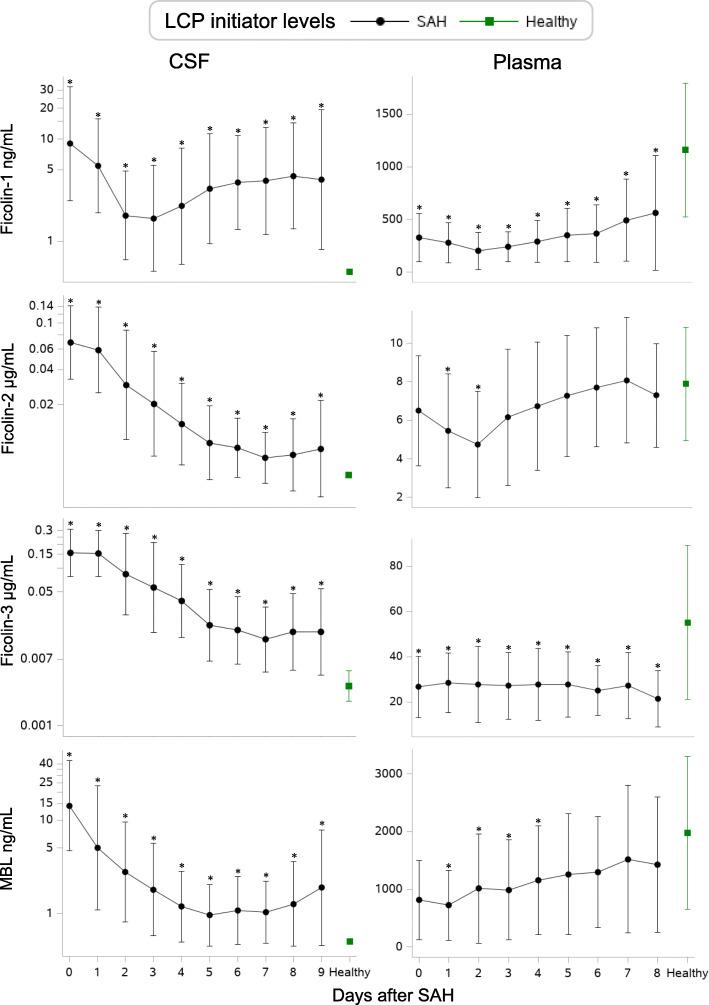
Concentrations of ficolin-1, ficolin-2, ficolin-3, and mannose-binding lectin (MBL) were analyzed in CSF and plasma from patients with SAH. Samples were collected daily from admission until day 9 (CSF; N_ = 63, n_ = 399) and day 8 (plasma; N_ = 50, n_ = 358), respectively. Twelve neurologically healthy patients undergoing spinal anesthesia and 12 healthy blood donors served as controls. The development of DCI during hospitalization and functional outcome at 3 months (modified Rankin Scale) were registered for patients.
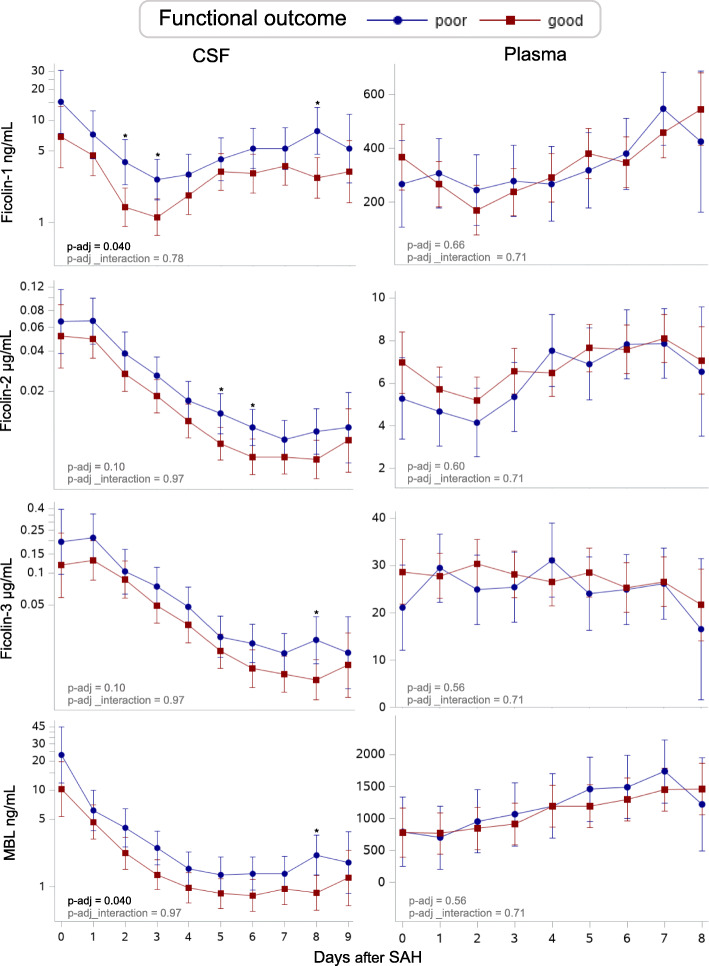
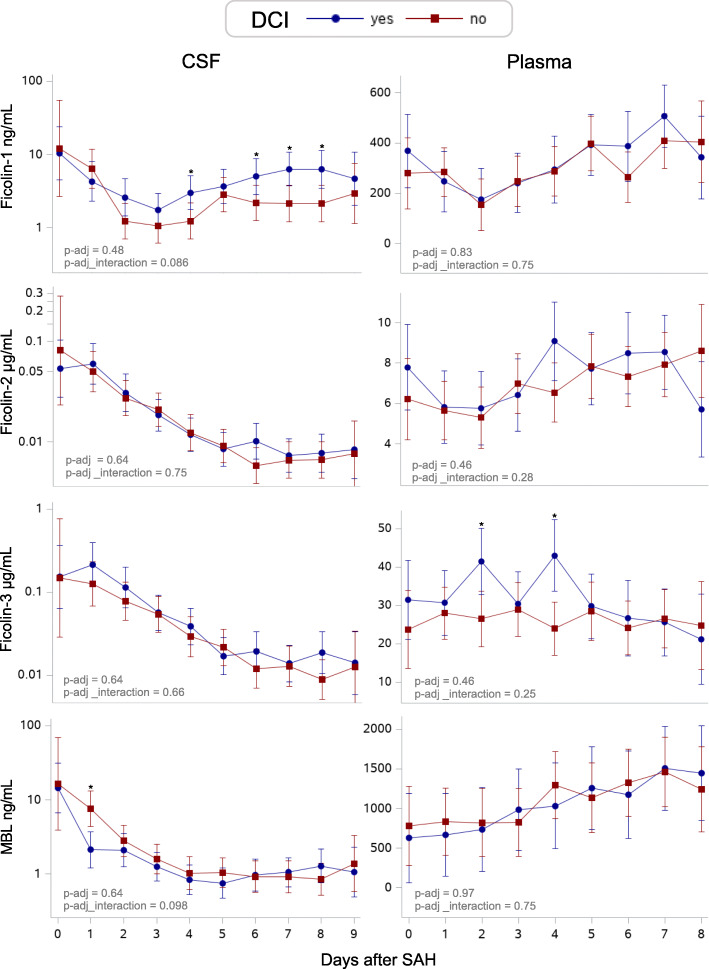
On admission, CSF levels of all LCP initiators were increased in SAH patients compared with healthy controls. Levels declined gradually over days in patients; however, a biphasic course was observed for ficolin-1. Increased CSF levels of all LCP initiators were associated with a poor functional outcome in univariate analyses. This relationship persisted for ficolin-1 and MBL in multivariate analysis after adjustments for confounders (age, sex, clinical severity, distribution and amount of blood on CT-imaging) and multiple testing (1.87 ng/mL higher in average, 95% CI, 1.17 to 2.99 and 1.69 ng/mL higher in average, 95% CI, 1.09 to 2.63, respectively). In patients who developed DCI compared with those without DCI, CSF levels of ficolin-1 and MBL tended to increase slightly more over time (p_interaction = 0.021 and 0.033, respectively); however, no association was found after adjustments for confounders and multiple testing (p-adj_interaction = 0.086 and 0.098, respectively). Plasma ficolin-1 and ficolin-3 were lower in SAH patients compared with healthy controls on all days. DCI and functional outcome were not associated with LCP initiator levels in plasma.
Patients with SAH displayed elevated CSF levels of ficolin-1, ficolin-2, ficolin-3, and MBL. Increased CSF levels of ficolin-1 and MBL were associated with a poor functional outcome.
This study was a retrospective analysis of samples, which had been prospectively sampled and stored in a biobank. Registered at clinicaltrials.gov ( NCT01791257 , February 13, 2013, and NCT02320539 , December 19, 2014).
本探索性研究调查了蛛网膜下腔出血(SAH)患者脑脊液(CSF)和血浆中凝集素补体途径(LCP)起始物的时程,以及它们与迟发性脑缺血(DCI)和功能结局的关系。
分析了 63 例 SAH 患者 CSF 和 50 例血浆样本中 ficolin-1、ficolin-2、ficolin-3 和甘露聚糖结合凝集素(MBL)的浓度。分别于入院当天至第 9 天(CSF;N_ = 63,n_ = 399)和第 8 天(血浆;N_ = 50,n_ = 358)进行采集。12 名接受脊髓麻醉的神经科健康患者和 12 名健康献血者作为对照。为患者记录住院期间 DCI 的发展和 3 个月时的功能结局(改良 Rankin 量表)。
入院时,SAH 患者的所有 LCP 起始物的 CSF 水平均高于健康对照组。在患者中,水平逐渐下降,但 ficolin-1 呈双相过程。在单变量分析中,所有 LCP 起始物的升高 CSF 水平与不良功能结局相关。在调整混杂因素(年龄、性别、临床严重程度、CT 成像上的血液分布和数量)和多次检验(平均升高 1.87ng/mL,95%CI 1.17 至 2.99 和平均升高 1.69ng/mL,95%CI 1.09 至 2.63)后,这种关系在多变量分析中仍然存在,ficolin-1 和 MBL。与无 DCI 的患者相比,发生 DCI 的患者 CSF 中 ficolin-1 和 MBL 的水平似乎随时间略有增加(p_interaction = 0.021 和 0.033,分别);然而,在调整混杂因素和多次检验后,未发现相关性(p-adj_interaction = 0.086 和 0.098,分别)。所有天,SAH 患者的血浆 ficolin-1 和 ficolin-3 水平均低于健康对照组。LCP 起始物水平与 DCI 和功能结局无关。
SAH 患者 CSF 中 ficolin-1、ficolin-2、ficolin-3 和 MBL 水平升高。升高的 CSF 中 ficolin-1 和 MBL 水平与不良的功能结局相关。
本研究是对样本的回顾性分析,这些样本是前瞻性采集并储存在生物库中的。在 clinicaltrials.gov 上注册(NCT01791257,2013 年 2 月 13 日和 NCT02320539,2014 年 12 月 19 日)。