Department of Internal Medicine, College of Medicine, Yeungnam University, Daegu, South Korea.
Department of Internal Medicine, School of Medicine, Kyungpook National University, Kyungpook National University Hospital, Daegu, South Korea.
BMJ Open. 2020 Nov 12;10(11):e041989. doi: 10.1136/bmjopen-2020-041989.
The reliable risk factors for mortality of COVID-19 has not evaluated in well-characterised cohort. This study aimed to identify risk factors for in-hospital mortality within 56 days in patients with severe infection of COVID-19.
Retrospective multicentre cohort study.
Five tertiary hospitals of Daegu, South Korea.
1005 participants over 19 years old confirmed COVID-19 using real-time PCR from nasopharyngeal and oropharyngeal swabs.
The clinical and laboratory features of patients with COVID-19 receiving respiratory support were analysed to ascertain the risk factors for mortality using the Cox proportional hazards regression model. The relationship between overall survival and risk factors was analysed using the Kaplan-Meier method.
In-hospital mortality for any reason within 56 days.
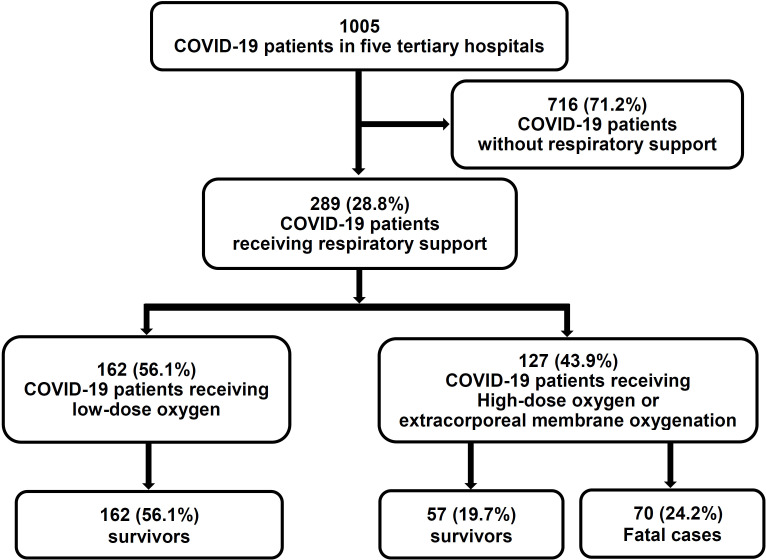
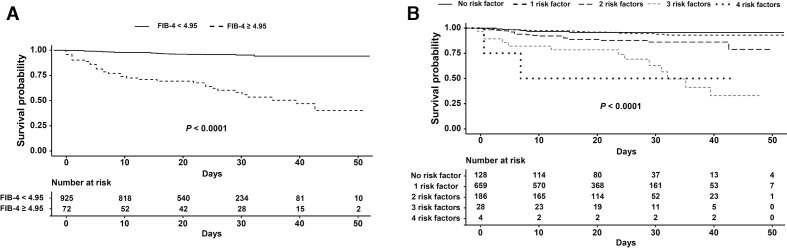
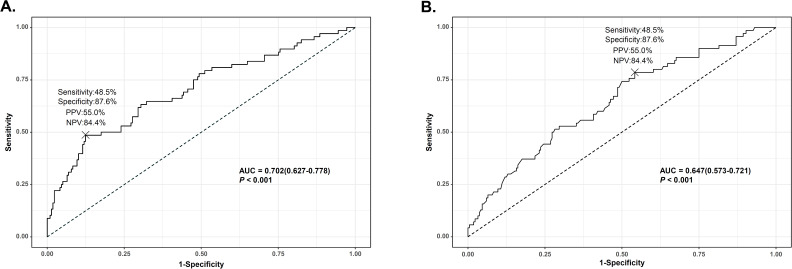
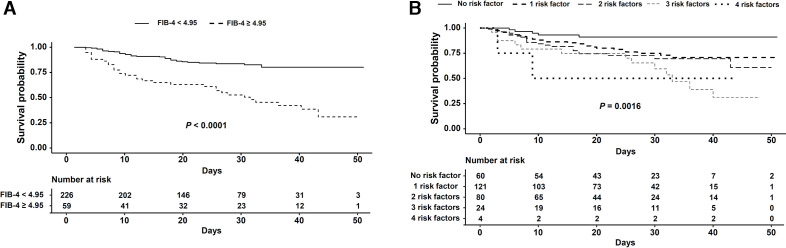
Of the 1005 patients, 289 (28.8%) received respiratory support, and of these, 70 patients (24.2%) died. In multivariate analysis, high fibrosis-4 index (FIB-4; HR 2.784), low lymphocyte count (HR 0.480), diabetes (HR 1.917) and systemic inflammatory response syndrome (HR 1.714) were found to be independent risk factors for mortality in patients with COVID-19 receiving respiratory support (all p<0.05). Regardless of respiratory support, survival in the high FIB-4 group was significantly lower than in the low FIB-4 group (28.8 days vs 44.0 days, respectively, p<0.001). A number of risk factors were also significantly related to survival in patients with COVID-19 regardless of respiratory support (0-4 risk factors, 50.2 days; 49.7 days; 44.4 days; 32.0 days; 25.0 days, respectively, p<0.001).
FIB-4 index is a useful predictive marker for mortality in patients with COVID-19 regardless of its severity.
在特征明确的队列中,尚未评估 COVID-19 死亡率的可靠危险因素。本研究旨在确定 COVID-19 严重感染患者住院 56 天内的死亡风险因素。
回顾性多中心队列研究。
韩国大邱的五所三级医院。
1005 名年龄在 19 岁以上的患者,通过鼻咽和口咽拭子实时 PCR 检测确诊为 COVID-19。
对接受呼吸支持的 COVID-19 患者的临床和实验室特征进行分析,使用 Cox 比例风险回归模型确定死亡率的风险因素。采用 Kaplan-Meier 法分析总生存率与风险因素的关系。
56 天内任何原因导致的院内死亡率。
在 1005 名患者中,289 名(28.8%)接受了呼吸支持,其中 70 名(24.2%)患者死亡。多变量分析发现,高纤维化-4 指数(FIB-4;HR 2.784)、低淋巴细胞计数(HR 0.480)、糖尿病(HR 1.917)和全身炎症反应综合征(HR 1.714)是 COVID-19 患者接受呼吸支持后死亡的独立危险因素(均 P<0.05)。无论是否接受呼吸支持,FIB-4 高组的生存率均明显低于 FIB-4 低组(分别为 28.8 天和 44.0 天,P<0.001)。无论是否接受呼吸支持,许多风险因素与 COVID-19 患者的生存率显著相关(0-4 个风险因素,50.2 天;49.7 天;44.4 天;32.0 天;25.0 天,均 P<0.001)。
FIB-4 指数是 COVID-19 患者死亡率的有用预测指标,无论严重程度如何。