Health and Human Physiological Sciences, Skidmore College, Saratoga Springs, NY, USA.
Physiol Rep. 2020 Nov;8(21):e14630. doi: 10.14814/phy2.14630.
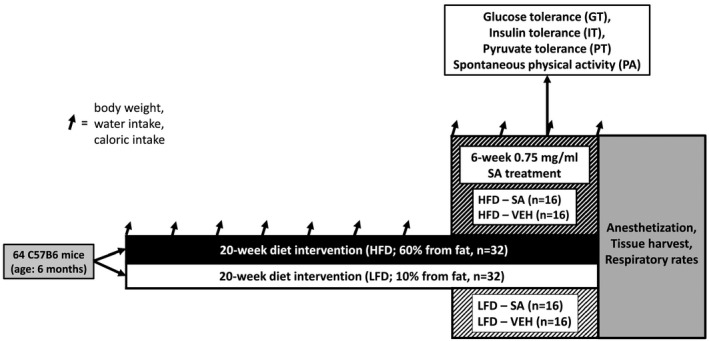
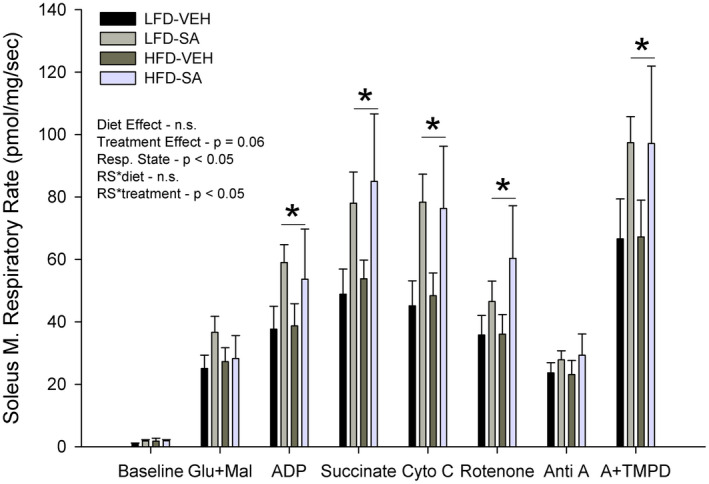
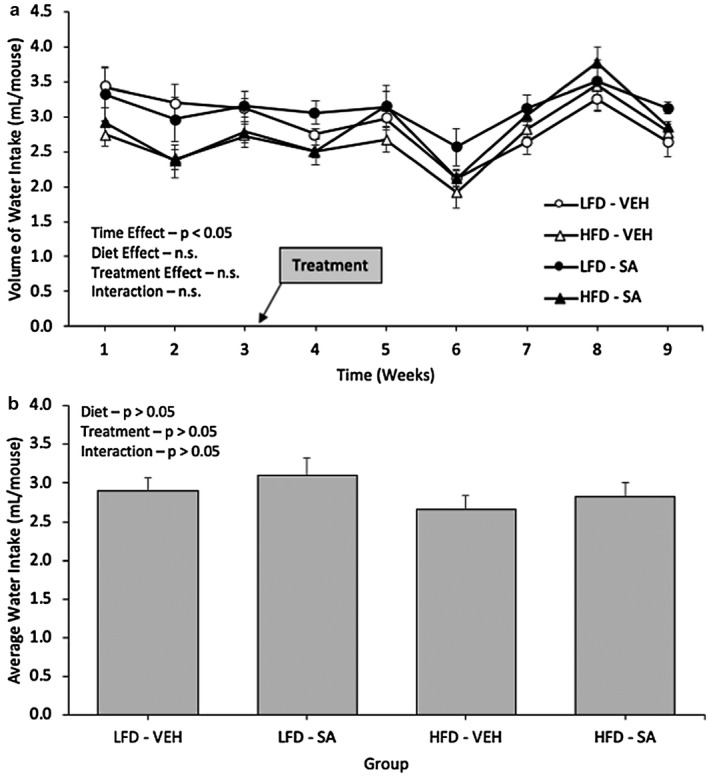
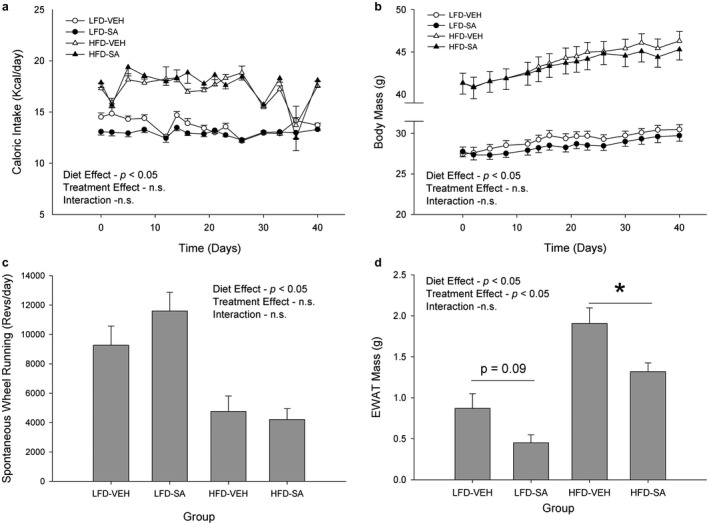
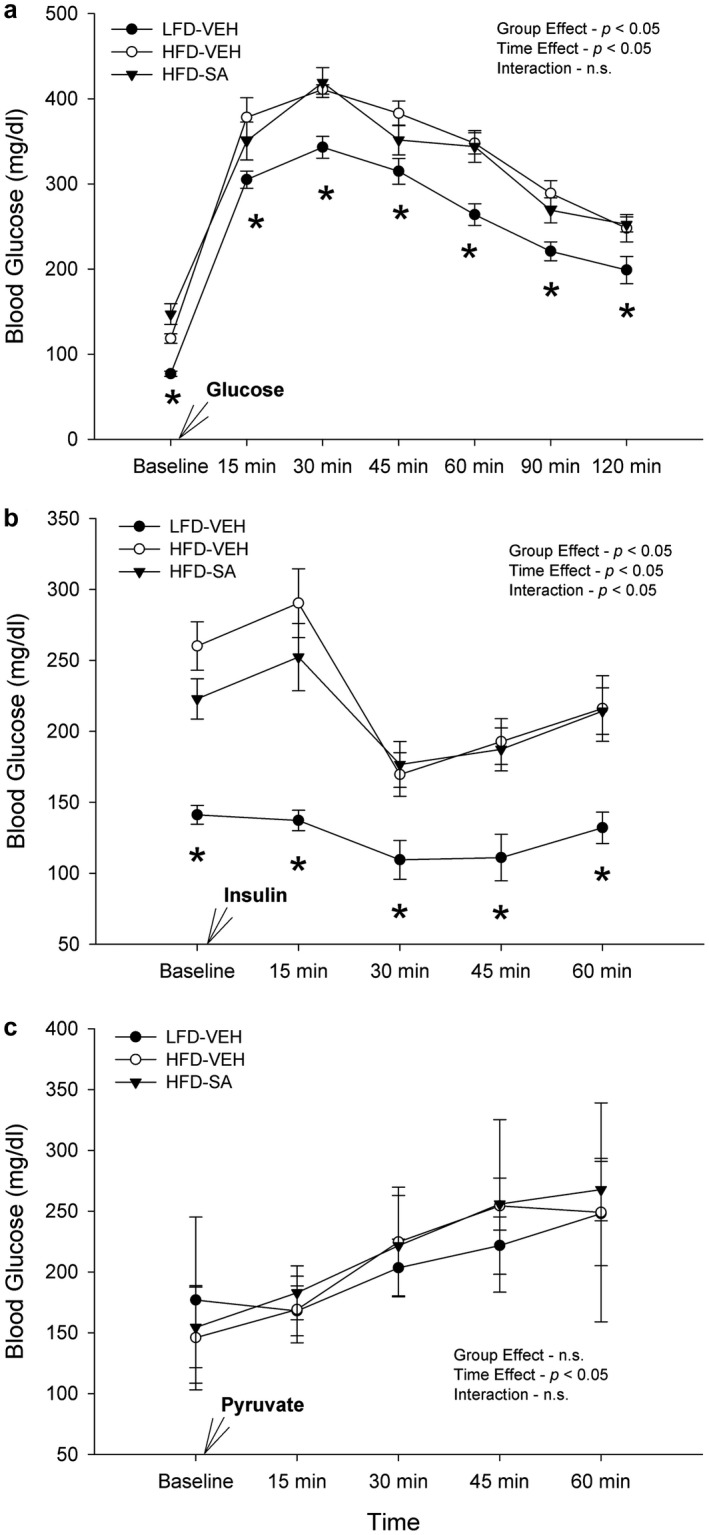
Obesity, insulin resistance, and poor metabolic profile are hallmarks of a high-fat diet (HFD), highlighting the need to understand underlying mechanisms. Therefore, we sought to determine the effect of succinic acid (SA) on metabolism in high-fat diet (HFD)-induced obesity. Animals were randomly assigned to either low-fat diet (LFD) or a high-fat diet (HFD). Mice consumed their respective diets for 4.5 months and then assigned to the following groups: (LFD)+vehicle, LFD + SA (0.75 mg/ml), HFD + vehicle, or HFD + SA. Body weight (BW), food, and water intake, were tracked weekly. After 6 weeks, insulin, glucose, and pyruvate tolerance tests were completed, and spontaneous physical activity was assessed. Epididymal white adipose tissue (EWAT) mass and in vitro measurements of oxidative skeletal muscle (soleus) respiration were obtained. Expectedly, the HFD increased BW and EWAT mass, and reduced glucose and insulin tolerance. SA significantly reduced EWAT mass, more so in HFD (p < .05), but had no effect on any in vivo measurements (BW, insulin, glucose, or pyruvate tolerance, nor physical activity, all p > .05). A significant (p < .05) interaction was observed between mitochondrial respiration and treatment, where SA increased respiration, likely owed to greater mitochondrial content, as assessed by complex IV activity in both LFD and HFD. In HFD-induced obesity, coupled with insulin desensitization, we found no favorable effect of succinic acid on glucose regulation, though adiposity was attenuated. In oxidative skeletal muscle, there was a tendency for increased respiratory capacity, likely owed to greater mitochondrial content, suggestive of a succinic acid-induced mitochondrial biogenesis.
肥胖、胰岛素抵抗和代谢谱不良是高脂肪饮食(HFD)的标志,这突出表明需要了解其潜在机制。因此,我们试图确定琥珀酸(SA)对高脂肪饮食(HFD)诱导的肥胖代谢的影响。动物被随机分配到低脂饮食(LFD)或高脂肪饮食(HFD)。小鼠分别消耗各自的饮食 4.5 个月,然后分为以下组:(LFD)+载体,LFD+SA(0.75mg/ml),HFD+载体或 HFD+SA。每周跟踪体重(BW)、食物和水的摄入量。6 周后,完成胰岛素、葡萄糖和丙酮酸耐量试验,并评估自发性体力活动。获得附睾白色脂肪组织(EWAT)质量和体外测量的氧化骨骼肌(比目鱼肌)呼吸。预计 HFD 会增加 BW 和 EWAT 质量,并降低葡萄糖和胰岛素耐量。SA 显著降低 EWAT 质量,在 HFD 中更为明显(p<0.05),但对任何体内测量(BW、胰岛素、葡萄糖或丙酮酸耐量,以及体力活动,均无影响,p>0.05)。观察到线粒体呼吸与处理之间存在显著(p<0.05)的相互作用,其中 SA 增加了呼吸,这可能归因于复合物 IV 活性在 LFD 和 HFD 中更大的线粒体含量。在 HFD 诱导的肥胖症中,伴随着胰岛素脱敏,我们发现琥珀酸对葡萄糖调节没有有利影响,尽管脂肪量减少了。在氧化骨骼肌中,呼吸能力有增加的趋势,这可能归因于更大的线粒体含量,表明琥珀酸诱导了线粒体生物发生。