Service of Infectious Diseases, Lausanne University Hospital and University of Lausanne, Lausanne, Switzerland.
Service of Hospital Preventive Medicine, Lausanne University Hospital and University of Lausanne, Lausanne, Switzerland.
PLoS One. 2020 Nov 13;15(11):e0240781. doi: 10.1371/journal.pone.0240781. eCollection 2020.
This study aims to describe the epidemiology of COVID-19 patients in a Swiss university hospital.
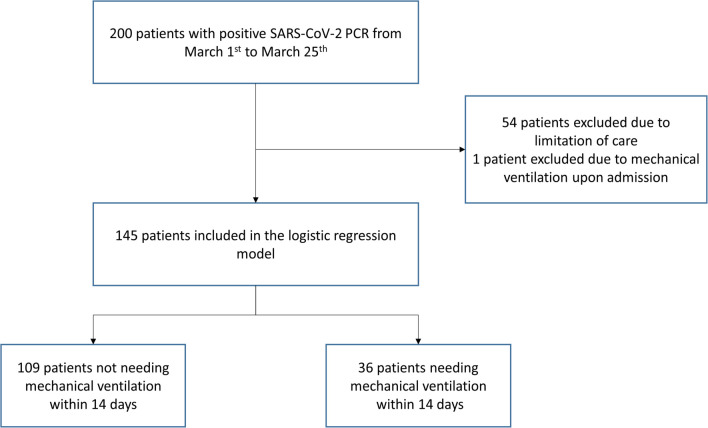
This retrospective observational study included all adult patients hospitalized with a laboratory confirmed SARS-CoV-2 infection from March 1 to March 25, 2020. We extracted data from electronic health records. The primary outcome was the need to mechanical ventilation at day 14. We used multivariate logistic regression to identify risk factors for mechanical ventilation. Follow-up was of at least 14 days.
145 patients were included in the multivariate model, of whom 36 (24.8%) needed mechanical ventilation at 14 days. The median time from symptoms onset to mechanical ventilation was 9·5 days (IQR 7.00, 12.75). Multivariable regression showed increased odds of mechanical ventilation with age (OR 1.09 per year, 95% CI 1.03-1.16, p = 0.002), in males (OR 6.99, 95% CI 1.68-29.03, p = 0.007), in patients who presented with a qSOFA score ≥2 (OR 7.24, 95% CI 1.64-32.03, p = 0.009), with bilateral infiltrate (OR 18.92, 3.94-98.23, p<0.001) or with a CRP of 40 mg/l or greater (OR 5.44, 1.18-25.25; p = 0.030) on admission. Patients with more than seven days of symptoms on admission had decreased odds of mechanical ventilation (0.087, 95% CI 0.02-0.38, p = 0.001).
This study gives some insight in the epidemiology and clinical course of patients admitted in a European tertiary hospital with SARS-CoV-2 infection. Age, male sex, high qSOFA score, CRP of 40 mg/l or greater and a bilateral radiological infiltrate could help clinicians identify patients at high risk for mechanical ventilation.
本研究旨在描述瑞士一家大学医院 COVID-19 患者的流行病学特征。
这是一项回顾性观察性研究,纳入了 2020 年 3 月 1 日至 3 月 25 日期间因实验室确诊的 SARS-CoV-2 感染而住院的所有成年患者。我们从电子病历中提取数据。主要结局为 14 天内需要机械通气。我们使用多变量逻辑回归来确定机械通气的危险因素。随访时间至少为 14 天。
共纳入 145 例患者进行多变量模型分析,其中 36 例(24.8%)在 14 天内需要机械通气。症状发作至机械通气的中位时间为 9.5 天(IQR 7.00,12.75)。多变量回归显示,年龄每增加 1 岁,机械通气的可能性增加 1.09(95%CI 1.03-1.16,p = 0.002),男性(OR 6.99,95%CI 1.68-29.03,p = 0.007),qSOFA 评分≥2 分(OR 7.24,95%CI 1.64-32.03,p = 0.009),双侧浸润(OR 18.92,3.94-98.23,p<0.001)或入院时 CRP 为 40mg/L 或更高(OR 5.44,1.18-25.25;p = 0.030)。入院时症状持续超过 7 天的患者机械通气的可能性降低(0.087,95%CI 0.02-0.38,p = 0.001)。
本研究为欧洲三级医院 SARS-CoV-2 感染患者的流行病学和临床过程提供了一些见解。年龄、男性、高 qSOFA 评分、CRP 为 40mg/L 或更高和双侧影像学浸润可帮助临床医生识别机械通气风险较高的患者。