• 文献检索
  • 文档翻译
  • 深度研究
  • 学术资讯
  • Suppr Zotero 插件Zotero 插件
  • 邀请有礼
  • 套餐&价格
  • 历史记录
应用&插件
Suppr Zotero 插件Zotero 插件浏览器插件Mac 客户端Windows 客户端微信小程序
定价
高级版会员购买积分包购买API积分包
服务
文献检索文档翻译深度研究API 文档MCP 服务
关于我们
关于 Suppr公司介绍联系我们用户协议隐私条款
关注我们

Suppr 超能文献

核心技术专利:CN118964589B侵权必究
粤ICP备2023148730 号-1Suppr @ 2026

文献检索

告别复杂PubMed语法,用中文像聊天一样搜索,搜遍4000万医学文献。AI智能推荐,让科研检索更轻松。

立即免费搜索

文件翻译

保留排版,准确专业,支持PDF/Word/PPT等文件格式,支持 12+语言互译。

免费翻译文档

深度研究

AI帮你快速写综述,25分钟生成高质量综述,智能提取关键信息,辅助科研写作。

立即免费体验

孟加拉国拉杰沙希一家三级护理医院的病例对照研究:医院分娩后新生儿败血症的危险因素和病因。

Risk factors and etiology of neonatal sepsis after hospital delivery: A case-control study in a tertiary care hospital of Rajshahi, Bangladesh.

机构信息

Rajshahi Medical College, Rajshahi, Bangladesh.

Medical Centre, University of Rajshahi, Rajshahi, Bangladesh.

出版信息

PLoS One. 2020 Nov 13;15(11):e0242275. doi: 10.1371/journal.pone.0242275. eCollection 2020.

DOI:10.1371/journal.pone.0242275
PMID:33186407
原文链接:https://pmc.ncbi.nlm.nih.gov/articles/PMC7665583/
Abstract

BACKGROUND

Sepsis is one of the major causes of neonatal death worldwide as well as in Bangladesh. The objective of the present study was to identify the risk factors and causative organisms of neonatal sepsis after delivery in a tertiary care hospital, Bangladesh.

METHODS

This was a case-control study conducted in the neonatal ward of Rajshahi Medical College Hospital (RMCH), a 1000-bed tertiary hospital situated in Rajshahi, Bangladesh. Neonates diagnosed as neonatal sepsis by clinical and laboratory parameters were included as cases in this study. Admitted neonates unsuspected or undiagnosed for sepsis were considered as controls. Maternal and neonatal information and their laboratory reports were collected and analyzed. Both bivariate and multiple logistic regression models were used to identify the risk factors of neonatal sepsis.

RESULTS

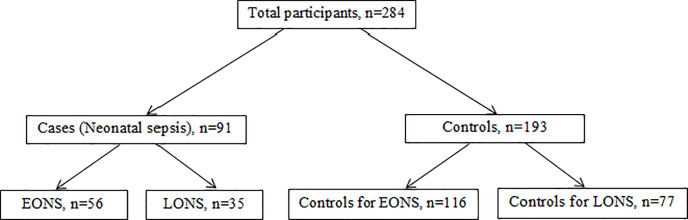
A total of 91 cases and 193 controls were included in the study. Maternal history of urinary tract infection (UTI) during the third trimester of pregnancy (aOR 2.75, 95% CI: 1.04-7.23, p <0.05), premature birth (aOR 2.77, 95% CI: 1.08-7.13, p <0.05) and APGAR score <7 at five minutes (aOR 2.58, 95% CI: 1.04-6.39, p <0.05) were associated with onset of neonatal sepsis in multiple logistic regression model. All these factors were also associated with developing early-onset neonatal sepsis, while maternal UTI and male sex of neonates were associated with developing late-onset neonatal sepsis. Escherichia coli (40.7%), Staphylococcus aureus (27.5%), and Klebsiella pneumoniae (18.7%) were the commonly isolated organisms causing neonatal sepsis. All these organisms were highly resistant to common antibiotics like amoxicillin, cephalosporins, aminoglycosides and quinolones. Carbapenemase group of drugs along with amikacin, nitrofurantoin and linezolid were the most sensitive drugs.

CONCLUSIONS

Strengthening the existing facility for antenatal screening for early diagnosis and treatment of maternal infection during pregnancy as well as identifying high-risk pregnancy for adequate perinatal management is necessary to prevent neonatal sepsis-related morbidity and mortality. Rational use of antibiotics according to local epidemiology and culture and sensitivity reports may minimize the increasing hazards of antibiotic resistance.

摘要

背景

败血症是全球以及孟加拉国新生儿死亡的主要原因之一。本研究的目的是确定孟加拉国一家三级保健医院分娩后新生儿败血症的危险因素和病原体。

方法

这是一项在拉杰沙希医科大学医院(RMCH)新生儿病房进行的病例对照研究。RMCH 是一家位于拉杰沙希的 1000 张床位的三级医院。本研究将通过临床和实验室参数诊断为败血症的新生儿纳入病例。将疑似或未诊断为败血症的入院新生儿视为对照。收集并分析了母婴信息及其实验室报告。使用单变量和多变量逻辑回归模型来确定新生儿败血症的危险因素。

结果

本研究共纳入 91 例病例和 193 例对照。母亲在妊娠晚期(第三 trimester)有尿路感染史(aOR 2.75,95%CI:1.04-7.23,p<0.05)、早产(aOR 2.77,95%CI:1.08-7.13,p<0.05)和 5 分钟时 APGAR 评分<7(aOR 2.58,95%CI:1.04-6.39,p<0.05)与新生儿败血症的发生相关。在多变量逻辑回归模型中,这些因素也与早发型新生儿败血症的发生相关,而母亲尿路感染和新生儿男性性别与晚发型新生儿败血症的发生相关。引起新生儿败血症的常见病原体包括大肠杆菌(40.7%)、金黄色葡萄球菌(27.5%)和肺炎克雷伯菌(18.7%)。所有这些病原体对常见抗生素如阿莫西林、头孢菌素、氨基糖苷类和喹诺酮类高度耐药。碳青霉烯类药物联合阿米卡星、呋喃妥因和利奈唑胺是最敏感的药物。

结论

加强现有的产前筛查设施,以便早期诊断和治疗孕妇感染,并对高危妊娠进行充分的围产期管理,是预防与新生儿败血症相关的发病率和死亡率所必需的。根据当地的流行病学和培养及药敏报告合理使用抗生素,可能会最大限度地减少抗生素耐药性不断增加的危害。
https://cdn.ncbi.nlm.nih.gov/pmc/blobs/18be/7665583/070743cc4e6f/pone.0242275.g001.jpg

相似文献

1
Risk factors and etiology of neonatal sepsis after hospital delivery: A case-control study in a tertiary care hospital of Rajshahi, Bangladesh.孟加拉国拉杰沙希一家三级护理医院的病例对照研究:医院分娩后新生儿败血症的危险因素和病因。
PLoS One. 2020 Nov 13;15(11):e0242275. doi: 10.1371/journal.pone.0242275. eCollection 2020.
2
Risk factors and etiology of early-onset neonatal sepsis in Northeastern part of India: Case-control study.印度东北部早发型新生儿败血症的危险因素及病因:病例对照研究
J Family Med Prim Care. 2024 Jan;13(1):54-58. doi: 10.4103/jfmpc.jfmpc_807_23. Epub 2024 Feb 8.
3
Characteristics of neonatal Sepsis at a tertiary care hospital in Saudi Arabia.沙特阿拉伯一家三级护理医院新生儿脓毒症的特征。
J Infect Public Health. 2019 Sep-Oct;12(5):666-672. doi: 10.1016/j.jiph.2019.03.007. Epub 2019 Apr 13.
4
Study of Risk Factors, Causative Organisms & Their Sensitivity Pattern in Neonatal Sepsis in a Community Based Tertiary Level Hospital.基于社区的三级医院新生儿败血症危险因素、致病微生物及其药敏模式的研究
Mymensingh Med J. 2019 Oct;28(4):839-848.
5
Antimicrobial Sensitivity Pattern in Neonatal Sepsis in Neonatal Intensive Care Unit of Mymensingh Medical College Hospital.迈门辛医学院医院新生儿重症监护病房新生儿败血症的抗菌药敏模式
Mymensingh Med J. 2020 Oct;29(4):784-792.
6
Neonatal sepsis at Mulago national referral hospital in Uganda: Etiology, antimicrobial resistance, associated factors and case fatality risk.乌干达穆拉戈国家转诊医院的新生儿败血症:病因、抗菌药物耐药性、相关因素和病死率风险。
PLoS One. 2020 Aug 10;15(8):e0237085. doi: 10.1371/journal.pone.0237085. eCollection 2020.
7
Risk Factors of Neonatal Sepsis in Neonatal Intensive Care Unit (NICU) of Mymensingh Medical College Hospital.迈门辛医学院医院新生儿重症监护病房(NICU)新生儿败血症的危险因素
Mymensingh Med J. 2021 Jul;30(3):671-677.
8
Predictors of neonatal sepsis in public referral hospitals, Northwest Ethiopia: A case control study.预测埃塞俄比亚西北部公立转诊医院新生儿败血症的因素:一项病例对照研究。
PLoS One. 2020 Jun 24;15(6):e0234472. doi: 10.1371/journal.pone.0234472. eCollection 2020.
9
Clinical features and antimicrobial susceptibility profiles of culture-proven neonatal sepsis in a tertiary children's hospital, 2013 to 2017.2013年至2017年一家三级儿童医院经培养证实的新生儿败血症的临床特征及抗菌药物敏感性谱
Medicine (Baltimore). 2019 Mar;98(12):e14686. doi: 10.1097/MD.0000000000014686.
10
Risk factors of multidrug-resistant organisms neonatal sepsis in Surabaya tertiary referral hospital: a single-center study.印度尼西亚泗水市三级转诊医院新生儿败血症中多重耐药菌的危险因素:一项单中心研究。
BMC Pediatr. 2024 Feb 29;24(1):153. doi: 10.1186/s12887-024-04639-9.

引用本文的文献

1
Prevalence of Neonatal Sepsis in a Tertiary Hospital in Jos: A Five-Year Retrospective Study.乔斯一家三级医院新生儿败血症的患病率:一项五年回顾性研究
Cureus. 2025 May 19;17(5):e84416. doi: 10.7759/cureus.84416. eCollection 2025 May.
2
Predicting Risk for Patent Ductus Arteriosus in the Neonate: A Machine Learning Analysis.预测新生儿动脉导管未闭的风险:一项机器学习分析。
Medicina (Kaunas). 2025 Mar 26;61(4):603. doi: 10.3390/medicina61040603.
3
Updating global estimates of pathogen-attributable diarrhoeal disease burden: a methodology and integrated protocol for a broad-scope systematic review of a syndrome with diverse infectious aetiologies.

本文引用的文献

1
Unfinished agenda of the neonates in developing countries: magnitude of neonatal sepsis: systematic review and meta-analysis.发展中国家新生儿未完成的议程:新生儿败血症的规模:系统评价与荟萃分析
Heliyon. 2019 Sep 27;5(9):e02519. doi: 10.1016/j.heliyon.2019.e02519. eCollection 2019 Sep.
2
Study of Risk Factors, Causative Organisms & Their Sensitivity Pattern in Neonatal Sepsis in a Community Based Tertiary Level Hospital.基于社区的三级医院新生儿败血症危险因素、致病微生物及其药敏模式的研究
Mymensingh Med J. 2019 Oct;28(4):839-848.
3
Predictors of Early Onset Neonatal Sepsis among Neonates in Dodoma, Tanzania: A Case Control Study.
更新全球病原体所致腹泻病负担的估计值:一种针对具有多种感染病因的综合征进行广泛系统评价的方法和综合方案。
BMJ Open. 2025 Apr 3;15(4):e093018. doi: 10.1136/bmjopen-2024-093018.
4
Neonatal Sepsis: A Comprehensive Review.新生儿败血症:全面综述
Antibiotics (Basel). 2024 Dec 25;14(1):6. doi: 10.3390/antibiotics14010006.
5
Distinct maternofetal immune signatures delineate preterm birth onset following urinary tract infection.独特的母胎免疫特征描绘了尿路感染后的早产发病情况。
bioRxiv. 2024 Oct 25:2024.10.22.619711. doi: 10.1101/2024.10.22.619711.
6
Phenotypic bacterial epidemiology and antimicrobial resistance profiles in neonatal sepsis at Jimma medical center, Ethiopia: Insights from prospective study.埃塞俄比亚吉马医疗中心新生儿败血症的表型细菌流行病学和抗菌药物耐药性概况:前瞻性研究的见解
PLoS One. 2024 Sep 16;19(9):e0310376. doi: 10.1371/journal.pone.0310376. eCollection 2024.
7
Gold nanoparticles-based biosensors: pioneering solutions for bacterial and viral pathogen detection-a comprehensive review.基于金纳米粒子的生物传感器:用于细菌和病毒病原体检测的开创性解决方案——全面综述。
World J Microbiol Biotechnol. 2024 Jul 16;40(9):269. doi: 10.1007/s11274-024-04072-1.
8
Association of low vitamin D level and full-term early-onset neonatal sepsis; a case-control study.维生素 D 水平低与足月早发型新生儿败血症的关系:病例对照研究。
Ital J Pediatr. 2024 May 18;50(1):101. doi: 10.1186/s13052-024-01665-2.
9
Neonatal sepsis in a tertiary health facility in Cape Coast, Ghana.加纳 Cape Coast 一家三级保健机构的新生儿败血症。
PLoS One. 2024 May 8;19(5):e0302533. doi: 10.1371/journal.pone.0302533. eCollection 2024.
10
Risk factors and etiology of early-onset neonatal sepsis in Northeastern part of India: Case-control study.印度东北部早发型新生儿败血症的危险因素及病因:病例对照研究
J Family Med Prim Care. 2024 Jan;13(1):54-58. doi: 10.4103/jfmpc.jfmpc_807_23. Epub 2024 Feb 8.
坦桑尼亚多多马地区新生儿早发性新生儿败血症的预测因素:病例对照研究。
J Trop Pediatr. 2020 Jun 1;66(3):257-266. doi: 10.1093/tropej/fmz062.
4
Determinants and Outcome of Community-Acquired Late-Onset Neonatal Sepsis in Rural Bangladesh.孟加拉国农村地区社区获得性晚发性新生儿败血症的决定因素及结局
Glob Pediatr Health. 2019 Mar 15;6:2333794X19833730. doi: 10.1177/2333794X19833730. eCollection 2019.
5
Risk Factors for Neonatal Sepsis: A Retrospective Case-Control Study among Neonates Who Were Delivered by Caesarean Section at the Trauma and Specialist Hospital, Winneba, Ghana.新生儿败血症的危险因素:加纳温尼巴创伤和专科医院剖宫产新生儿的回顾性病例对照研究。
Biomed Res Int. 2018 Dec 19;2018:6153501. doi: 10.1155/2018/6153501. eCollection 2018.
6
Bacteriological profile and antibiotic susceptibility of neonatal sepsis in neonatal intensive care unit of a tertiary hospital in Nepal.尼泊尔一家三级医院新生儿重症监护病房新生儿败血症的细菌学特征及抗生素敏感性
BMC Pediatr. 2018 Jun 27;18(1):208. doi: 10.1186/s12887-018-1176-x.
7
Incidence and risk factors of neonatal infections in a rural Bangladeshi population: a community-based prospective study.孟加拉国农村地区新生儿感染的发病率及危险因素:一项基于社区的前瞻性研究。
J Health Popul Nutr. 2018 Mar 9;37(1):6. doi: 10.1186/s41043-018-0136-2.
8
Bacterial etiologic agents causing neonatal sepsis and associated risk factors in Gondar, Northwest Ethiopia.埃塞俄比亚西北部贡德尔地区引起新生儿败血症的细菌病原体及相关危险因素
BMC Pediatr. 2017 Jun 6;17(1):137. doi: 10.1186/s12887-017-0892-y.
9
Managing Neonatal and Early Childhood Syndromic Sepsis in Sub-District Hospitals in Resource Poor Settings: Improvement in Quality of Care through Introduction of a Package of Interventions in Rural Bangladesh.在资源匮乏地区的基层医院管理新生儿和儿童早期综合征性败血症:通过在孟加拉国农村地区引入一套干预措施提高护理质量
PLoS One. 2017 Jan 23;12(1):e0170267. doi: 10.1371/journal.pone.0170267. eCollection 2017.
10
Risk Factors for Neonatal Sepsis in Public Hospitals of Mekelle City, North Ethiopia, 2015: Unmatched Case Control Study.2015年埃塞俄比亚北部默克莱市公立医院新生儿败血症的危险因素:非匹配病例对照研究
PLoS One. 2016 May 10;11(5):e0154798. doi: 10.1371/journal.pone.0154798. eCollection 2016.