Department of Ophthalmology and Visual Sciences, University of Alabama at Birmingham School of Medicine, Birmingham, Alabama, United States.
The First Affiliated Hospital of Chongqing Medical University, Chongqing Key Laboratory of Ophthalmology, and Chongqing Eye Institute, Chongqing, China.
Invest Ophthalmol Vis Sci. 2020 Nov 2;61(13):19. doi: 10.1167/iovs.61.13.19.
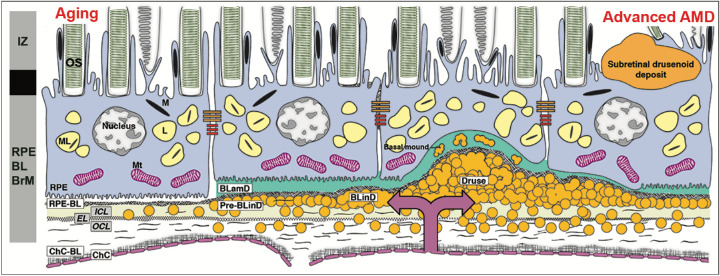
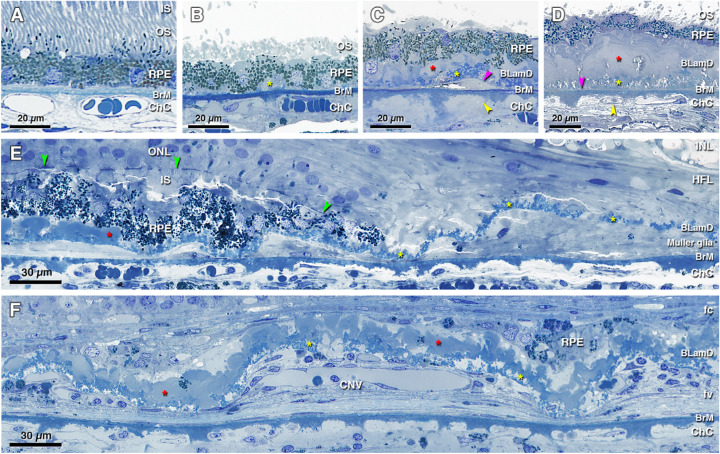
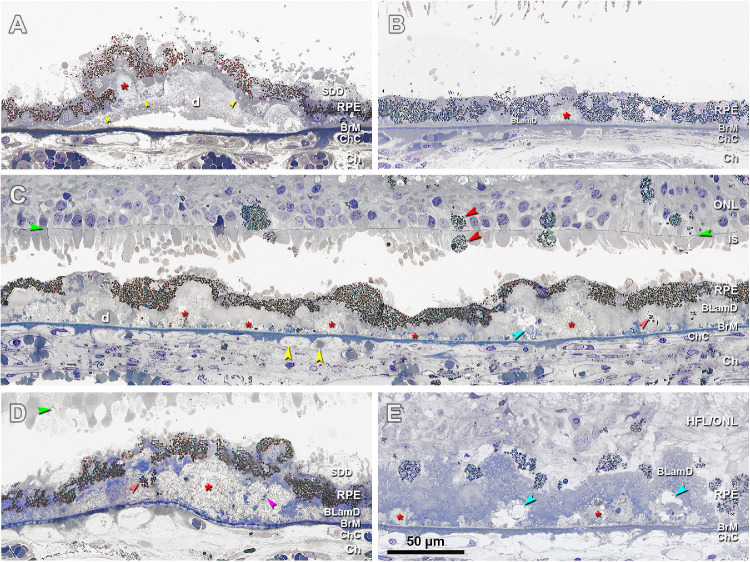
Basal laminar deposit (BLamD) is a consistent finding in age-related macular degeneration (AMD). We quantified BLamD thickness, appearance, and topography in eyes of aged donors with and without AMD and evaluated its relationship to other components of the retinal pigment epithelium-basal lamina/Bruch's membrane (RPE-BL-BrM) complex.
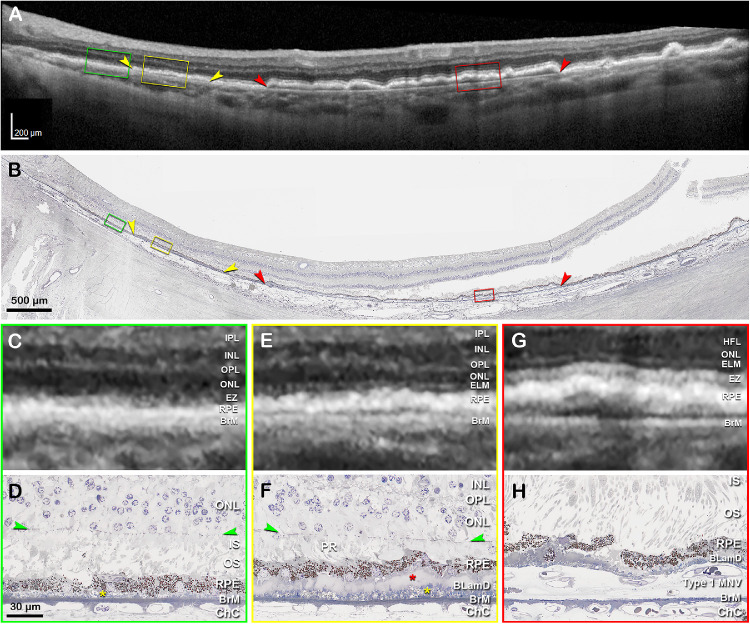
Donor eyes (n = 132) were classified as normal (n = 54), early to intermediate AMD (n = 24), geographic atrophy (GA; n = 13), and neovascular AMD (NV; n = 41). In high-resolution histology, we assessed RPE, BLamD, and BrM thicknesses and phenotypes at 3309 predefined locations in the central (foveal and perifovea) and superior (perifoveal) sections. Pre-mortem optical coherence tomography (OCT) imaging of a 90-year-old woman was compared to postmortem histopathology.
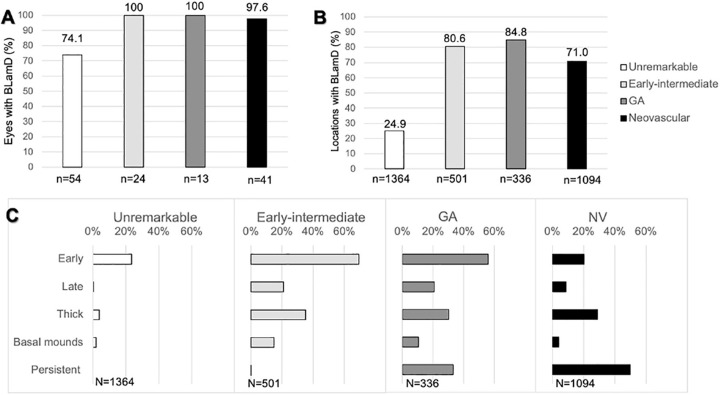
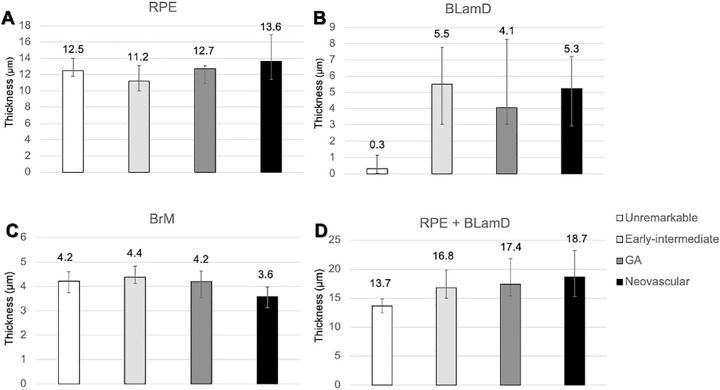
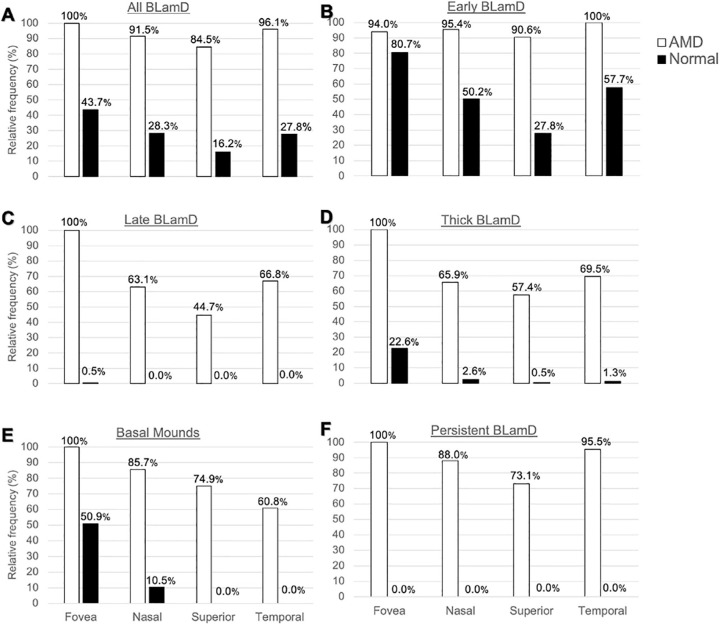
In non-atrophic areas of AMD eyes, the RPE-BLamD is thick (normal = 13.7 µm, early-intermediate = 16.8 µm, GA = 17.4 µm, NV = 18.7 µm), because the BLamD is thick (normal = 0.3 µm, early-intermediate = 5.5 µm, GA = 4.1 µm, NV = 5.3 µm). RPE layer thickness is similar across these stages. Disease-associated variants of BLamD (thick, late, basal mounds) cluster subfoveally. A thick BLamD is visible on OCT as a hyporeflective split in the RPE-BL-BrM complex. BrM is thin (3.5 µm) in NV (normal = 4.2 µm, early to intermediate = 4.4 µm, and GA = 4.2 µm).
The RPE-BL-BrM complex is thick in AMD, driven by the accumulation and expansion of BLamD rather than expansion of either three-layer BrM, RPE-BL, or RPE. BLamD is clinically appreciable by OCT in some patients as a non-neovascular "split RPE-BL-BrM complex" or "double-layer sign." BLamD may contribute toward the formation and progression of high-risk drusen yet also exhibit protective properties.
基底膜层沉积物(BLamD)是年龄相关性黄斑变性(AMD)的一种常见表现。我们定量分析了 AMD 眼和非 AMD 眼的 BLamD 厚度、外观和分布,并评估了其与视网膜色素上皮-基底膜/布鲁赫膜(RPE-BL-BrM)复合体其他成分的关系。
对 132 只供体眼(n=132)进行分类:正常(n=54)、早期至中期 AMD(n=24)、地图状萎缩(GA;n=13)和新生血管性 AMD(NV;n=41)。在高分辨率组织学中,我们在中央(中心和旁中心)和上(旁中心)区域的 3309 个预设位置评估了 RPE、BLamD 和 BrM 厚度和表型。对一名 90 岁女性的生前光学相干断层扫描(OCT)成像与死后组织病理学进行了比较。
在 AMD 眼的非萎缩区域,RPE-BLamD 较厚(正常=13.7μm,早期-中期=16.8μm,GA=17.4μm,NV=18.7μm),因为 BLamD 较厚(正常=0.3μm,早期-中期=5.5μm,GA=4.1μm,NV=5.3μm)。这些阶段的 RPE 层厚度相似。与疾病相关的 BLamD 变体(厚、晚期、基底丘)聚集在中心下。OCT 上可见 BLamD 增厚,表现为 RPE-BL-BrM 复合体的低反射性分离。BrM 在 NV 中较薄(3.5μm)(正常=4.2μm,早期-中期=4.4μm,GA=4.2μm)。
AMD 中 RPE-BL-BrM 复合体较厚,由 BLamD 的积累和扩张引起,而不是三层 BrM、RPE-BL 或 RPE 的扩张。在一些患者中,BLamD 可通过 OCT 临床识别,表现为非新生血管性“RPE-BL-BrM 复合体分离”或“双层征”。BLamD 可能有助于高危 drusen 的形成和进展,但也表现出保护特性。