
在坐姿和头低位倾斜姿势下,视神经头部形态变化超过 12 小时。
Optic Nerve Head Morphological Changes Over 12 Hours in Seated and Head-Down Tilt Postures.
机构信息
University of Houston, College of Optometry, Houston, Texas, United States.
出版信息
Invest Ophthalmol Vis Sci. 2020 Nov 2;61(13):21. doi: 10.1167/iovs.61.13.21.
PURPOSE
The purpose of this study was to determine changes in optic nerve head (ONH) morphology in seated and 6° head-down tilt (HDT) postures over a 12-hour period.
METHODS
Thirty eyes of 30 healthy human subjects (15 females) were included. Composite radial and circular optical coherence tomography (OCT) scans centered on the ONH, intraocular pressure (IOP), and optic nerve sheath diameter (ONSD) were acquired every two hours from 7 a.m. to 7 p.m. for both seated (n = 30) and HDT (n = 10) sessions. Global minimum rim width (BMO-MRW), total retinal thickness (TRT), retinal nerve fiber layer thickness (RNFLT), and Bruch's membrane opening (BMO) height were quantified.
RESULTS
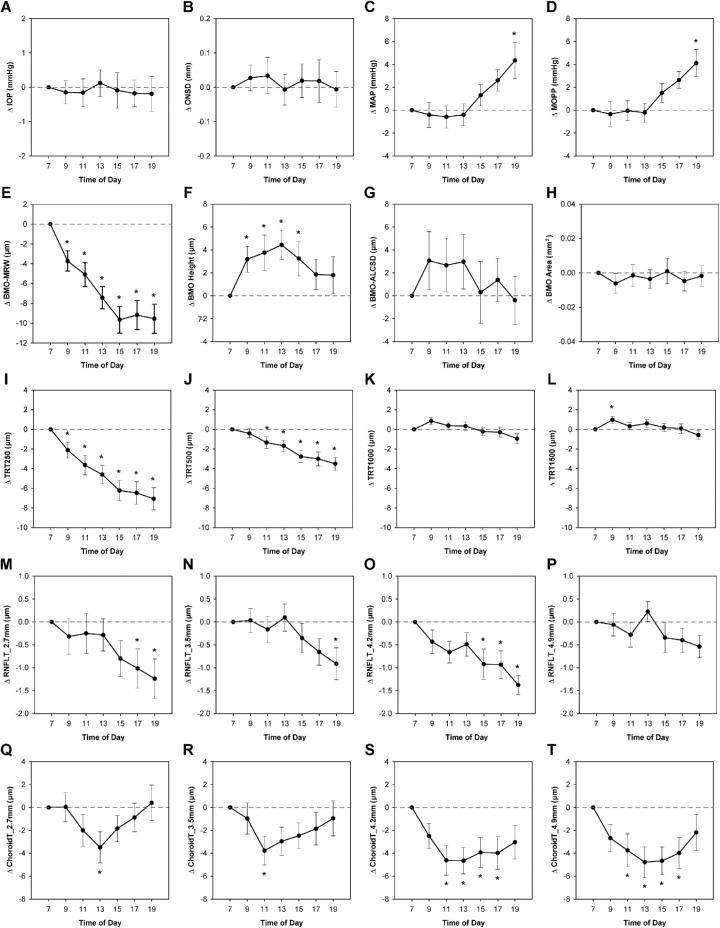
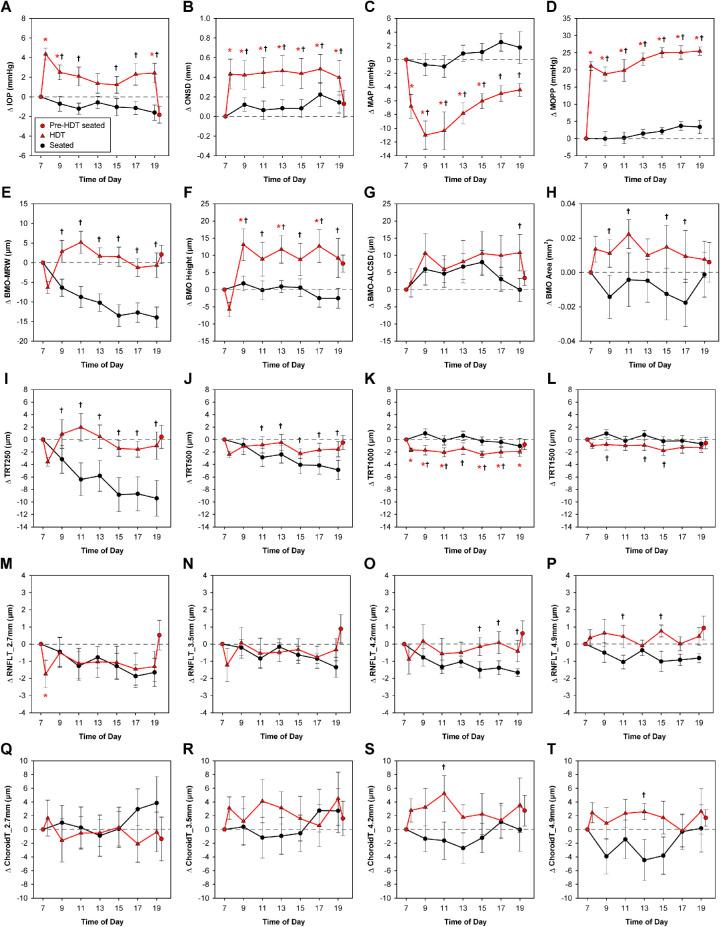
BMO-MRW decreased an average of 9.55 ± 8.03 µm (P < 0.01) over 12 hours in a seated position (range, -26.64 to +3.36 µm), and thinning was greater in females (-13.56 vs. -5.55 µm, P = 0.004). Modest decreases in TRT from the BMO to 500 µm (P < 0.04) and RNFLT for the 2.7, 3.5, and 4.2 mm circular scans (P < 0.02) were also observed. BMO-MRW thinning was not related to changes in IOP or ONSD (P = 0.34). In HDT, IOP and ONSD increased, BMO height moved anteriorly, and BMO-MRW thinning did not occur (P > 0.1).
CONCLUSIONS
The neuroretinal rim thins throughout the day in healthy individuals, and this change cannot be explained by changes in IOP or ONSD during the same time period. A HDT posture blunts the neuroretinal rim thinning observed in a seated position, suggesting a role of the translaminar pressure difference.
目的
本研究旨在确定在 12 小时内,人处于坐姿和 6°头低位(HDT)两种姿势时视盘形态的变化。
方法
纳入 30 名健康人(15 名女性)的 30 只眼。对 ONH 中心进行复合放射状和圆形光学相干断层扫描(OCT),每两小时采集一次眼压(IOP)和视神经鞘直径(ONSD),时间为上午 7 点至下午 7 点,共进行两次,一次为坐姿(n = 30),一次为 HDT(n = 10)。定量测量最小眶脊宽度(BMO-MRW)、总视网膜厚度(TRT)、视网膜神经纤维层厚度(RNFLT)和 Bruch 膜开口(BMO)高度。
结果
在坐姿中,BMO-MRW 在 12 小时内平均减少 9.55 ± 8.03 µm(P < 0.01)(范围,-26.64 至 +3.36 µm),女性的变薄更为明显(-13.56 对 -5.55 µm,P = 0.004)。从 BMO 到 500 µm 的 TRT 也略有减少(P < 0.04),2.7、3.5 和 4.2 mm 圆形扫描的 RNFLT 也略有减少(P < 0.02)。BMO-MRW 变薄与 IOP 或 ONSD 的变化无关(P = 0.34)。在 HDT 中,IOP 和 ONSD 增加,BMO 高度向前移动,BMO-MRW 变薄并未发生(P > 0.1)。
结论
在健康个体中,神经视网膜边缘全天变薄,而在同一时间段内,IOP 或 ONSD 的变化无法解释这种变化。HDT 姿势削弱了坐姿时观察到的神经视网膜边缘变薄,提示跨层压力差的作用。


 Zotero 插件