Department of Plant Pathology, The Ohio State University, Columbus, OH 43210, USA.
Department of Biology, University of Pennsylvania, Philadelphia, PA 19104, USA.
Sci Adv. 2020 Nov 13;6(46). doi: 10.1126/sciadv.abc4516. Print 2020 Nov.
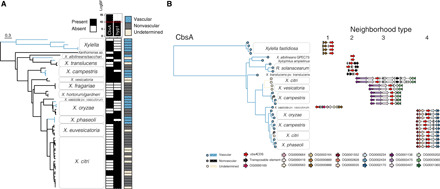
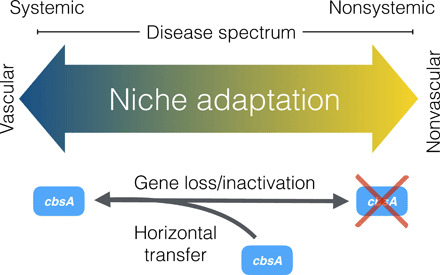
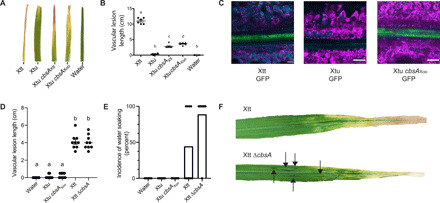
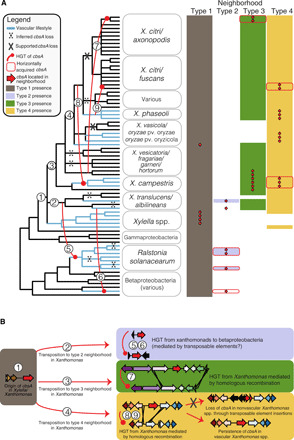
Vascular plant pathogens travel long distances through host veins, leading to life-threatening, systemic infections. In contrast, nonvascular pathogens remain restricted to infection sites, triggering localized symptom development. The contrasting features of vascular and nonvascular diseases suggest distinct etiologies, but the basis for each remains unclear. Here, we show that the hydrolase CbsA acts as a phenotypic switch between vascular and nonvascular plant pathogenesis. was enriched in genomes of vascular phytopathogenic bacteria in the family Xanthomonadaceae and absent in most nonvascular species. CbsA expression allowed nonvascular to cause vascular blight, while mutagenesis resulted in reduction of vascular or enhanced nonvascular symptom development. Phylogenetic hypothesis testing further revealed that was lost in multiple nonvascular lineages and more recently gained by some vascular subgroups, suggesting that vascular pathogenesis is ancestral. Our results overall demonstrate how the gain and loss of single loci can facilitate the evolution of complex ecological traits.
植物维管束病原体通过宿主维管束长距离传播,导致危及生命的系统性感染。相比之下,非维管束病原体则局限于感染部位,引发局部症状的发展。维管束和非维管束疾病的不同特征表明存在不同的病因,但每种病因的基础尚不清楚。在这里,我们表明,水解酶 CbsA 是植物维管束和非维管束病原体之间的表型转换开关。CbsA 在黄单胞菌科的维管束植物病原菌基因组中富集,而在大多数非维管束物种中缺失。CbsA 的表达使非维管束能够引起维管束枯萎病,而 CbsA 的突变导致维管束症状的减少或非维管束症状的增强。系统发育假说检验进一步表明,CbsA 在多个非维管束谱系中丢失,而在一些维管束亚群中最近获得,这表明维管束病原体是原始的。总的来说,我们的结果表明,单个基因座的获得和丢失如何促进复杂生态特征的进化。