Department of Medicine, Stanford Prevention Research Center, Stanford University School of Medicine, Stanford, CA, USA.
Department of Nutritional Sciences, University of Vienna, Vienna, Austria.
Int J Obes (Lond). 2021 Jan;45(1):225-234. doi: 10.1038/s41366-020-00708-y. Epub 2020 Nov 14.
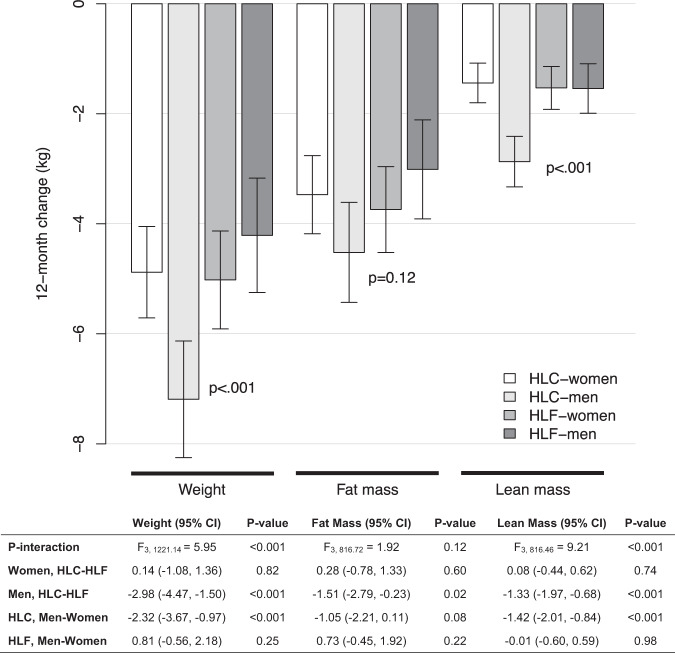
BACKGROUND/OBJECTIVES: Biological sex factors and sociocultural gender norms affect the physiology and behavior of weight loss. However, most diet intervention studies do not report outcomes by sex, thereby impeding reproducibility. The objectives of this study were to compare 12-month changes in body weight and composition in groups defined by diet and sex, and adherence to a healthy low carbohydrate (HLC) vs. healthy low fat (HLF) diet.
PARTICIPANTS/METHODS: This was a secondary analysis of the DIETFITS trial, in which 609 overweight/obese nondiabetic participants (age, 18-50 years) were randomized to a 12-month HLC (n = 304) or HLF (n = 305) diet. Our first aim concerned comparisons in 12-month changes in weight, fat mass, and lean mass by group with appropriate adjustment for potential confounders. The second aim was to assess whether or not adherence differed by diet-sex group (HLC women n = 179, HLC men n = 125, HLF women n = 167, HLF men n = 138).
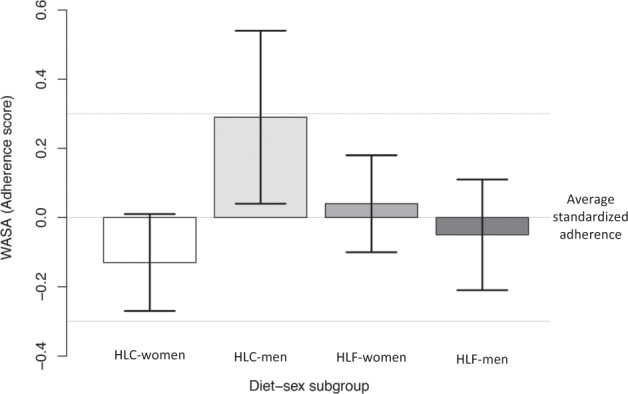
12-month changes in weight (p < 0.001) were different by group. HLC produced significantly greater weight loss, as well as greater loss of both fat mass and lean mass, than HLF among men [-2.98 kg (-4.47, -1.50); P < 0.001], but not among women. Men were more adherent to HLC than women (p = 0.02). Weight loss estimates within group remained similar after adjusting for adherence, suggesting adherence was not a mediator.
By reporting outcomes by sex significant weight loss differences were identified between HLC and HLF, which were not recognized in the original primary analysis. These findings highlight the need to consider sex in the design, analysis, and reporting of diet trials.
背景/目的:生物性别因素和社会文化性别规范影响减肥的生理和行为。然而,大多数饮食干预研究并未按性别报告结果,从而阻碍了可重复性。本研究的目的是比较按饮食和性别定义的组在 12 个月时体重和成分的变化,以及对健康低碳水化合物(HLC)与健康低脂肪(HLF)饮食的依从性。
参与者/方法:这是 DIETFITS 试验的二次分析,其中 609 名超重/肥胖非糖尿病参与者(年龄 18-50 岁)被随机分为 12 个月的 HLC(n=304)或 HLF(n=305)饮食。我们的第一个目的是比较体重、脂肪量和瘦体重在 12 个月的变化,同时适当调整潜在混杂因素。第二个目的是评估饮食-性别组的依从性是否存在差异(HLC 女性 n=179,HLC 男性 n=125,HLF 女性 n=167,HLF 男性 n=138)。
12 个月时体重变化(p<0.001)因组而异。HLC 组的体重减轻幅度明显大于 HLF 组,男性中 HLC 组的体重减轻量也明显大于 HLF 组[2.98kg(4.47,1.50);P<0.001],但女性中并非如此。男性对 HLC 的依从性高于女性(p=0.02)。在调整了依从性后,组内的体重减轻估计值仍然相似,这表明依从性不是一个中介因素。
通过按性别报告结果,我们发现 HLC 和 HLF 之间存在显著的体重减轻差异,而在原始主要分析中并未发现这些差异。这些发现强调了在设计、分析和报告饮食试验时需要考虑性别因素。