Medical Practice Evaluation Center, Massachusetts General Hospital, Boston, MA, USA; Division of Pulmonary and Critical Care Medicine, Massachusetts General Hospital, Boston, MA, USA; Harvard Medical School, Boston, MA, USA.
Medical Practice Evaluation Center, Massachusetts General Hospital, Boston, MA, USA; Harvard Medical School, Boston, MA, USA.
Lancet Glob Health. 2021 Feb;9(2):e120-e129. doi: 10.1016/S2214-109X(20)30452-6. Epub 2020 Nov 11.
Health-care resource constraints in low-income and middle-income countries necessitate the identification of cost-effective public health interventions to address COVID-19. We aimed to develop a dynamic COVID-19 microsimulation model to assess clinical and economic outcomes and cost-effectiveness of epidemic control strategies in KwaZulu-Natal province, South Africa.
We compared different combinations of five public health interventions: health-care testing alone, where diagnostic testing is done only for individuals presenting to health-care centres; contact tracing in households of cases; isolation centres, for cases not requiring hospital admission; mass symptom screening and molecular testing for symptomatic individuals by community health-care workers; and quarantine centres, for household contacts who test negative. We calibrated infection transmission rates to match effective reproduction number (R) estimates reported in South Africa. We assessed two main epidemic scenarios for a period of 360 days, with an R of 1·5 and 1·2. Strategies with incremental cost-effectiveness ratio (ICER) of less than US$3250 per year of life saved were considered cost-effective. We also did sensitivity analyses by varying key parameters (R values, molecular testing sensitivity, and efficacies and costs of interventions) to determine the effect on clinical and cost projections.
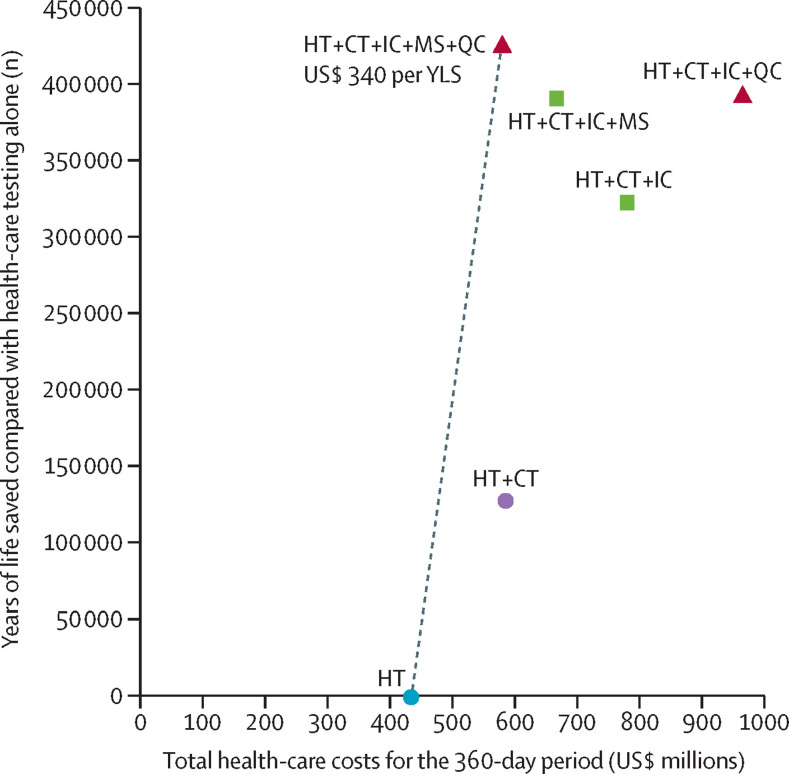
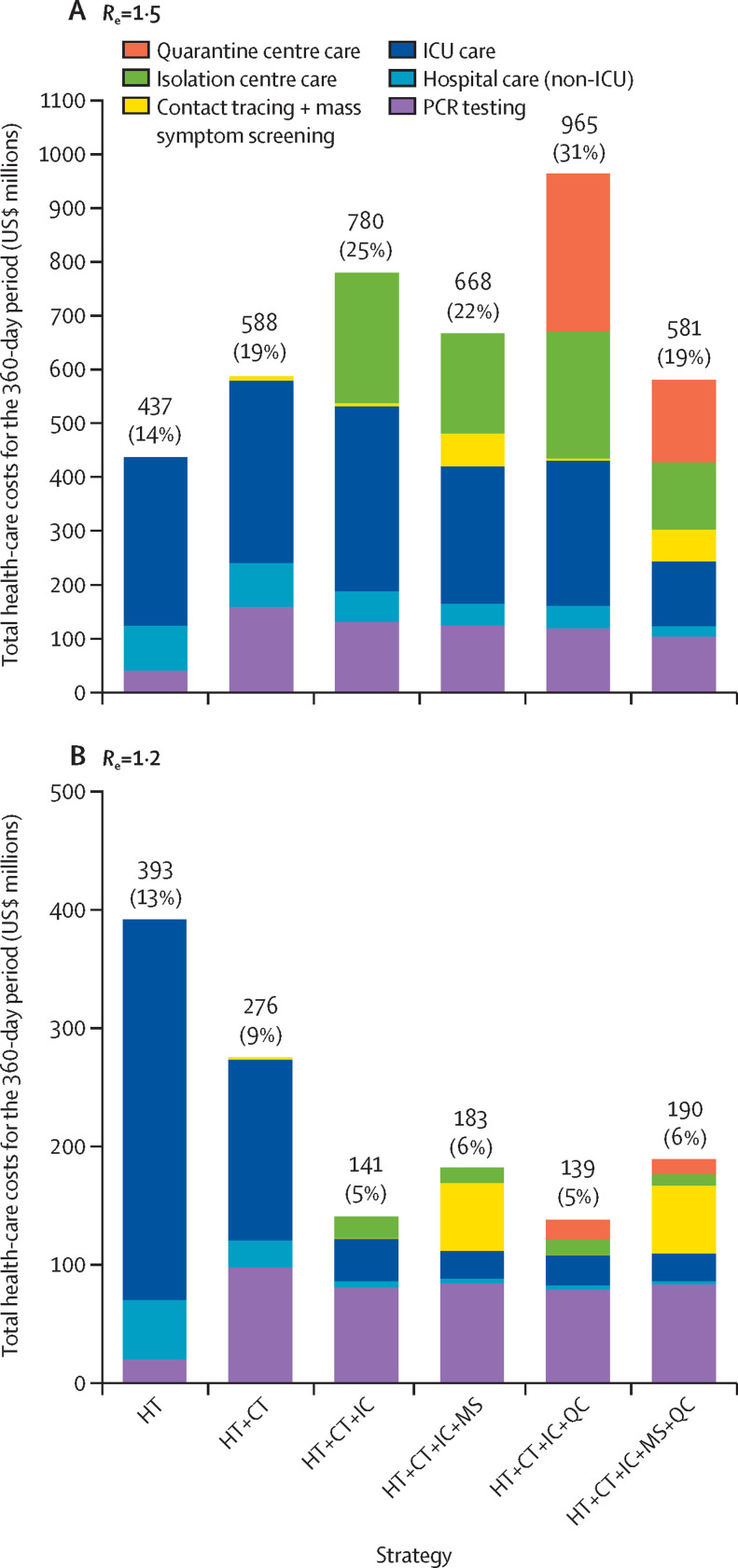
When R was 1·5, health-care testing alone resulted in the highest number of COVID-19 deaths during the 360-day period. Compared with health-care testing alone, a combination of health-care testing, contact tracing, use of isolation centres, mass symptom screening, and use of quarantine centres reduced mortality by 94%, increased health-care costs by 33%, and was cost-effective (ICER $340 per year of life saved). In settings where quarantine centres were not feasible, a combination of health-care testing, contact tracing, use of isolation centres, and mass symptom screening was cost-effective compared with health-care testing alone (ICER $590 per year of life saved). When R was 1·2, health-care testing, contact tracing, use of isolation centres, and use of quarantine centres was the least costly strategy, and no other strategies were cost-effective. In sensitivity analyses, a combination of health-care testing, contact tracing, use of isolation centres, mass symptom screening, and use of quarantine centres was generally cost-effective, with the exception of scenarios in which R was 2·6 and when efficacies of isolation centres and quarantine centres for transmission reduction were reduced.
In South Africa, strategies involving household contact tracing, isolation, mass symptom screening, and quarantining household contacts who test negative would substantially reduce COVID-19 mortality and would be cost-effective. The optimal combination of interventions depends on epidemic growth characteristics and practical implementation considerations.
US National Institutes of Health, Royal Society, Wellcome Trust.
在低收入和中等收入国家,医疗资源有限,因此需要确定具有成本效益的公共卫生干预措施,以应对 COVID-19。我们旨在开发一种 COVID-19 动态微观模拟模型,以评估南非夸祖鲁-纳塔尔省的传染病控制策略的临床和经济结果以及成本效益。
我们比较了五种公共卫生干预措施的不同组合:仅对前往医疗中心的个人进行医疗保健检测(即对出现症状的人进行诊断检测);对病例的家庭进行接触者追踪;对无需住院的病例设立隔离中心;由社区卫生工作者对有症状的个人进行大规模症状筛查和分子检测;对检测结果呈阴性的家庭接触者设立隔离中心。我们将感染传播率校准到与南非报告的有效繁殖数(R)估计值相匹配。我们评估了两种主要的传染病情景,持续 360 天,R 值分别为 1.5 和 1.2。增量成本效益比(ICER)低于每年每挽救 1 生命 3250 美元的策略被认为具有成本效益。我们还通过改变关键参数(R 值、分子检测灵敏度以及干预措施的功效和成本)来进行敏感性分析,以确定对临床和成本预测的影响。
当 R 值为 1.5 时,仅进行医疗保健检测在 360 天内导致 COVID-19 死亡人数最多。与仅进行医疗保健检测相比,医疗保健检测、接触者追踪、使用隔离中心、大规模症状筛查和使用隔离中心的组合将死亡率降低了 94%,增加了 33%的医疗保健成本,并且具有成本效益(ICER 为每年每挽救 1 生命 340 美元)。在无法建立隔离中心的情况下,与仅进行医疗保健检测相比,医疗保健检测、接触者追踪、使用隔离中心和大规模症状筛查的组合具有成本效益(ICER 为每年每挽救 1 生命 590 美元)。当 R 值为 1.2 时,医疗保健检测、接触者追踪、使用隔离中心和使用隔离中心的组合是成本最低的策略,而其他策略均不具有成本效益。在敏感性分析中,除了 R 值为 2.6 且隔离中心和隔离中心对传播减少的功效降低的情况外,医疗保健检测、接触者追踪、使用隔离中心、大规模症状筛查和使用隔离中心的组合通常具有成本效益。
在南非,涉及家庭接触者追踪、隔离、大规模症状筛查和对检测结果呈阴性的家庭接触者进行隔离的策略将大大降低 COVID-19 的死亡率,并且具有成本效益。干预措施的最佳组合取决于传染病的增长特征和实际实施情况。
美国国立卫生研究院、英国皇家学会、惠康信托基金会。