Department of Neurology, University of Medicine and Pharmacy "Victor Babes", Timisoara, Romania.
Department of Otorhinolaryngology, University of Medicine and Pharmacy "Victor Babes", Timisoara, Romania.
BMC Neurol. 2020 Nov 14;20(1):417. doi: 10.1186/s12883-020-01990-z.
Our objective was to find which additional factors can influence the favorable result in stroke patients after receiving fibrinolytic and/or endovascular treatment, quantified as a more than 30% improvement of the NIHSS score at 7 days.
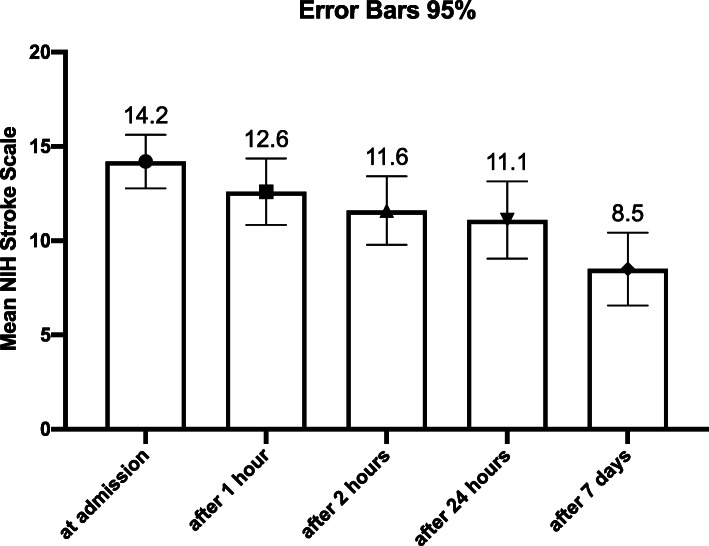
This is a retrospective study to find factors that could influence a favorable evolution of patients with stroke that underwent fibrinolytic and or thrombectomy using the NIHSS score changes. At the admission in the hospital, blood glucose, blood count, coagulation time, INR, aPTT, PT, platelet count, NIHSS questionnaire and ASPECTS score were collected. NIHSS was assessed at the admission, after 1 h, after 2 h, after 24 h and after 7 days.
As compared to the initial evaluation, at 7 days after admission 59% (72) of patients have improved with more than 30% the NIHSS. Higher levels of systolic blood pressure, glycemia and lower ASPECTS score at admission were observed in non-achievers. The value of INR contributed to model: for every unit increase of INR, the chance of better outcome decreases by 90,1%. High glycemia has also a negative impact: for every unit increase, the chance of better outcome decreases by 24%. Higher initial ASPECTS score is associated with better outcomes: each point increase of ASPECTS score at initial evaluation, increases the chance of better outcome by 154.2%.
Males, older age, diabetes, and hyperglycemia correlate with a worse outcome after cerebral stroke regardless of the benefit yielded fibrinolytic and/or thrombectomy therapy. In this study, patients with the above-mentioned factors did not improve more than 30% of baseline NIHSS score from admission to the 7th day.
我们的目的是找到哪些额外的因素可以影响接受溶栓和/或血管内治疗的中风患者的良好结果,以 NIHSS 评分在 7 天内提高 30%以上来量化。
这是一项回顾性研究,旨在寻找影响接受溶栓和/或血栓切除术的中风患者良好转归的因素,使用 NIHSS 评分变化来衡量。在入院时,收集血糖、血细胞计数、凝血时间、INR、aPTT、PT、血小板计数、NIHSS 问卷和 ASPECTS 评分。入院时、1 小时后、2 小时后、24 小时后和 7 天后评估 NIHSS。
与初始评估相比,入院后 7 天 59%(72 例)的患者 NIHSS 提高了 30%以上。未达到目标的患者入院时收缩压较高、血糖水平较高、ASPECTS 评分较低。入院时 INR 值与模型相关:INR 每增加 1 个单位,获得更好结果的机会就会降低 90.1%。高血糖也有负面影响:血糖每增加 1 个单位,获得更好结果的机会就会降低 24%。较高的初始 ASPECTS 评分与更好的结局相关:初始评估时 ASPECTS 评分每增加 1 分,获得更好结局的机会就会增加 154.2%。
男性、年龄较大、糖尿病和高血糖与接受溶栓和/或血栓切除术治疗后中风的不良预后相关。在这项研究中,具有上述因素的患者从入院到第 7 天 NIHSS 基线评分没有提高 30%以上。