Ioannidis Konstantinos, Hook Roxanne W, Grant Jon E, Czabanowska Katarzyna, Roman-Urrestarazu Andres, Chamberlain Samuel R
Department of Psychiatry, University of Cambridge, UK; Cambridge and Peterborough NHS Foundation Trust, Cambridge, UK; Care and Public Health Research Institute, Maastricht University, Maastricht, Netherlands.
Cambridge and Peterborough NHS Foundation Trust, Cambridge, UK.
J Psychiatr Res. 2021 Jan;132:215-222. doi: 10.1016/j.jpsychires.2020.11.004. Epub 2020 Nov 4.
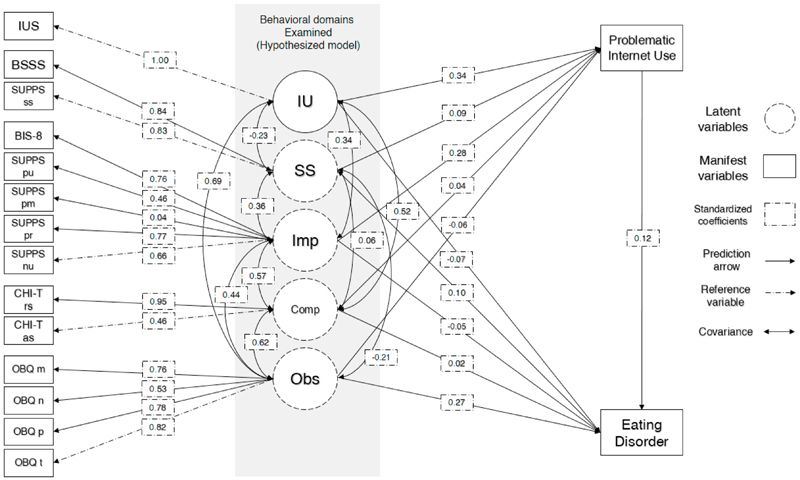
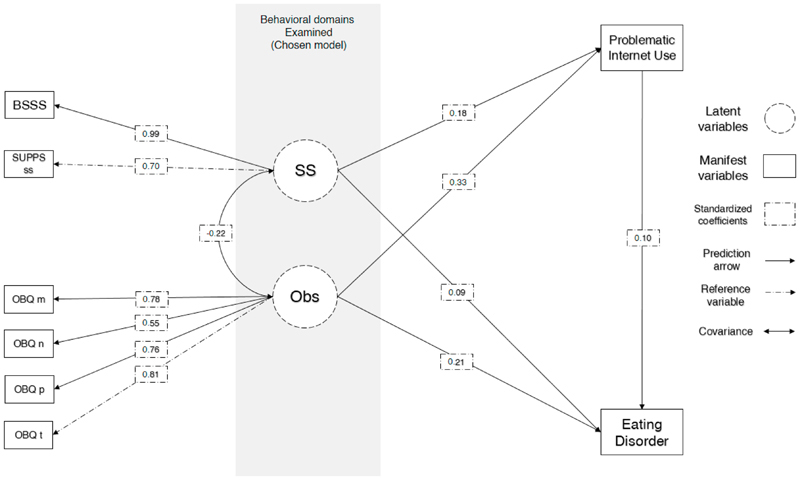
Eating disorders are widespread illnesses with significant global impact. There is growing concern about how young people overuse online resources leading to mental health sequelae. We gathered data from 639 individuals from a population cohort. Participants were all young adults at the point of contact and were grouped as having probable eating disorder with excessive exercise (n = 37) or controls (n = 602). We measured obsessionality, compulsivity, impulsivity, and problematic internet use. Group differences in these domains were evaluated; and structural equation modelling (SEM) was used to assess structural relationships between variables. Cases had higher scores of obsessional thoughts of threat (Cohen's d = 0.94, p < 0.001), intolerance towards uncertainty (Cohen's d = 0.72; p < 0.001), thoughts of importance and control (Cohen's d = 0.65, p < 0.01), compulsivity (Cohen's d = 0.72; p < 0.001), negative urgency (Cohen's d = 0.75, p < 0.001), and higher problematic usage of the internet (Cohen's d = 0.73; p-corrected <0.001). Our SEM showed significant partial mediation of problematic internet use on both the effect of obsessionality latent factor on cases (z-value = 2.52, p < 0.05), as well as of sensation seeking latent factor on cases (z-value = 2.09, p < 0.05). Youth with eating disorder and heightened exercise levels have increased obsessive thoughts of threat, compulsivity traits and sensation seeking impulsivity. The association between obsessive thoughts and eating disorders, as well as sensation seeking and eating disorders were partially mediated by problematic internet use. Problematic internet use may be playing a role in the development or maintenance of eating disorder symptoms in the background of obsessional thoughts and sensation seeking impulsive traits.
饮食失调是一种广泛存在的疾病,对全球有着重大影响。人们越来越担心年轻人过度使用网络资源会导致心理健康问题。我们从一个人群队列中收集了639人的数据。参与者在接触时均为年轻成年人,分为可能患有饮食失调且运动过度的组(n = 37)和对照组(n = 602)。我们测量了强迫观念、强迫行为、冲动性和有问题的互联网使用情况。评估了这些领域的组间差异;并使用结构方程模型(SEM)来评估变量之间的结构关系。病例组在威胁强迫观念得分更高(科恩d值 = 0.94,p < 0.001)、对不确定性的不耐受(科恩d值 = 0.72;p < 0.001)、重要性和控制观念(科恩d值 = 0.65,p < 0.01)、强迫行为(科恩d值 = 0.72;p < 0.001)、消极紧迫性(科恩d值 = 0.75,p < 0.001)以及更高的有问题的互联网使用(科恩d值 = 0.73;p校正后 < 0.001)。我们的结构方程模型显示,有问题的互联网使用在强迫观念潜在因素对病例组的影响(z值 = 2.52,p < 0.05)以及感觉寻求潜在因素对病例组的影响(z值 = 2.09,p < 0.05)上均有显著的部分中介作用。患有饮食失调且运动水平较高的年轻人,其威胁强迫观念、强迫行为特质和感觉寻求冲动性有所增加。强迫观念与饮食失调之间的关联以及感觉寻求与饮食失调之间的关联,部分是由有问题的互联网使用介导的。在强迫观念和感觉寻求冲动特质的背景下,有问题的互联网使用可能在饮食失调症状的发展或维持中起作用。