Jin Nanxiang, Paffhausen Benjamin H, Duer Aron, Menzel Randolf
Institut für Biologie - Neurobiologie, Freie Universität Berlin, Berlin, Germany.
Front Behav Neurosci. 2020 Oct 20;14:590999. doi: 10.3389/fnbeh.2020.590999. eCollection 2020.
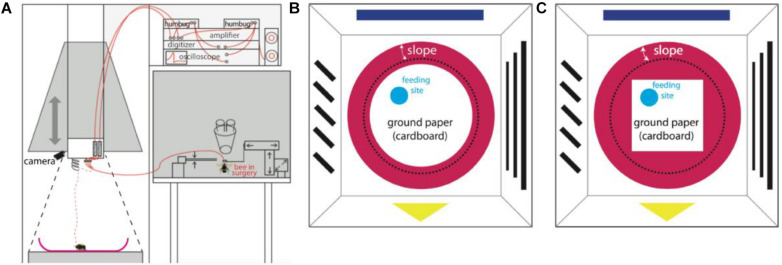
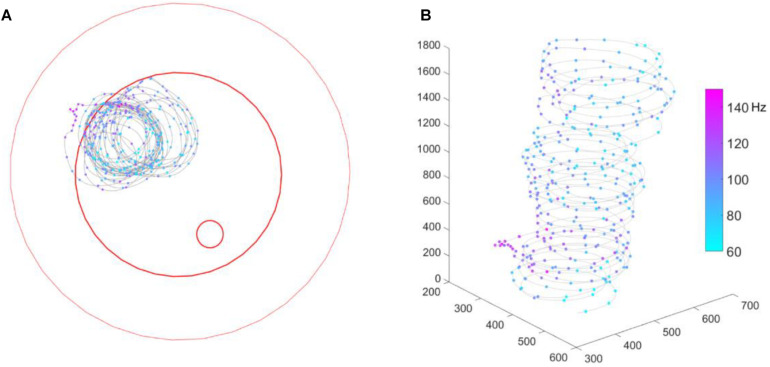
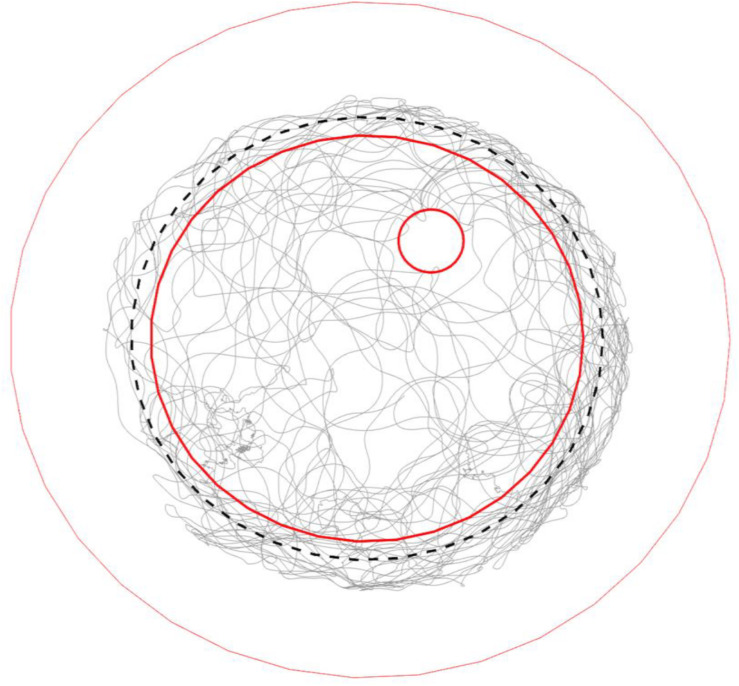
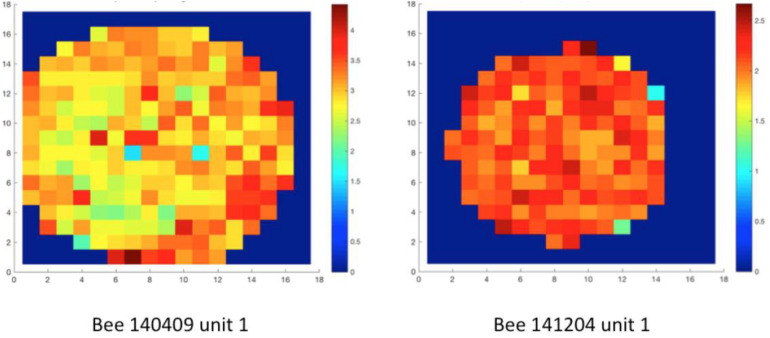
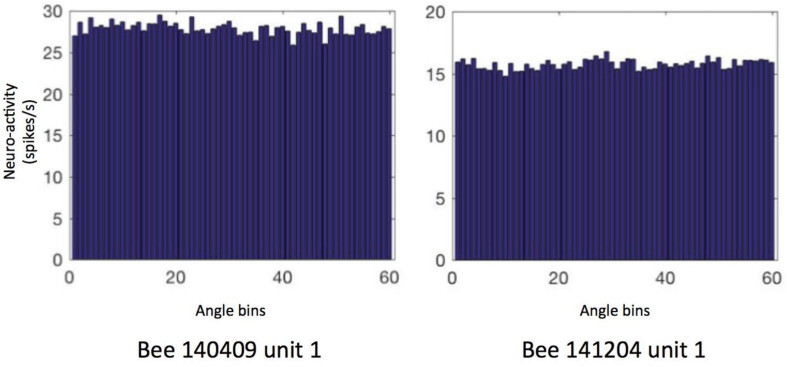
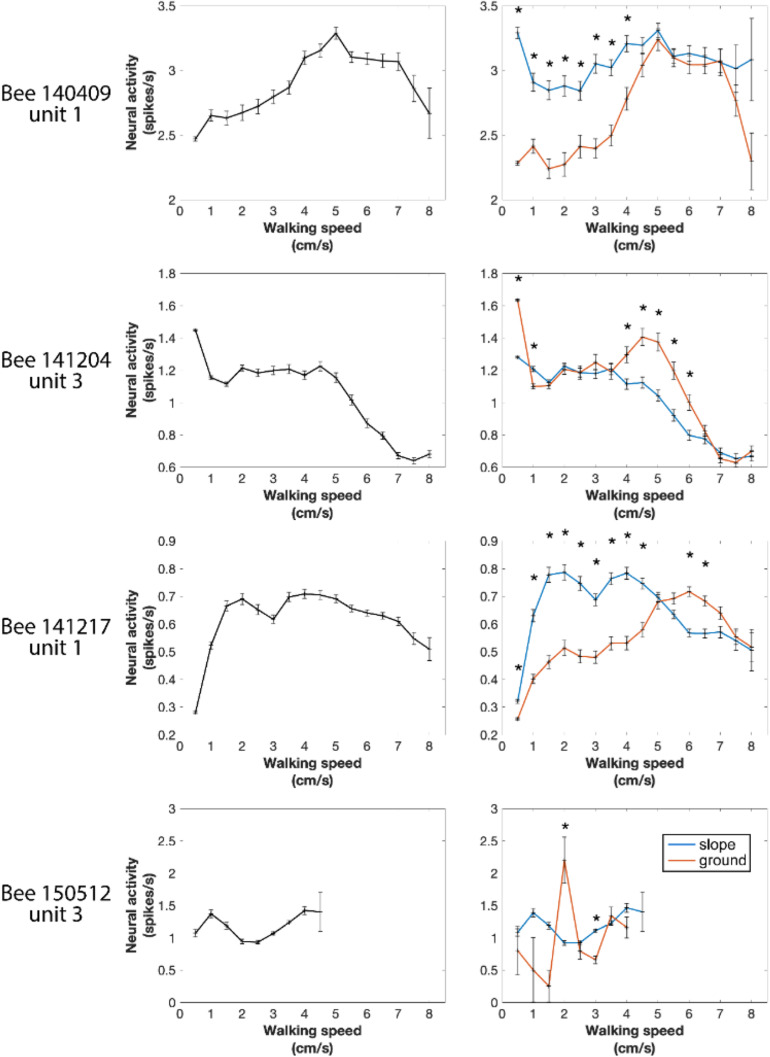
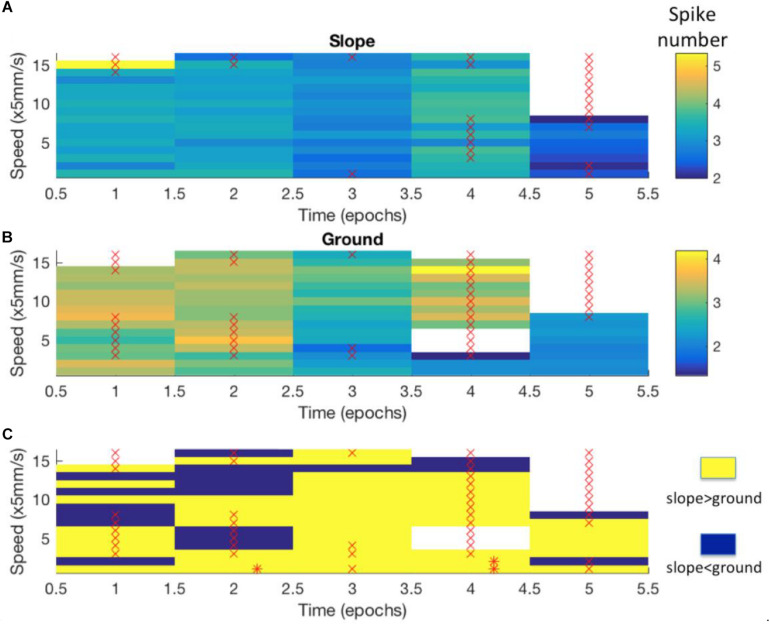
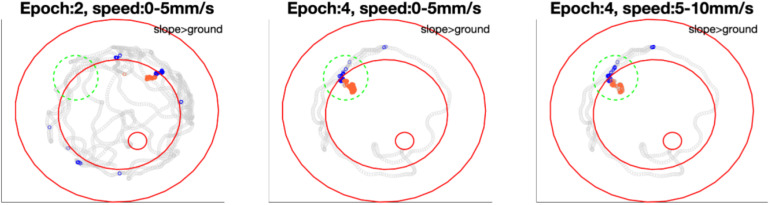
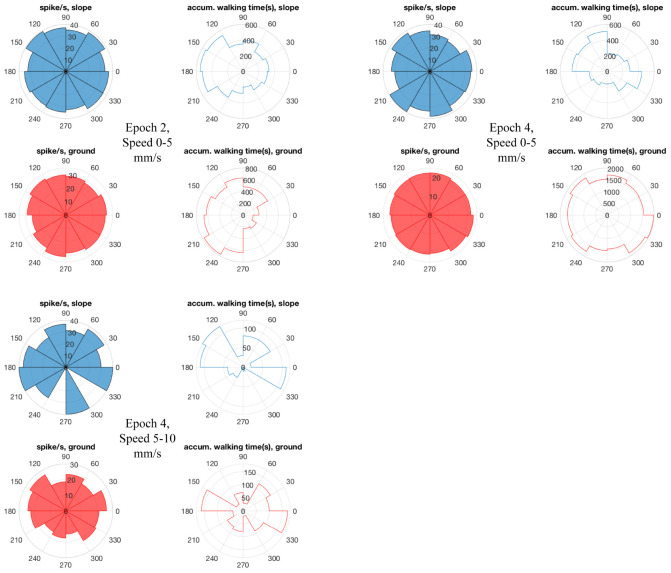
Central place foraging insects like honeybees and bumblebees learn to navigate efficiently between nest and feeding site. Essential components of this behavior can be moved to the laboratory. A major component of navigational learning is the active exploration of the test arena. These conditions have been used here to search for neural correlates of exploratory walking in the central arena (ground), and thigmotactic walking in the periphery (slope). We chose mushroom body extrinsic neurons (MBENs) because of their learning-related plasticity and their multi-modal sensitivities that may code relevant parameters in a brain state-dependent way. Our aim was to test whether MBENs code space-related components or are more involved in state-dependent processes characterizing exploration and thigmotaxis. MBENs did not respond selectively to body directions or locations. Their spiking activity differently correlated with walking speed depending on the animals' locations: on the ground, reflecting exploration, or on the slope, reflecting thigmotaxis. This effect depended on walking speed in different ways for different animals. We then asked whether these effects depended on spatial parameters or on the two states, exploration and thigmotaxis. Significant epochs of stable changes in spiking did not correlate with restricted locations in the arena, body direction, or walking transitions between ground and slope. We thus conclude that the walking speed dependencies are caused by the two states, exploration and thigmotaxis, rather than by spatial parameters.
像蜜蜂和大黄蜂这样的中心地觅食昆虫学会在巢穴和觅食地点之间高效导航。这种行为的基本组成部分可以转移到实验室中。导航学习的一个主要组成部分是对测试区域的主动探索。这里利用这些条件来寻找在中心区域(地面)的探索性行走以及在外围(斜坡)的趋触性行走的神经关联。我们选择蘑菇体外部神经元(MBENs)是因为它们与学习相关的可塑性以及它们的多模态敏感性,这些敏感性可能以依赖大脑状态的方式编码相关参数。我们的目的是测试MBENs是否编码与空间相关的组成部分,或者是否更多地参与表征探索和趋触性的依赖状态的过程。MBENs对身体方向或位置没有选择性反应。它们的放电活动根据动物的位置与行走速度有不同的相关性:在地面上,反映探索,或在斜坡上,反映趋触性。这种效应因不同动物而异,以不同方式依赖于行走速度。然后我们询问这些效应是依赖于空间参数还是依赖于探索和趋触性这两种状态。放电稳定变化的显著时期与测试区域内的受限位置、身体方向或地面与斜坡之间的行走转换无关。因此我们得出结论,行走速度依赖性是由探索和趋触性这两种状态引起的,而不是由空间参数引起的。