Bagarinao Epifanio, Watanabe Hirohisa, Maesawa Satoshi, Mori Daisuke, Hara Kazuhiro, Kawabata Kazuya, Yoneyama Noritaka, Ohdake Reiko, Imai Kazunori, Masuda Michihito, Yokoi Takamasa, Ogura Aya, Taoka Toshiaki, Koyama Shuji, Tanabe Hiroki C, Katsuno Masahisa, Wakabayashi Toshihiko, Kuzuya Masafumi, Hoshiyama Minoru, Isoda Haruo, Naganawa Shinji, Ozaki Norio, Sobue Gen
Brain and Mind Research Center, Nagoya University, Nagoya, Japan.
Department of Neurology, Fujita Health University School of Medicine, Toyoake, Japan.
Front Aging Neurosci. 2020 Oct 28;12:592469. doi: 10.3389/fnagi.2020.592469. eCollection 2020.
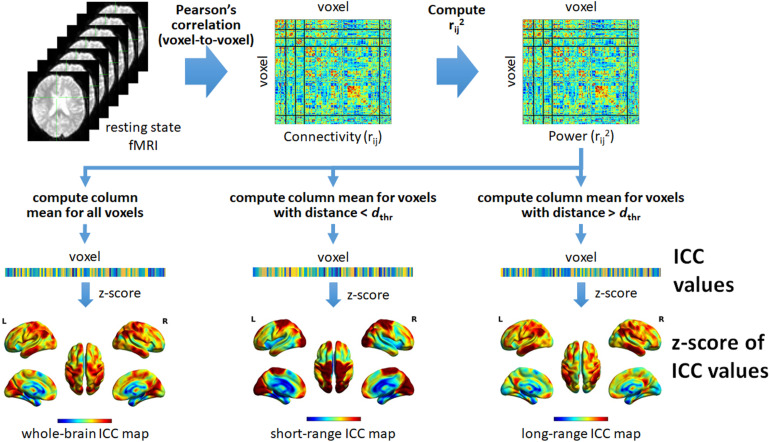
Recent studies have demonstrated that connector hubs, regions considered critical for the flow of information across neural systems, are mostly involved in neurodegenerative dementia. Considering that aging can significantly affect the brain's intrinsic connectivity, identifying aging's impact on these regions' overall connection strength is important to differentiate changes associated with healthy aging from neurodegenerative disorders. Using resting state functional magnetic resonance imaging data from a carefully selected cohort of 175 healthy volunteers aging from 21 to 86 years old, we computed an intrinsic connectivity contrast (ICC) metric, which quantifies a region's overall connectivity strength, for whole brain, short-range, and long-range connections and examined age-related changes of this metric over the adult lifespan. We have identified a limited number of hub regions with ICC values that showed significant negative relationship with age. These include the medial precentral/midcingulate gyri and insula with both their short-range and long-range (and thus whole-brain) ICC values negatively associated with age, and the angular, middle frontal, and posterior cingulate gyri with their long-range ICC values mainly involved. Seed-based connectivity analyses further confirmed that these regions are connector hubs with connectivity profile that strongly overlapped with multiple large-scale brain networks. General cognitive performance was not associated with these hubs' ICC values. These findings suggest that even healthy aging could negatively impact the efficiency of regions critical for facilitating information transfer among different functional brain networks. The extent of the regions involved, however, was limited.
最近的研究表明,连接枢纽,即被认为对跨神经系统的信息流至关重要的区域,大多与神经退行性痴呆有关。鉴于衰老会显著影响大脑的内在连接性,确定衰老对这些区域整体连接强度的影响对于区分与健康衰老相关的变化和神经退行性疾病很重要。我们使用来自精心挑选的175名年龄在21至86岁之间的健康志愿者队列的静息态功能磁共振成像数据,计算了一种内在连接性对比(ICC)指标,该指标量化了一个区域的整体连接强度,用于全脑、短程和长程连接,并研究了该指标在成年期的年龄相关变化。我们已经确定了数量有限的枢纽区域,其ICC值与年龄呈显著负相关。这些区域包括中央前回/扣带回中部和脑岛,它们的短程和长程(以及全脑)ICC值均与年龄呈负相关,以及角回、额中回和扣带回后部,主要涉及它们的长程ICC值。基于种子点的连接性分析进一步证实,这些区域是连接枢纽,其连接模式与多个大规模脑网络强烈重叠。一般认知能力与这些枢纽的ICC值无关。这些发现表明,即使是健康衰老也可能对促进不同功能性脑网络之间信息传递的关键区域的效率产生负面影响。然而,所涉及区域的范围是有限的。