Rabee Alaa Emara, Forster Robert, Elekwachi Chijioke, Sabra Ebrahim, Lamara Mebarek
Animal and Poultry Nutrition Department, Desert Research Center, Cairo, Cairo, Egypt.
Lethbridge Research and Development Centre, Agriculture and Agrifood Canada, Lethbridge, AB, Canada.
PeerJ. 2020 Oct 29;8:e10184. doi: 10.7717/peerj.10184. eCollection 2020.
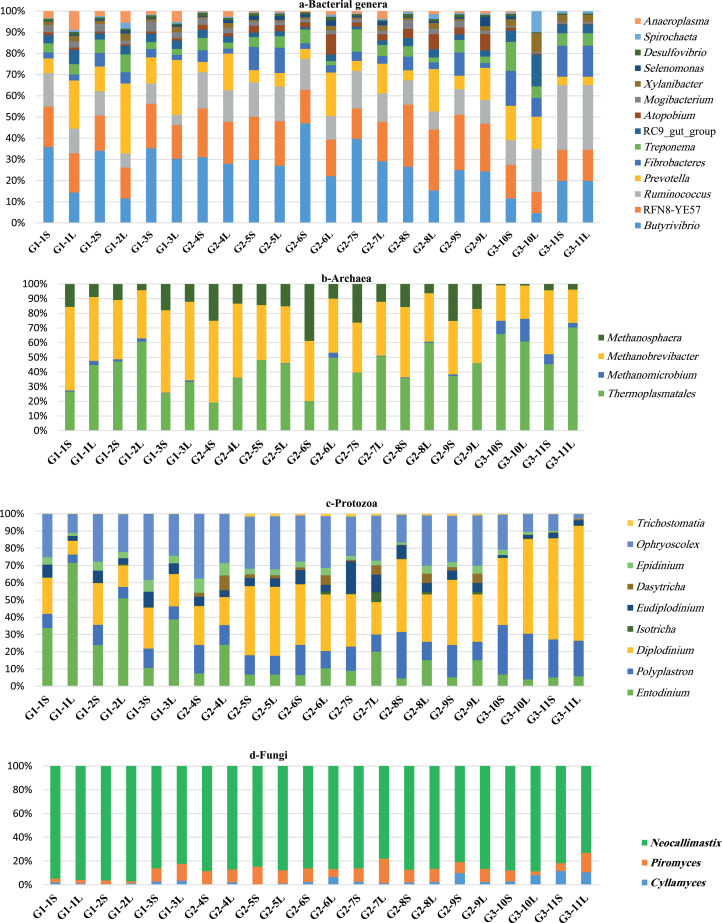
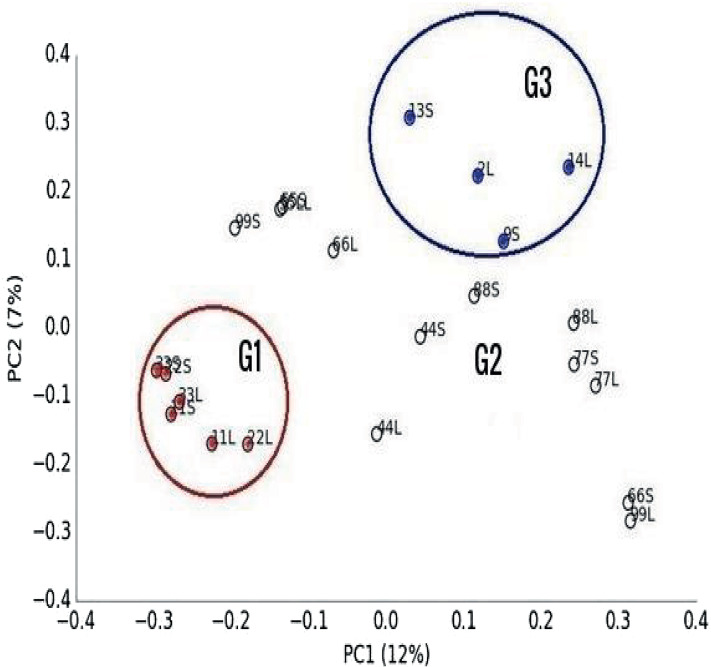
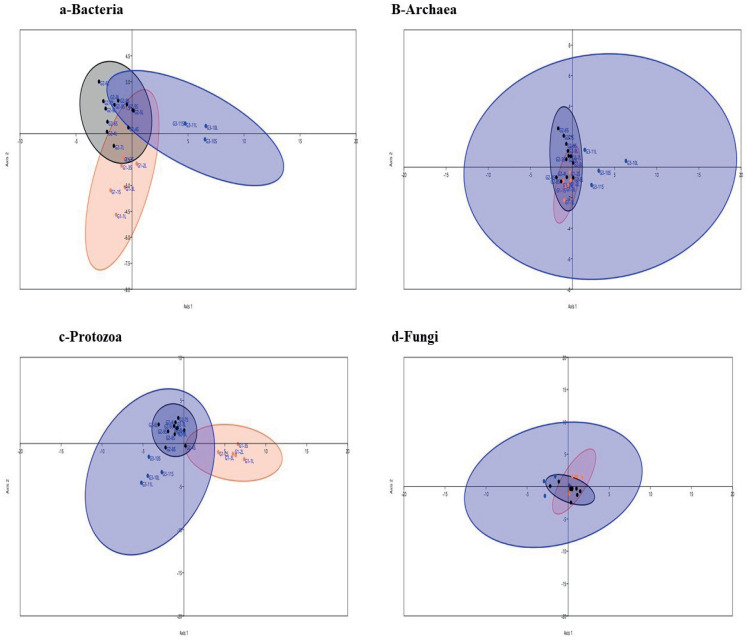
Breakdown of plant biomass in rumen depends on interactions between bacteria, archaea, fungi, and protozoa; however, the majority of studies of the microbiome of ruminants, including the few studies of the rumen of camels, only studied one of these microbial groups. In this study, we applied total rRNA sequencing to identify active microbial communities in 22 solid and liquid rumen samples from 11 camels. These camels were reared at three stations that use different feeding systems: clover, hay and wheat straw (G1), fresh clover (G2), and wheat straw (G3). Bacteria dominated the libraries of sequence reads generated from all rumen samples, followed by protozoa, archaea, and fungi respectively. Firmicutes, Thermoplasmatales, , and dominated bacterial, archaeal, protozoal and fungal communities, respectively in all samples. Libraries generated from camels reared at facility G2, where they were fed fresh clover, showed the highest alpha diversity. Principal co-ordinate analysis and linear discriminate analysis showed clusters associated with facility/feed and the relative abundance of microbes varied between liquid and solid fractions. This provides preliminary evidence that bacteria dominate the microbial communities of the camel rumen and these communities differ significantly between populations of domesticated camels.
瘤胃中植物生物质的分解取决于细菌、古菌、真菌和原生动物之间的相互作用;然而,大多数关于反刍动物微生物组的研究,包括少数关于骆驼瘤胃的研究,只研究了这些微生物群体中的一种。在本研究中,我们应用总rRNA测序来鉴定来自11头骆驼的22个瘤胃固体和液体样本中的活跃微生物群落。这些骆驼在三个采用不同饲养系统的养殖场饲养:三叶草、干草和小麦秸秆(G1)、新鲜三叶草(G2)和小麦秸秆(G3)。细菌在所有瘤胃样本产生的序列读数文库中占主导地位,其次分别是原生动物、古菌和真菌。在所有样本中,厚壁菌门、嗜热放线菌目等分别在细菌、古菌、原生动物和真菌群落中占主导地位。在以新鲜三叶草为食的G2养殖场饲养的骆驼所产生的文库显示出最高的α多样性。主坐标分析和线性判别分析表明,聚类与养殖场/饲料相关,并且微生物的相对丰度在液体和固体部分之间有所不同。这提供了初步证据,表明细菌在骆驼瘤胃微生物群落中占主导地位,并且这些群落在家养骆驼种群之间存在显著差异。