
通过供应氢气提高光合生物量生产力。
Enhanced Phototrophic Biomass Productivity through Supply of Hydrogen Gas.
作者信息
Sleutels Tom, Sebastião Bernardo Rita, Kuntke Philipp, Janssen Marcel, Buisman Cees J N, Hamelers Hubertus V M
机构信息
Wetsus, European Centre of Excellence for Sustainable Water Technology, Oostergoweg 9, Leeuwarden 8911MA, The Netherlands.
Environmental Technology, Wageningen University, Bornse Weilanden 9, P.O. Box 17, 6700 AA Wageningen, The Netherlands.
出版信息
Environ Sci Technol Lett. 2020 Nov 10;7(11):861-865. doi: 10.1021/acs.estlett.0c00718. Epub 2020 Sep 22.
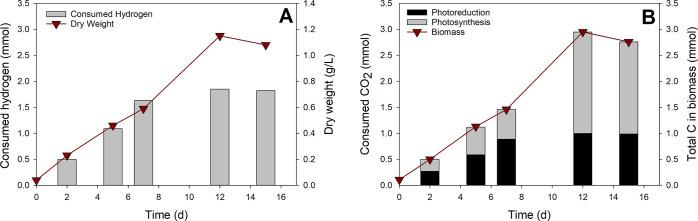
Industrial production of phototrophic microorganisms is often hindered by low productivity due to limited light availability and therefore requires large land areas. This letter demonstrates that supply of hydrogen gas (H) increases in phototrophic biomass productivity compared to a culture growing on light only. Experiments were performed growing in batch bottles, with and without H in the headspace, which were exposed to light intensities of 70 and 100 μmol/m/s. At 70 μmol/m/s with H, the average increase in biomass was 96 mg DW/L/d, whereas at 100 μmol/m/s without H, the average increase in biomass was 27 mg DW/L/d. Even at lower light intensity, the addition of H tripled the biomass yield compared to growth under light only. Photoreduction and photosynthesis occurred simultaneously, as both H consumption and O production were measured during biomass growth. Photoreduction used 1.85 mmol of H to produce 1.0 mmol of biomass, while photosynthesis produced 1.95 mmol of biomass. After transferring the culture to the dark, growth ceased, also in the presence of H, showing that both light and H were needed for growth. A renewable H supply for higher biomass productivity is attractive since the combined efficiency of photovoltaics and electrolysis exceeds the photosynthetic efficiency.
由于光照有限,光养微生物的工业生产往往因生产率低下而受到阻碍,因此需要大面积土地。这封信表明,与仅在光照下生长的培养物相比,供应氢气(H₂)可提高光养生物量的生产率。实验在分批培养瓶中进行,顶空有或没有H₂,培养瓶暴露于70和100 μmol/m²/s的光照强度下。在70 μmol/m²/s且有H₂的条件下,生物量的平均增加量为96 mg DW/L/d,而在100 μmol/m²/s且无H₂的条件下,生物量的平均增加量为27 mg DW/L/d。即使在较低光照强度下,与仅在光照下生长相比,添加H₂使生物量产量增加了两倍。光还原和光合作用同时发生,因为在生物量生长过程中同时测量了H₂消耗和O₂产生。光还原消耗1.85 mmol的H₂以产生1.0 mmol的生物量,而光合作用产生1.95 mmol的生物量。将培养物转移到黑暗环境后,生长停止,即使存在H₂也是如此,这表明生长既需要光照也需要H₂。由于光伏和电解的综合效率超过了光合效率,为提高生物量生产率提供可再生的H₂供应具有吸引力。


 Zotero 插件