Wang Yao, Sharma Anu, Padnick-Silver Lissa, Francis-Sedlak Megan, Holt Robert J, Foley Colleen, Massry Guy, Douglas Raymond S
Cedars-Sinai Medical Center, Los Angeles, CA, USA.
Division of Diabetes, Endocrinology, and Metabolism, Department of Internal Medicine, University of Utah School of Medicine, Salt Lake City, UT, USA.
Ophthalmol Ther. 2021 Mar;10(1):75-87. doi: 10.1007/s40123-020-00318-x. Epub 2020 Nov 16.
Thyroid eye disease (TED) is an autoimmune disease that causes retro-orbital inflammation and subsequent proptosis, corneal exposure, strabismus, and variable vision changes. European studies have shown that TED can severely impact quality of life (QOL), but little is known about the QOL of patients with TED in the USA. Given that patient QOL influences TED severity classifications and subsequent treatment, understanding physician-perceived patient QOL is extremely important.
This retrospective chart review (conducted in 2018) examined QOL in US patients with moderate-to-severe TED, as reported by treating physicians who regularly manage patients with TED (≥ 5 patients in prior 12 months). The physicians graded patients' overall QOL (7-point Likert scale; 1 = "not at all impaired", 7 = "extremely impaired"), assessing mental health, vision changes, and ocular structural signs/symptoms. Patient demographics and clinical findings were examined to understand the impact of disease presentation on physician-perceived QOL.
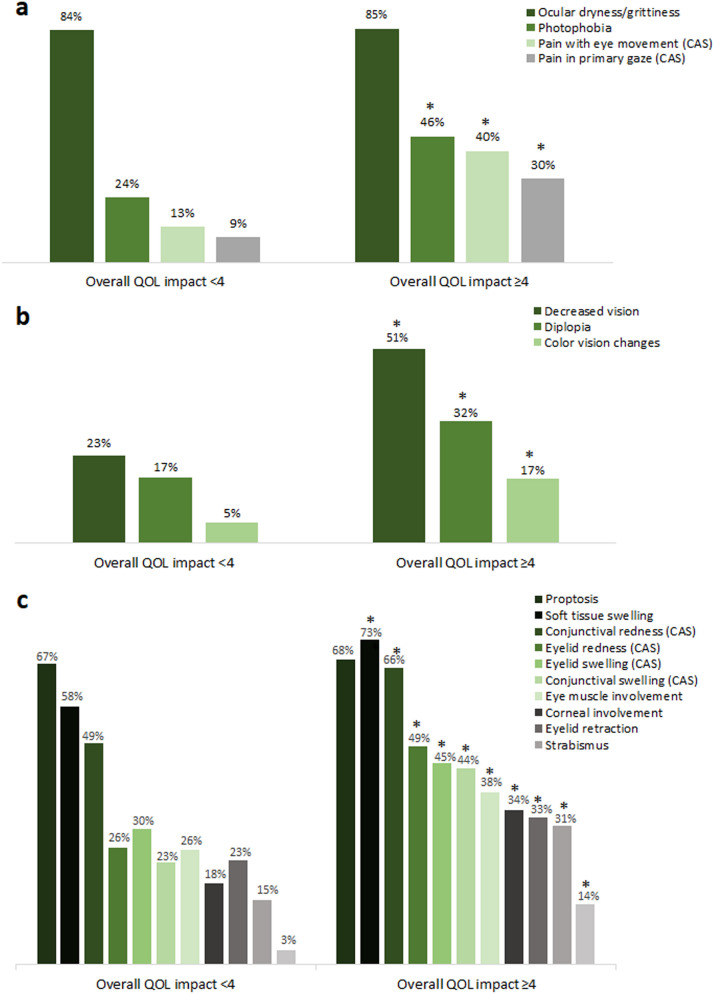
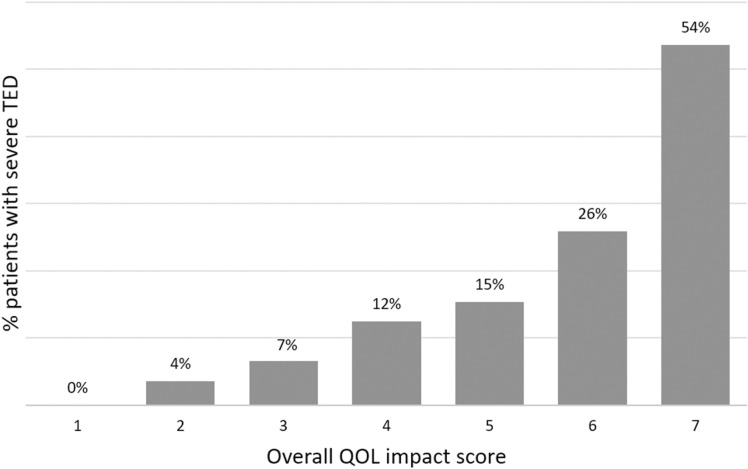
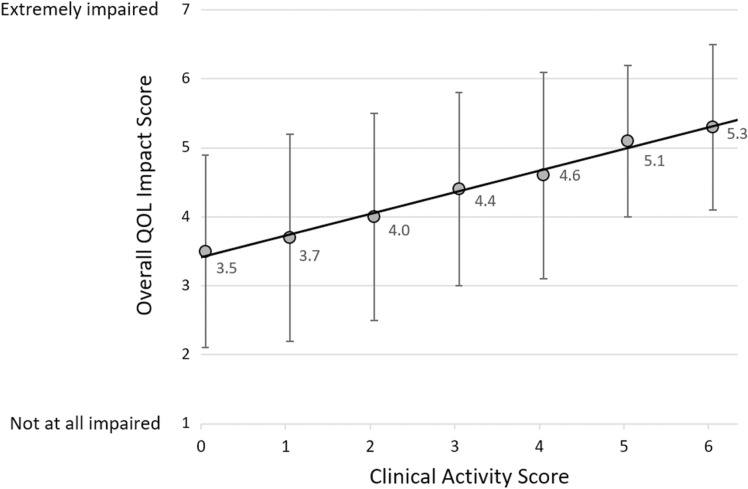
Medical record data of 714 US patients with moderate-to-severe TED were provided by 181 physicians (73 endocrinologists, 108 ophthalmologists). Patients had a mean age of 49.4 (standard deviation [SD] 13.6) years, and 102 cases (14%) were severe. Anxiety and/or depression was reported in 36% of patients (an increase from the 18.9% prevalence reported for the USA in 2017 by the US National Institute of Mental Health; P < 0.001). The mean physician-reported QOL impact score was 4.1 (SD 1.5). Furthermore, 62 and 89% of patients with moderate and severe TED, respectively, had a high physician-perceived QOL impact (≥ 4). The higher QOL impact group had significantly higher rates of pain symptoms, visual disturbances (including diplopia), and orbito-facial structural changes. Higher disease activity and severity were associated with lower physician-perceived QOL.
Patients' QOL, as evaluated by US physicians, is highly impacted by the activity and severity of TED. Additionally, mental health issues were more frequently reported by patients with TED than in the general US population. Ocular pain, strabismus, and diplopia appear to be main drivers of physician-perceived QOL impairment in this sample of US patients with TED.
甲状腺眼病(TED)是一种自身免疫性疾病,可导致眶后炎症以及随后出现的眼球突出、角膜暴露、斜视和视力变化。欧洲的研究表明,TED会严重影响生活质量(QOL),但对于美国TED患者的生活质量却知之甚少。鉴于患者的生活质量会影响TED的严重程度分类及后续治疗,了解医生所感知的患者生活质量极其重要。
这项回顾性病历审查(于2018年进行)调查了美国中重度TED患者的生活质量,这些数据由定期管理TED患者(过去12个月内≥5例患者)的治疗医生报告。医生对患者的总体生活质量进行评分(采用7分李克特量表;1 =“完全未受损”,7 =“极度受损”),评估心理健康、视力变化以及眼部结构体征/症状。研究患者的人口统计学和临床特征,以了解疾病表现对医生所感知的生活质量的影响。
181名医生(73名内分泌科医生,108名眼科医生)提供了714例美国中重度TED患者的病历数据。患者的平均年龄为49.4岁(标准差[SD]13.6),其中102例(14%)为重度患者。36%的患者报告有焦虑和/或抑郁(高于美国国家心理健康研究所2017年报告的美国患病率18.9%;P<0.001)。医生报告的生活质量影响平均评分为4.1(SD 1.5)。此外,中度和重度TED患者中,分别有62%和89%的患者具有较高的医生所感知的生活质量影响(≥4)。生活质量影响较高的组疼痛症状、视觉障碍(包括复视)和眶面部结构变化的发生率显著更高。疾病活动度和严重程度越高,医生所感知的生活质量越低。
美国医生评估的患者生活质量受到TED活动度和严重程度的高度影响。此外,TED患者报告的心理健康问题比美国普通人群更为频繁。在这个美国TED患者样本中,眼部疼痛、斜视和复视似乎是医生所感知的生活质量受损的主要驱动因素。