Department of Ophthalmology and Visual Sciences, Kellogg Eye Center, Ann Arbor, Michigan.
Division of Metabolism, Endocrine and Diabetes, Michigan Medicine and University of Michigan, Ann Arbor.
JAMA Ophthalmol. 2023 Feb 1;141(2):159-166. doi: 10.1001/jamaophthalmol.2022.3225.
Thyroid eye disease (TED) results in varying degrees of proptosis and diplopia negatively affecting quality of life (QoL), producing possibly substantial visual changes, disfigurement, and disability.
To determine the association of varying TED severities with QoL in a non-TED population by assessing health state utility scores.
DESIGN, SETTING, AND PARTICIPANTS: This qualitative study, conducted from April 20, 2020, to April 29, 2021, assessed health states for active, moderate-severe TED, and values were elicited using time trade-off methods. Six health states of varying severity were determined from 2 placebo-controlled clinical trials (171 patients with TED and clinical activity score ≥4, ±diplopia/proptosis) and refined using interviews with US patients with TED (n = 6). Each health state description was validated by interviews with additional TED patient advocates (n = 3) and physician experts (n = 3). Health state descriptions and a QOL questionnaire were piloted and administered to a general population. Visual analog scales (VASs) were also administered to detect concurrence of the findings.
TED health state utility scores and whether they differ from one another were assessed using Shapiro-Wilk, Kruskal-Wallis, pairwise Wilcoxon rank sum, and paired t tests.
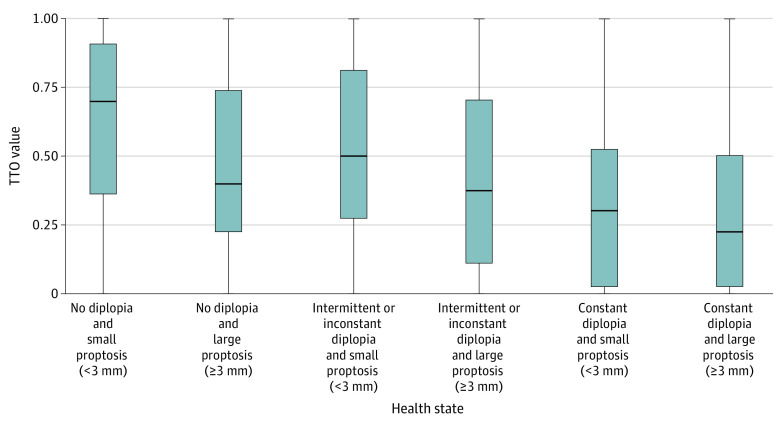
A total of 111 participants completed time trade-off interviews. The mean (SD) utility value was 0.44 (0.34). The lowest (worse) mean utility value was observed in the most severe disease state (constant diplopia/large proptosis) with 0.30 (95% CI, 0.24-0.36), followed by constant diplopia/small proptosis (0.34; 95% CI, 0.29-0.40), intermittent or inconstant diplopia/large proptosis (0.43; 95% CI, 0.36-0.49), no diplopia/large proptosis (0.46; 95% CI, 0.40-0.52), and intermittent or inconstant diplopia/small proptosis (0.52; 95% CI, 0.45-0.58). The highest (best) mean value, 0.60 (95% CI, 0.54-0.67), was observed for the least severe disease state (no diplopia/small proptosis).
These findings suggest that patients with active, moderate-severe TED may have substantial disutility, with increasing severity of proptosis/diplopia more likely to have detrimental associations with QoL. These health state scores may provide a baseline for determining QoL improvement in these TED health states (utility gains) treated with new therapies.
甲状腺眼病(TED)导致不同程度的眼球突出和复视,对生活质量(QoL)产生负面影响,可能导致显著的视觉变化、毁容和残疾。
通过评估健康状态效用评分,确定不同 TED 严重程度与非 TED 人群生活质量的关联。
设计、地点和参与者:本定性研究于 2020 年 4 月 20 日至 2021 年 4 月 29 日进行,评估了活动性、中重度 TED 患者的健康状况,并使用时间权衡法得出价值。根据 2 项安慰剂对照临床试验(171 例 TED 患者,临床活动评分≥4,伴或不伴复视/眼球突出)确定了 6 种不同严重程度的健康状况,并通过对美国 TED 患者的访谈进行了改进(n=6)。每个健康状况描述都经过 TED 患者倡导者(n=3)和医学专家(n=3)的访谈验证。健康状况描述和生活质量问卷进行了试点,并在一般人群中进行了调查。还进行了视觉模拟量表(VAS)以检测发现的一致性。
使用 Shapiro-Wilk、Kruskal-Wallis、两两 Wilcoxon 秩和检验和配对 t 检验评估 TED 健康状态效用评分以及它们之间是否存在差异。
共有 111 名参与者完成了时间权衡访谈。平均(SD)效用值为 0.44(0.34)。最严重疾病状态(持续复视/大眼球突出)观察到的平均(最差)效用值最低为 0.30(95%CI,0.24-0.36),其次是持续复视/小眼球突出(0.34;95%CI,0.29-0.40),间歇性或不恒定复视/大眼球突出(0.43;95%CI,0.36-0.49),无复视/大眼球突出(0.46;95%CI,0.40-0.52),间歇性或不恒定复视/小眼球突出(0.52;95%CI,0.45-0.58)。最高(最佳)平均价值为 0.60(95%CI,0.54-0.67),见于最轻微的疾病状态(无复视/小眼球突出)。
这些发现表明,活动性、中重度 TED 患者可能存在显著的失能,眼球突出/复视的严重程度增加更可能与生活质量产生不利关联。这些健康状态评分可能为评估新疗法治疗这些 TED 健康状态(效用获益)的生活质量改善提供基线。