Longnecker D S
Dartmouth Medical School, Hanover, NH.
Gut. 1987;28 Suppl(Suppl):253-8. doi: 10.1136/gut.28.suppl.253.
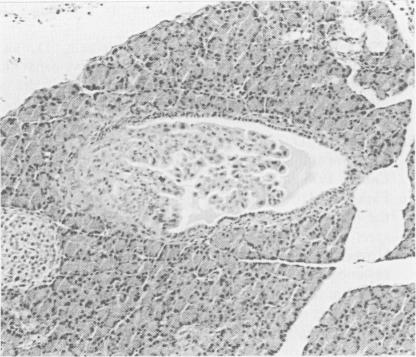
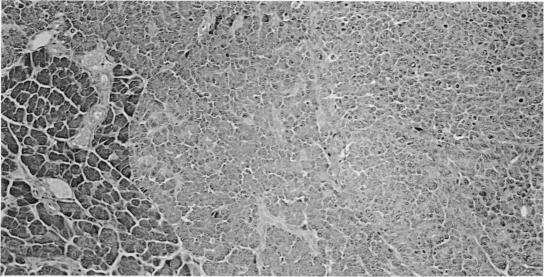
The adaptive changes of hypertrophy and hyperplasia are diffuse and reversible responses of the pancreas to growth promoting stimuli. Early stages of neoplastic growth in the pancreas have been studied in carcinogen treated animals and preneoplastic lesions including atypical acinar cell foci and nodules, tubular ductal complexes and intraductal hyperplasia were identified. Neoplastic growth is clonal rather than diffuse and involves multiple steps through preneoplastic stages to produce a tumour. The individual steps are commonly regarded as reflecting a series of changes in the genome of the cells. Although the changes are likely to be irreversible, completion of the sequence usually requires a major portion of the lifespan of the host. The rate of progression of preneoplastic lesions to cancer may be modulated by the same factors that control adaptive growth. It follows that such factors will influence the probability that a carcinoma will develop. Cholecystokinin (CCK) seems to provide one example of a hormone/growth factor that can stimulate normal, adaptive, and neoplastic growth, and it is to be expected that other such hormones will be identified.
肥大和增生的适应性变化是胰腺对生长促进刺激的弥漫性和可逆性反应。在致癌物处理的动物中研究了胰腺肿瘤生长的早期阶段,并鉴定出包括非典型腺泡细胞灶和结节、管状导管复合体和导管内增生在内的癌前病变。肿瘤生长是克隆性的而非弥漫性的,并且涉及通过癌前阶段的多个步骤以产生肿瘤。各个步骤通常被认为反映了细胞基因组中的一系列变化。虽然这些变化可能是不可逆的,但序列的完成通常需要宿主寿命的大部分时间。癌前病变发展为癌症的进展速度可能受到控制适应性生长的相同因素的调节。因此,这些因素将影响癌症发生的可能性。胆囊收缩素(CCK)似乎提供了一种能够刺激正常、适应性和肿瘤生长的激素/生长因子的例子,并且可以预期将鉴定出其他此类激素。