Division of Informatics, Imaging & Data Sciences, School of Biological Sciences, Faculty of Biology, Medicine and Health, University of Manchester, Manchester, UK.
Oxford Centre for Diabetes, Endocrinology and Metabolism, University of Oxford, Oxford, UK.
Thorax. 2021 Jan;76(1):53-60. doi: 10.1136/thoraxjnl-2020-215218. Epub 2020 Nov 16.
Shift work causes misalignment between internal circadian time and the external light/dark cycle and is associated with metabolic disorders and cancer. Approximately 20% of the working population in industrialised countries work permanent or rotating night shifts, exposing this large population to the risk of circadian misalignment-driven disease. Analysis of the impact of shift work on chronic inflammatory diseases is lacking. We investigated the association between shift work and asthma.
We describe the cross-sectional relationship between shift work and prevalent asthma in >280000 UK Biobank participants, making adjustments for major confounding factors (smoking history, ethnicity, socioeconomic status, physical activity, body mass index). We also investigated chronotype.
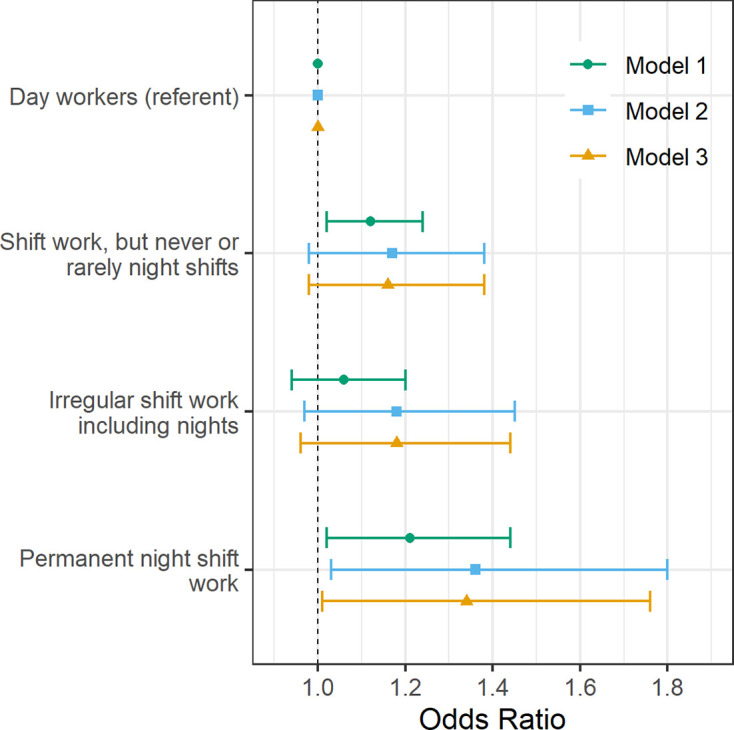
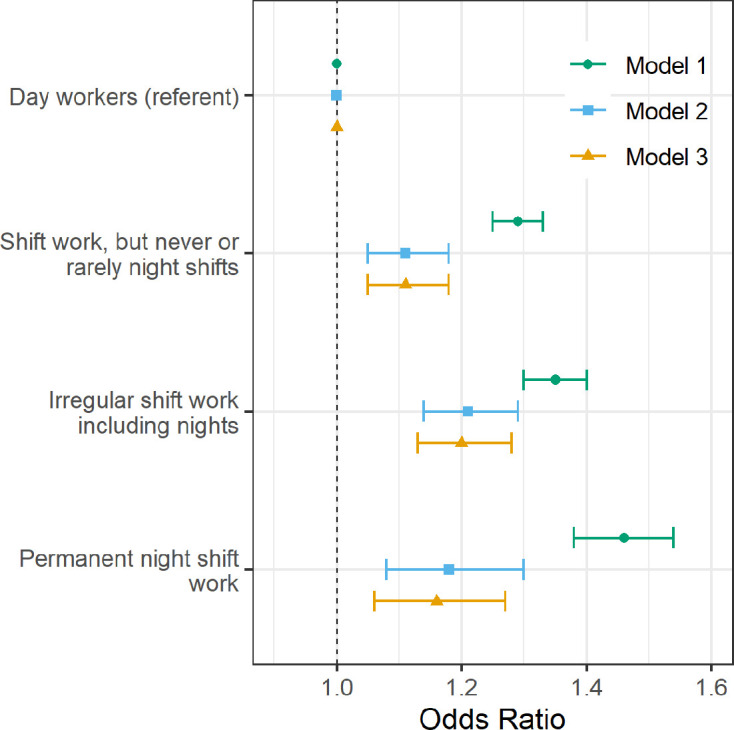
Compared with day workers, 'permanent' night shift workers had a higher likelihood of moderate-severe asthma (OR 1.36 (95% CI 1.03 to 1.8)) and all asthma (OR 1.23 (95% CI 1.03 to 1.46)). Individuals doing any type of shift work had higher adjusted odds of wheeze/whistling in the chest. Shift workers who never or rarely worked on nights and people working permanent nights had a higher adjusted likelihood of having reduced lung function (FEV <80% predicted). We found an increase in the risk of moderate-severe asthma in morning chronotypes working irregular shifts, including nights (OR 1.55 (95% CI 1.06 to 2.27)).
The public health implications of these findings are far-reaching due to the high prevalence and co-occurrence of both asthma and shift work. Future longitudinal follow-up studies are needed to determine if modifying shift work schedules to take into account chronotype might present a public health measure to reduce the risk of developing inflammatory diseases such as asthma.
轮班工作导致内部生物钟与外部明暗周期失配,并与代谢紊乱和癌症有关。在工业化国家,约有 20%的劳动力从事固定或轮班夜班工作,使这一大规模人群面临昼夜节律失调驱动疾病的风险。目前缺乏对轮班工作与慢性炎症性疾病之间关系的分析。我们调查了轮班工作与哮喘之间的关联。
我们描述了 280000 多名英国生物库参与者中轮班工作与现患哮喘之间的横断面关系,并对主要混杂因素(吸烟史、种族、社会经济地位、身体活动、体重指数)进行了调整。我们还研究了昼夜节律类型。
与日间工作者相比,“固定”夜班工作者患中重度哮喘的可能性更高(OR 1.36[95%CI 1.03 至 1.8])和所有哮喘(OR 1.23[95%CI 1.03 至 1.46])。从事任何类型轮班工作的人调整后喘息/哮鸣的几率更高。从不或很少上夜班的轮班工作者和上固定夜班的人调整后肺功能(FEV<80%预计值)降低的可能性更高。我们发现,不规则轮班工作(包括夜班)的早晨型生物钟的中重度哮喘风险增加(OR 1.55[95%CI 1.06 至 2.27])。
由于哮喘和轮班工作的高患病率和共病性,这些发现具有深远的公共卫生意义。需要进行未来的纵向随访研究,以确定是否可以通过调整轮班工作时间表来考虑昼夜节律类型,从而提出一项公共卫生措施来降低患哮喘等炎症性疾病的风险。