Department of Life Sciences, Sir Ernst Chain Building, Imperial College London, London, SW7 2AZ, UK.
London Centre for Nanotechnology, University College London, London, WC1H 0AH, UK.
Nat Commun. 2020 Nov 16;11(1):5818. doi: 10.1038/s41467-020-19482-6.
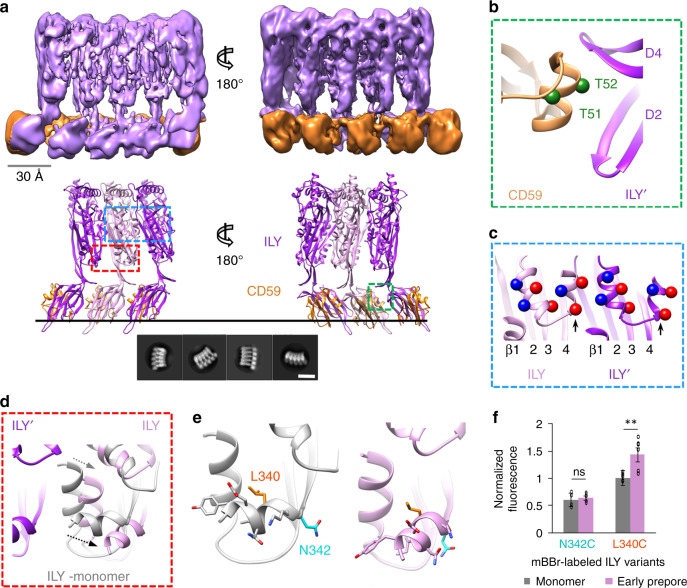
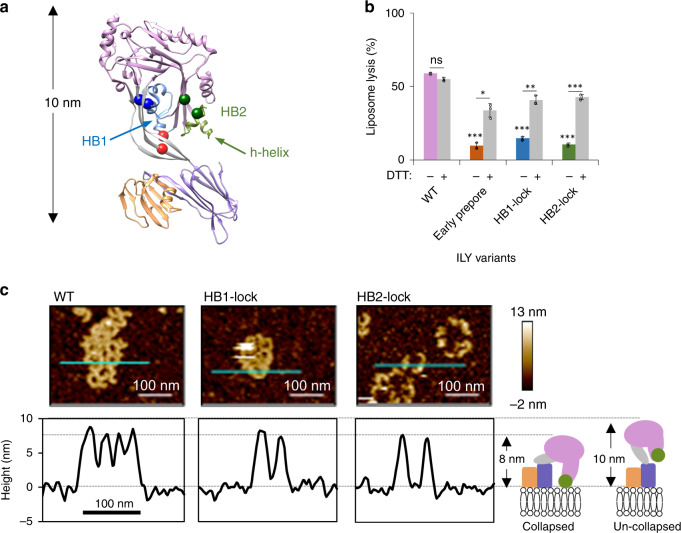
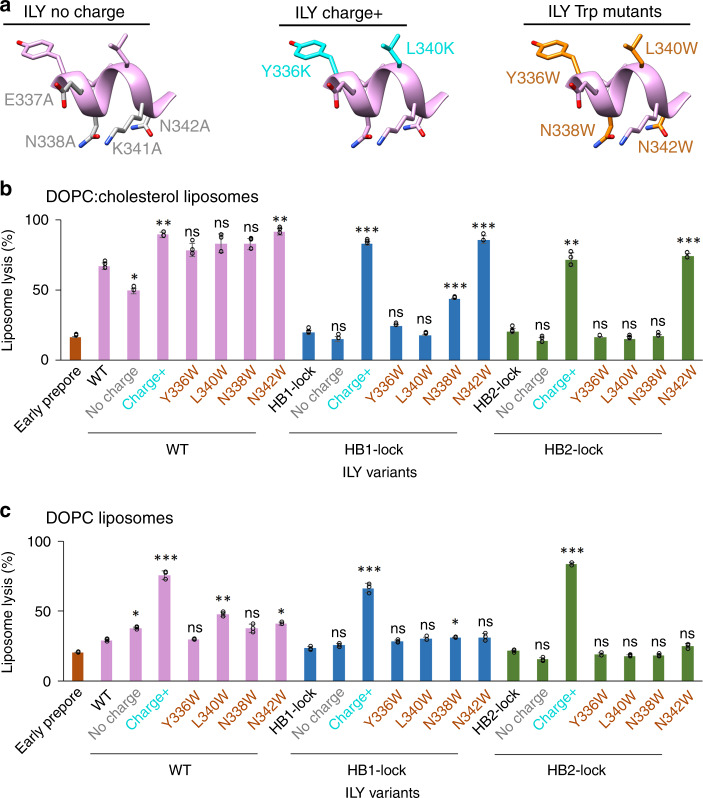
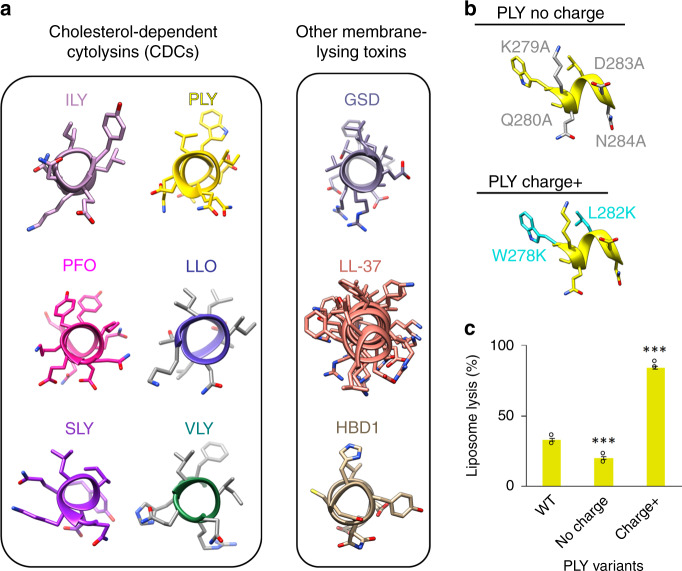
Cholesterol-dependent cytolysins (CDCs) are pore-forming proteins that serve as major virulence factors for pathogenic bacteria. They target eukaryotic cells using different mechanisms, but all require the presence of cholesterol to pierce lipid bilayers. How CDCs use cholesterol to selectively lyse cells is essential for understanding virulence strategies of several pathogenic bacteria, and for repurposing CDCs to kill new cellular targets. Here we address that question by trapping an early state of pore formation for the CDC intermedilysin, bound to the human immune receptor CD59 in a nanodisc model membrane. Our cryo electron microscopy map reveals structural transitions required for oligomerization, which include the lateral movement of a key amphipathic helix. We demonstrate that the charge of this helix is crucial for tuning lytic activity of CDCs. Furthermore, we discover modifications that overcome the requirement of cholesterol for membrane rupture, which may facilitate engineering the target-cell specificity of pore-forming proteins.
胆固醇依赖性细胞溶素(CDCs)是一类形成孔道的蛋白,它们是致病性细菌的主要毒力因子。它们通过不同的机制靶向真核细胞,但都需要胆固醇来刺穿脂双层。CDC 如何利用胆固醇选择性地裂解细胞,对于理解几种致病性细菌的毒力策略以及重新利用 CDC 来杀死新的细胞靶标至关重要。在这里,我们通过在纳米盘模型膜中捕获与人类免疫受体 CD59 结合的中间溶菌素(一种 CDC)的早期孔形成状态来解决这个问题。我们的冷冻电镜图谱揭示了寡聚化所需的结构转变,包括关键的两亲性螺旋的侧向运动。我们证明,该螺旋的电荷对于调节 CDC 的溶细胞活性至关重要。此外,我们发现了一些修饰,可以克服胆固醇对膜破裂的要求,这可能有助于工程改造形成孔道的蛋白的靶细胞特异性。