Sha Wenxin, Hu Fei, Bu Shizhong
Diabetes Research Center, School of Medicine, Ningbo University, Ningbo, Zhejiang 315211, P.R. China.
Exp Ther Med. 2020 Dec;20(6):266. doi: 10.3892/etm.2020.9396. Epub 2020 Oct 27.
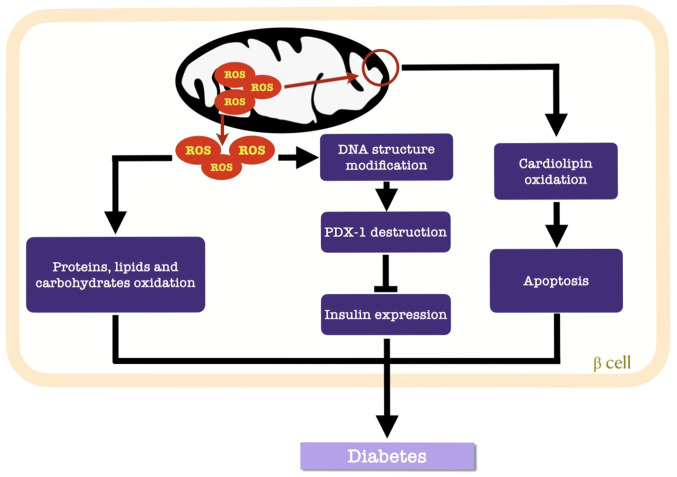
Pancreatic β-cells are the only source of insulin in humans. Mitochondria uses pyruvate to produce ATP as an intermediate link between glucose intake and insulin secretion in β-cells, in a process known as glucose-stimulated insulin secretion (GSIS). Previous studies have demonstrated that GSIS is negatively regulated by various factors in the mitochondria, including tRNA mutations, high p58 expression, reduced nicotinamide nucleotide transhydrogenase activity, abnormal levels of uncoupling proteins and reduced expression levels of transcription factors A, B1 and B2. Additionally, oxidative stress damages mitochondria and impairs antioxidant defense mechanisms, leading to the increased production of reactive oxygen species, which induces β-cell dysfunction. Inflammation in islets can also damage β-cell physiology. Inflammatory cytokines trigger the release of cytochrome from the mitochondria via the NF-κB pathway. The present review examined the potential factors underlying mitochondrial dysfunction and their association with islet β-cell failure, which may offer novel insights regarding future strategies for the preservation of mitochondrial function and enhancement of antioxidant activity for individuals with diabetes mellitus.
胰腺β细胞是人体胰岛素的唯一来源。线粒体利用丙酮酸产生ATP,作为β细胞中葡萄糖摄取与胰岛素分泌之间的中间环节,这一过程称为葡萄糖刺激的胰岛素分泌(GSIS)。先前的研究表明,GSIS受到线粒体中多种因素的负调控,包括tRNA突变、p58高表达、烟酰胺核苷酸转氢酶活性降低、解偶联蛋白水平异常以及转录因子A、B1和B2表达水平降低。此外,氧化应激会损害线粒体并削弱抗氧化防御机制,导致活性氧生成增加,进而诱导β细胞功能障碍。胰岛炎症也会损害β细胞生理功能。炎性细胞因子通过NF-κB途径触发线粒体释放细胞色素。本综述探讨了线粒体功能障碍的潜在因素及其与胰岛β细胞衰竭的关联,这可能为未来保护线粒体功能和增强糖尿病患者抗氧化活性的策略提供新的见解。