Garnier Romain, Benetka Jan R, Kraemer John, Bansal Shweta
Department of Biology, Georgetown University, Washington DC, USA.
Unacast, Oslo, Norway.
medRxiv. 2020 Nov 9:2020.11.07.20201335. doi: 10.1101/2020.11.07.20201335.
Eliminating disparities in the burden of COVID-19 requires equitable access to control measures across socio-economic groups. Limited research on socio-economic differences in mobility hampers our ability to understand whether inequalities in social distancing are occurring during the SARS-CoV-2 pandemic.
To assess how mobility patterns have varied across the United States during the COVID-19 pandemic, and identify associations with socio-economic factors of populations.
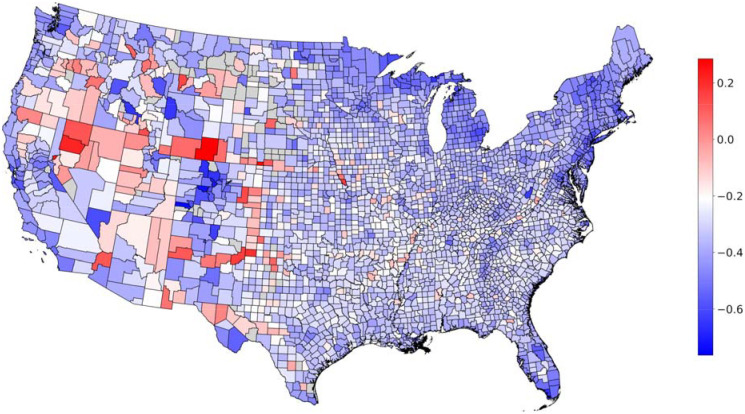
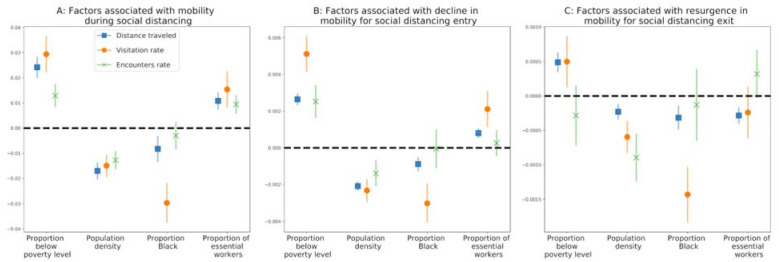
We used anonymized mobility data from tens of millions of devices to measure the speed and depth of social distancing at the county level between February and May 2020. Using linear mixed models, we assessed the associations between social distancing and socio-economic variables, including the proportion of people below the poverty level, the proportion of Black people, the proportion of essential workers, and the population density.
We find that the speed, depth, and duration of social distancing in the United States is heterogeneous. We particularly show that social distancing is slower and less intense in counties with higher proportions of people below the poverty level and essential workers; and in contrast, that social distancing is intense in counties with higher population densities and larger Black populations.
Socio-economic inequalities appear to be associated with the levels of adoption of social distancing, potentially resulting in wide-ranging differences in the impact of COVID-19 in communities across the United States. This is likely to amplify existing health disparities, and needs to be addressed to ensure the success of ongoing pandemic mitigation efforts.
消除新冠疫情负担方面的差异需要社会经济群体公平获得防控措施。关于流动性方面社会经济差异的研究有限,这妨碍了我们理解在新冠病毒大流行期间社交距离方面是否存在不平等现象。
评估在新冠疫情期间美国各地的流动模式如何变化,并确定与人群社会经济因素的关联。
设计、背景和参与者:我们使用来自数千万台设备的匿名移动数据,来衡量2020年2月至5月县级社交距离的速度和程度。我们使用线性混合模型评估社交距离与社会经济变量之间的关联,这些变量包括贫困人口比例、黑人比例、必要工作人员比例和人口密度。
我们发现美国社交距离的速度、程度和持续时间存在异质性。我们特别表明,在贫困人口比例和必要工作人员比例较高的县,社交距离较慢且强度较小;相反,在人口密度较高和黑人人口较多的县,社交距离强度较大。
社会经济不平等似乎与社交距离的采用程度相关,这可能导致新冠疫情在美国各社区的影响存在广泛差异。这可能会加剧现有的健康差距,需要加以解决以确保正在进行的疫情缓解努力取得成功。