Malaria and Neglected Tropical Diseases Research Team, Ethiopian Public Health Institute , Addis Ababa, Ethiopia.
National Laboratories Capacity Building Directorate, Ethiopian Public Health Institute , Addis Ababa, Ethiopia.
Glob Health Action. 2020 Dec 31;13(1):1841963. doi: 10.1080/16549716.2020.1841963.
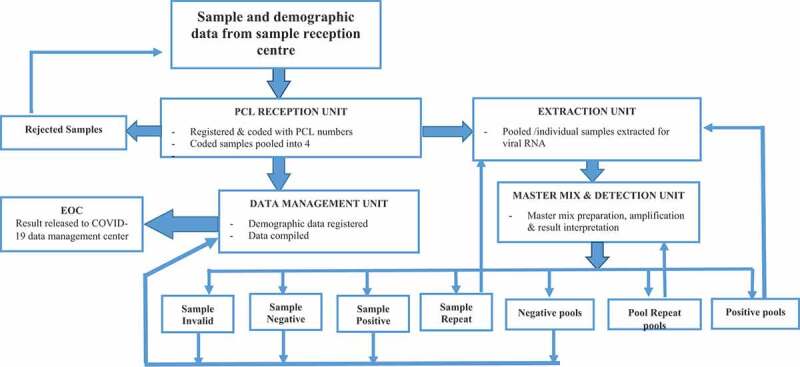
The Coronavirus pandemic is recording unprecedented deaths worldwide. The temporal distribution and burden of the disease varies from setting to setting based on economic status, demography and geographic location. A rapid increase in the number of COVID-19 cases is being reported in Africa as of June 2020. Ethiopia reported the first COVID-19 case on 13 March 2020. Limited molecular laboratory capacity in resource constrained settings is a challenge in the diagnosis of the ever-increasing cases and the overall management of the disease. In this article, the Ethiopian Public Health Institute (EPHI) shares the experience, challenges and prospects in the rapid establishment of one of its COVID-19 testing laboratories from available resources. The first steps in establishing the COVID-19 molecular testing laboratory were i) identifying a suitable space ii) renovating it and iii) mobilizing materials including consumables, mainly from the Malaria and Neglected Tropical Diseases (NTDs) research team at the EPHI. A chain of experimental design was set up with distinct laboratories to standardize the extraction of samples, preparation of the master mix and detection. At the commencement of sample reception and testing, laboratory contamination was among the primary challenges faced. The source of the contamination was identified in the master mix room and resolved. In summary, the established COVID-19 testing lab has tested more than 40,000 samples (August 2020) and is the preferred setting for research and training. The lessons learned may benefit the further establishment of emergency testing laboratories for COVID-19 and/or other epidemic/pandemic diseases in resource-limited settings.
冠状病毒大流行在全球范围内造成的死亡人数前所未有。根据经济状况、人口统计学和地理位置的不同,疾病的时间分布和负担在不同环境中有所差异。截至 2020 年 6 月,非洲报告的 COVID-19 病例数量迅速增加。埃塞俄比亚于 2020 年 3 月 13 日报告了首例 COVID-19 病例。在资源有限的环境中,分子实验室能力有限,这是诊断不断增加的病例以及整体管理疾病的挑战。在本文中,埃塞俄比亚公共卫生研究所(EPHI)分享了从现有资源中快速建立其 COVID-19 检测实验室之一的经验、挑战和前景。建立 COVID-19 分子检测实验室的第一步是:i)确定一个合适的空间;ii)对其进行翻新;iii)调动材料,包括耗材,主要来自 EPHI 的疟疾和被忽视的热带病(NTDs)研究团队。建立了一系列实验设计,有明确的实验室来标准化样本提取、主混合物制备和检测。在开始接收和检测样本时,实验室污染是面临的主要挑战之一。污染的来源在主混合室中被确定并得到解决。总之,已建立的 COVID-19 检测实验室已经测试了超过 40000 个样本(2020 年 8 月),是研究和培训的首选场所。所吸取的经验教训可能有助于在资源有限的环境中进一步建立 COVID-19 和/或其他传染病/大流行疾病的紧急检测实验室。