National Data Management Center for Health, Ethiopian Public Health Institute (EPHI), Addis Ababa, Ethiopia.
Partnership and Cooperation Directorate, Ministry of Health, Addis Ababa, Ethiopia.
PLoS One. 2022 Jun 9;17(6):e0269458. doi: 10.1371/journal.pone.0269458. eCollection 2022.
Ethiopia has been responding to the COVID-19 pandemic through a combination of interventions, including non-pharmaceutical interventions, quarantine, testing, isolation, contact tracing, and clinical management. Estimating the resources consumed for COVID-19 prevention and control could inform efficient decision-making for epidemic/pandemic-prone diseases in the future. This study aims to estimate the unit cost of COVID-19 sample collection, laboratory diagnosis, and contact tracing in Addis Ababa, Ethiopia.
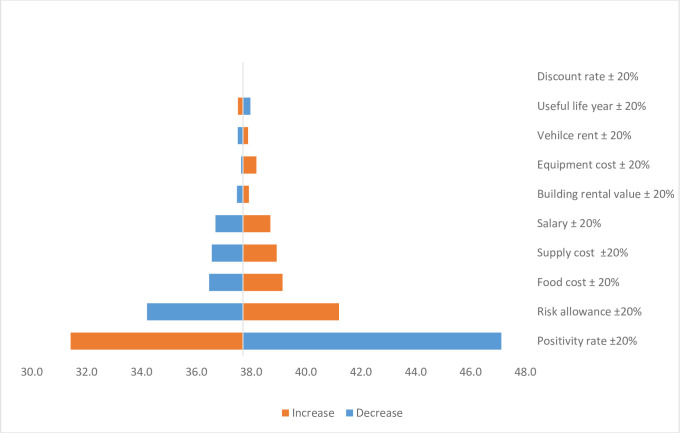
Primary and secondary data were collected to estimate the costs of COVID-19 sample collection, diagnosis, and contact tracing. A healthcare system perspective was used. We used a combination of micro-costing (bottom-up) and top-down approaches to estimate resources consumed and the unit costs of the interventions. We used available cost and outcome data between May and December 2020. The costs were classified into capital and recurrent inputs to estimate unit and total costs. We identified the cost drivers of the interventions. We reported the cost for the following outcome measures: (1) cost per sample collected, (2) cost per laboratory diagnosis, (3) cost per sample collected and laboratory diagnosis, (4) cost per contact traced, and (5) cost per COVID-19 positive test identified. We conducted one-way sensitivity analysis by varying the input parameters. All costs were reported in US dollars (USD).
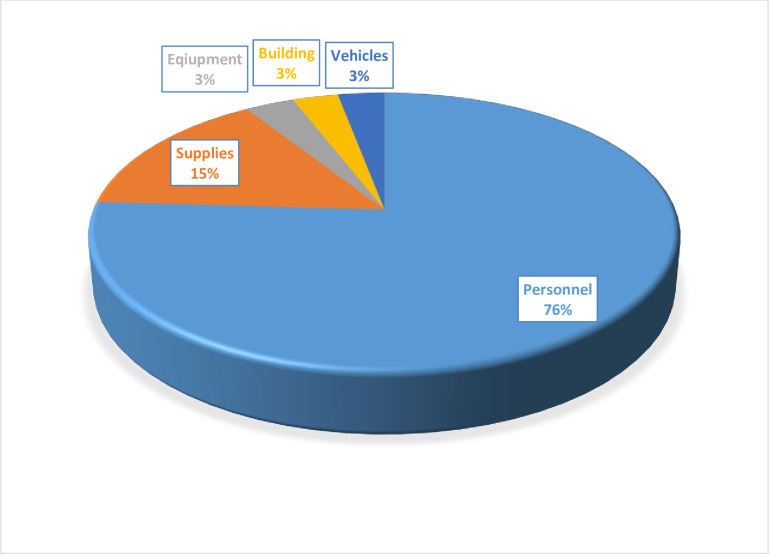
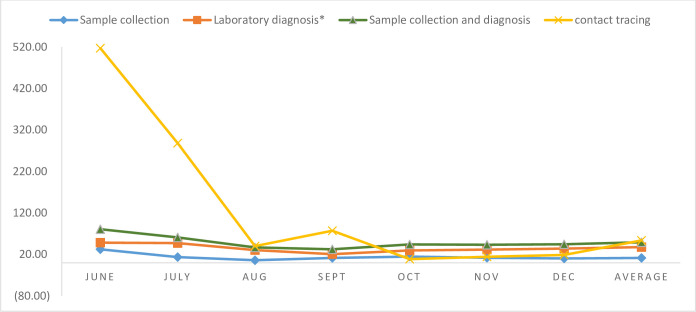
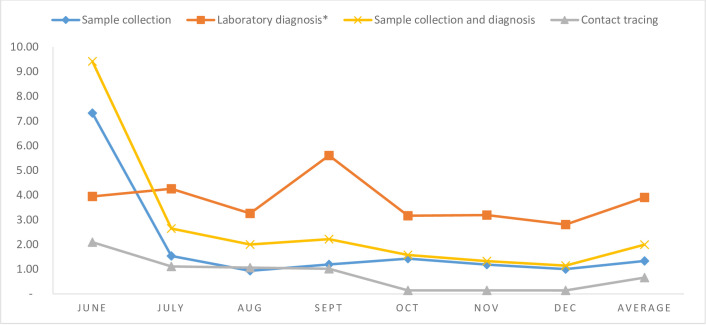
The unit cost per sample collected was USD 1.33. The unit cost of tracing a contact of an index case was USD 0.66. The unit cost of COVID-19 diagnosis, excluding the cost for sample collection was USD 3.91. The unit cost of sample collection per COVID-19 positive individual was USD 11.63. The unit cost for COVID-19 positive test through contact tracing was USD 54.00. The unit cost COVID-19 DNA PCR diagnosis for identifying COVID-19 positive individuals, excluding the sample collection and transport cost, was USD 37.70. The cost per COVID-19 positive case identified was USD 49.33 including both sample collection and laboratory diagnosis costs. Among the cost drivers, personnel cost (salary and food cost) takes the highest share for all interventions, ranging from 51-76% of the total cost.
The costs of sample collection, diagnosis, and contact tracing for COVID-19 were high given the low per capita health expenditure in Ethiopia and other low-income settings. Since the personnel cost accounts for the highest cost, decision-makers should focus on minimizing this cost when faced with pandemic-prone diseases by strengthening the health system and using digital platforms. The findings of this study can help decision-makers prioritize and allocate resources for effective public health emergency response.
埃塞俄比亚通过综合干预措施应对 COVID-19 疫情,包括非药物干预措施、检疫、检测、隔离、接触者追踪和临床管理。估算 COVID-19 防控所消耗的资源,可以为未来应对易发生疫情/大流行的疾病提供有效的决策依据。本研究旨在估算埃塞俄比亚亚的斯亚贝巴 COVID-19 样本采集、实验室诊断和接触者追踪的单位成本。
收集了初级和次级数据,以估算 COVID-19 样本采集、诊断和接触者追踪的成本。采用卫生保健系统视角。我们结合微观成本法(自下而上)和自上而下的方法来估算干预措施所消耗的资源和单位成本。我们利用 2020 年 5 月至 12 月期间可用的成本和结果数据。成本分为资本和经常性投入,以估算单位和总费用。我们确定了干预措施的成本驱动因素。我们报告了以下结果指标的成本:(1)每份样本采集的成本,(2)每份实验室诊断的成本,(3)样本采集和实验室诊断的每份成本,(4)每份接触者追踪的成本,(5)每份 COVID-19 阳性检测的成本。我们通过改变输入参数进行了单因素敏感性分析。所有成本均以美元(USD)报告。
每份样本采集的单位成本为 1.33 美元。追踪病例接触者的单位成本为 0.66 美元。COVID-19 诊断的单位成本(不包括样本采集成本)为 3.91 美元。每例 COVID-19 阳性个体的样本采集单位成本为 11.63 美元。通过接触者追踪发现 COVID-19 阳性个体的单位成本为 54.00 美元。用于确定 COVID-19 阳性个体的 COVID-19 DNA PCR 诊断的单位成本(不包括样本采集和运输成本)为 37.70 美元。包括样本采集和实验室诊断费用在内,每例 COVID-19 阳性病例的识别成本为 49.33 美元。在成本驱动因素中,人员成本(工资和食品成本)占所有干预措施总成本的 51%-76%,占比最高。
鉴于埃塞俄比亚和其他低收入国家的人均卫生支出较低,COVID-19 的样本采集、诊断和接触者追踪成本较高。由于人员成本占总成本的比例最高,决策者在应对易发生大流行的疾病时,应着眼于通过加强卫生系统和使用数字平台来最小化这一成本。本研究的结果可以帮助决策者为有效的公共卫生应急响应确定优先事项和分配资源。