Department of Molecular Genetics and Cell Biology, University of Chicago, Chicago, United States.
Elife. 2020 Nov 17;9:e56893. doi: 10.7554/eLife.56893.
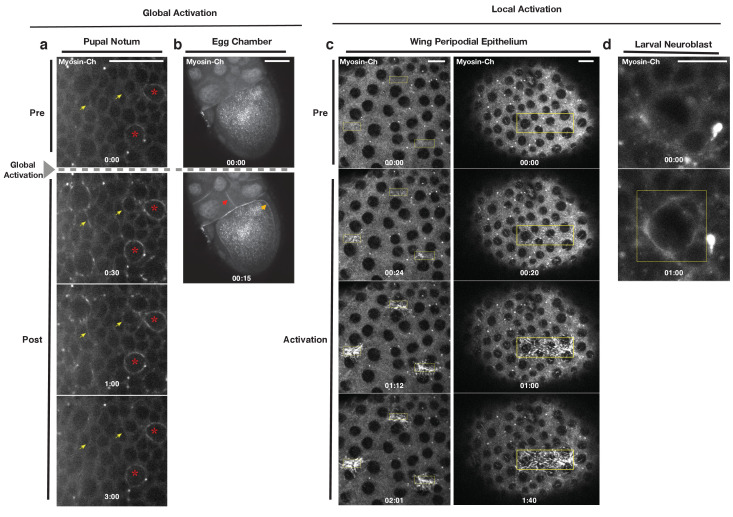
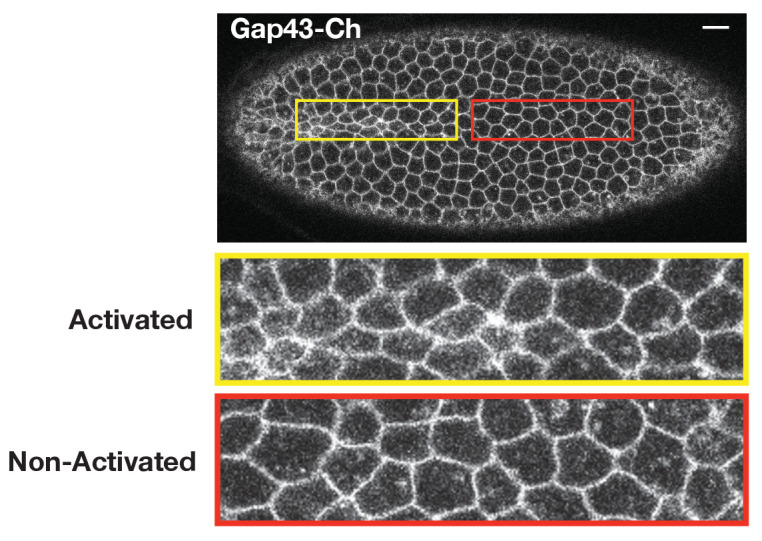
Ventral furrow formation, the first step in gastrulation, is a well-studied example of tissue morphogenesis. Rho1 is highly active in a subset of ventral cells and is required for this morphogenetic event. However, it is unclear whether spatially patterned Rho1 activity alone is sufficient to recapitulate all aspects of this morphogenetic event, including anisotropic apical constriction and coordinated cell movements. Here, using an optogenetic probe that rapidly and robustly activates Rho1 in tissues, we show that Rho1 activity induces ectopic deformations in the dorsal and ventral epithelia of embryos. These perturbations reveal substantial differences in how ventral and dorsal cells, both within and outside the zone of Rho1 activation, respond to spatially and temporally identical patterns of Rho1 activation. Our results demonstrate that an asymmetric zone of Rho1 activity is not sufficient to recapitulate ventral furrow formation and reveal that additional, ventral-specific factors contribute to the cell- and tissue-level behaviors that emerge during ventral furrow formation.
腹沟形成是原肠胚形成的第一步,是组织形态发生的一个很好的研究范例。Rho1 在一小部分腹侧细胞中高度活跃,并且是这个形态发生事件所必需的。然而,目前尚不清楚空间上有图案的 Rho1 活性是否足以重现这个形态发生事件的所有方面,包括各向异性的顶端收缩和协调的细胞运动。在这里,我们使用一种光遗传学探针,该探针可以快速而稳健地激活组织中的 Rho1,结果表明 Rho1 活性诱导了胚胎的背侧和腹侧上皮的异位变形。这些扰动揭示了腹侧和背侧细胞(无论是在 Rho1 激活区内外)对空间和时间相同的 Rho1 激活模式的反应存在显著差异。我们的结果表明,不对称的 Rho1 活性区不足以重现腹沟形成,并表明额外的、腹侧特异性的因素有助于在腹沟形成过程中出现的细胞和组织水平的行为。