Department of Mental Health, Johns Hopkins Bloomberg School of Public Health, Baltimore, MD 21205, USA.
Department of Kinesiology, University of Maryland School of Public Health, College Park, MD 20742, USA.
Soc Cogn Affect Neurosci. 2020 Dec 17;15(11):1238-1251. doi: 10.1093/scan/nsaa149.
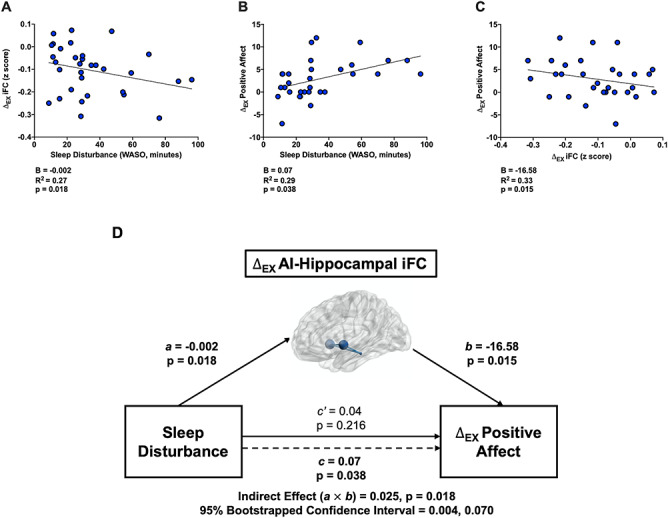
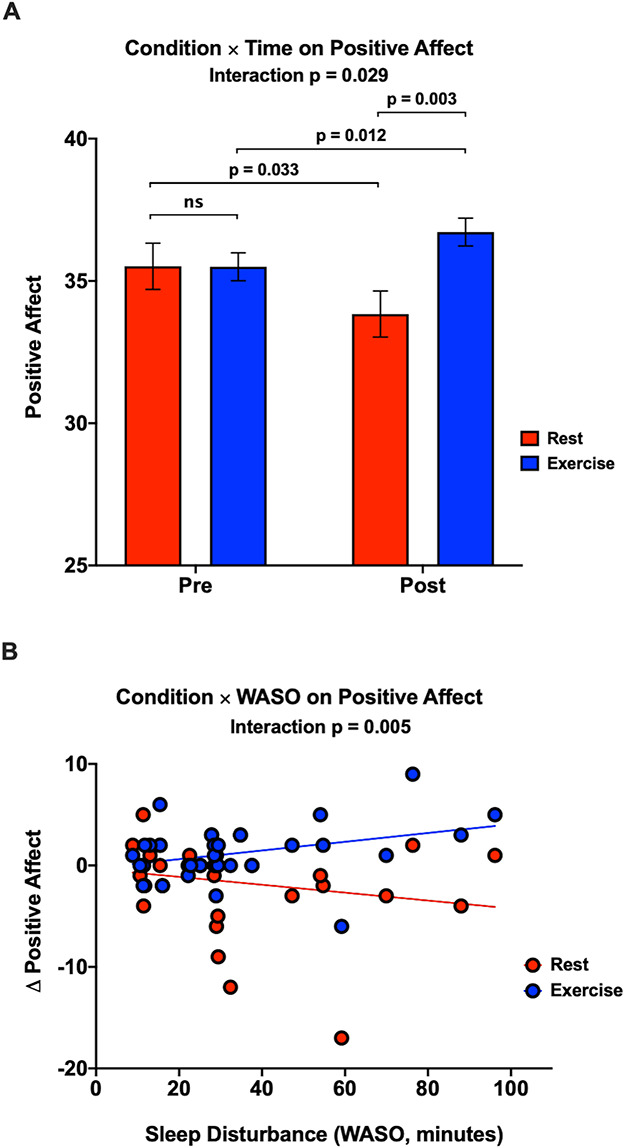
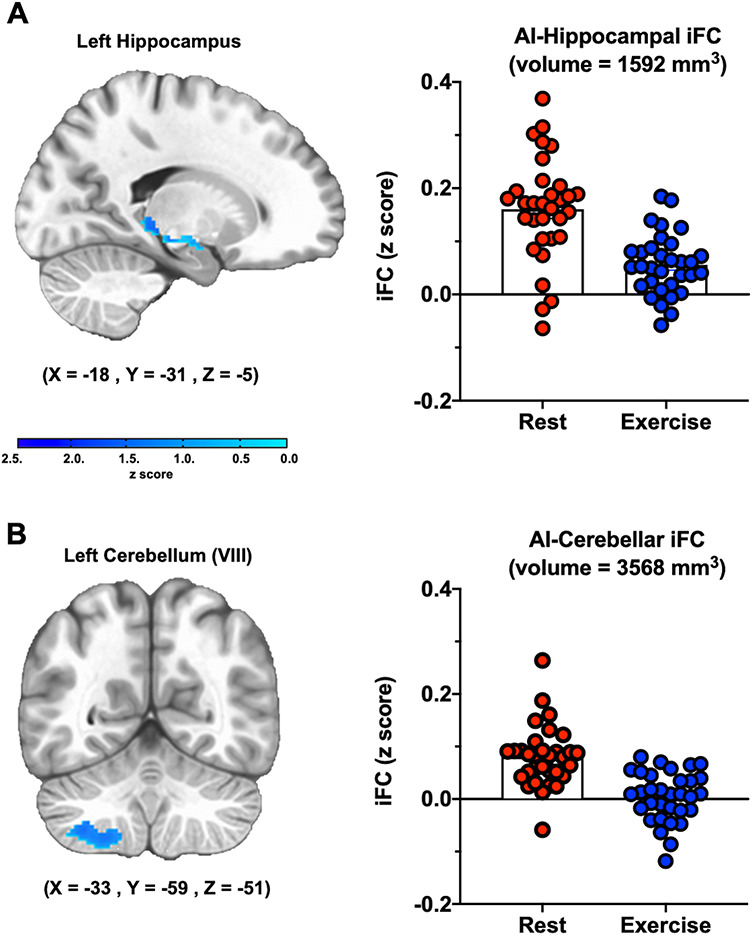
Older adults comprise the fastest growing global demographic and are at increased risk of poor mental health outcomes. Although aerobic exercise and sleep are critical to the preservation of emotional well-being, few studies have examined their combined mood-enhancing effects, or the potential neural mechanisms underlying these effects. Here, we used a randomized crossover design to test the impact of acute exercise on mood and the intrinsic functional connectivity (iFC) of the cingulo-opercular network in physically healthy older adults. Wrist actigraphy provided objective indices of sleep. Results revealed that 30 min of moderate-intensity aerobic exercise acutely enhanced positive affect (PA) and reduced iFC between the cingulo-opercular network and the hippocampus. Both effects were magnified among older adults with greater sleep disturbance. Exercise-induced changes in hippocampal iFC mediated relations between sleep disturbance and exercise-induced increases in PA. These findings provide evidence that aerobic exercise enhances mood, that it does so by altering connectivity between the anterior insula-a key hub in the cingulo-opercular network-and the hippocampus and that lower sleep quality is a stronger predictor of these effects among older adults. These observations underscore the benefits of moderate-intensity exercise-a safe and scalable behavioral intervention-and provide new clues about the neural circuitry underlying the interactive effects of sleep and exercise on mood.
老年人是全球增长最快的人群,他们面临着更高的心理健康问题风险。尽管有氧运动和睡眠对情绪健康至关重要,但很少有研究探讨它们对情绪的综合增强作用,或这些作用背后的潜在神经机制。在这里,我们使用随机交叉设计来测试急性运动对情绪的影响,以及身体健康的老年人中扣带前回-脑岛网络的内在功能连接(iFC)。腕部动作分析提供了睡眠的客观指标。结果表明,30 分钟的中等强度有氧运动可急性增强积极情绪(PA),并降低扣带前回-脑岛网络与海马体之间的 iFC。在睡眠障碍较大的老年人中,这两种效果更为明显。运动引起的海马体 iFC 变化介导了睡眠障碍与运动引起的 PA 增加之间的关系。这些发现为有氧运动增强情绪提供了证据,它通过改变前脑岛(扣带前回-脑岛网络中的一个关键枢纽)与海马体之间的连接来实现,而较低的睡眠质量是老年人中这些效果的更强预测因素。这些观察结果强调了中等强度运动的益处——一种安全且可扩展的行为干预措施,并提供了有关睡眠和运动对情绪的交互作用的神经回路的新线索。