Stem Cells & Development Unit, Institut Pasteur, Paris, France.
CNRS UMR 3738, Institut Pasteur, Paris, France.
PLoS Biol. 2020 Nov 17;18(11):e3000902. doi: 10.1371/journal.pbio.3000902. eCollection 2020 Nov.
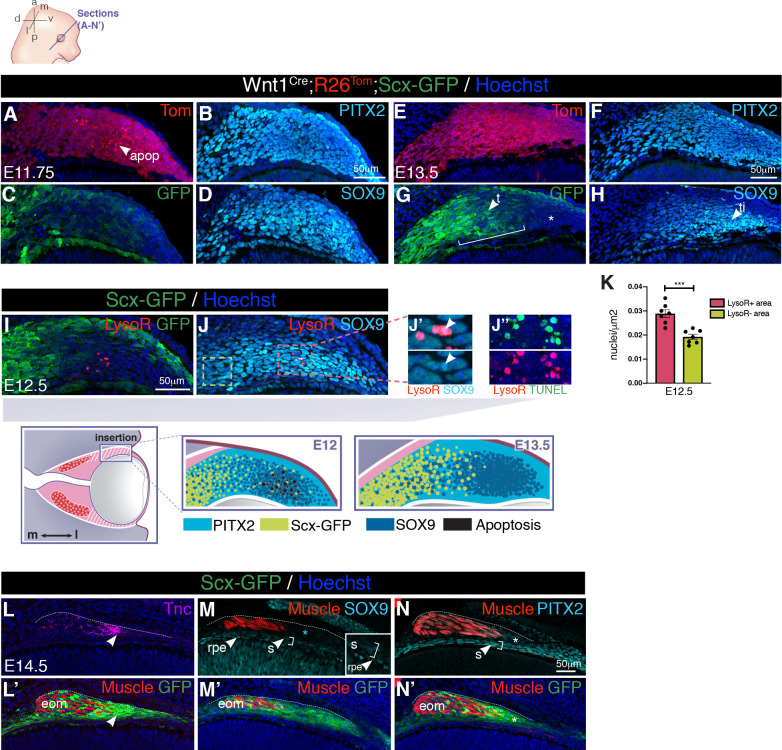
Coordinated development of muscles, tendons, and their attachment sites ensures emergence of functional musculoskeletal units that are adapted to diverse anatomical demands among different species. How these different tissues are patterned and functionally assembled during embryogenesis is poorly understood. Here, we investigated the morphogenesis of extraocular muscles (EOMs), an evolutionary conserved cranial muscle group that is crucial for the coordinated movement of the eyeballs and for visual acuity. By means of lineage analysis, we redefined the cellular origins of periocular connective tissues interacting with the EOMs, which do not arise exclusively from neural crest mesenchyme as previously thought. Using 3D imaging approaches, we established an integrative blueprint for the EOM functional unit. By doing so, we identified a developmental time window in which individual EOMs emerge from a unique muscle anlage and establish insertions in the sclera, which sets these muscles apart from classical muscle-to-bone type of insertions. Further, we demonstrate that the eyeballs are a source of diffusible all-trans retinoic acid (ATRA) that allow their targeting by the EOMs in a temporal and dose-dependent manner. Using genetically modified mice and inhibitor treatments, we find that endogenous local variations in the concentration of retinoids contribute to the establishment of tendon condensations and attachment sites that precede the initiation of muscle patterning. Collectively, our results highlight how global and site-specific programs are deployed for the assembly of muscle functional units with precise definition of muscle shapes and topographical wiring of their tendon attachments.
肌肉、肌腱及其附着部位的协调发育确保了功能性肌骨单位的出现,这些单位适应了不同物种之间多样化的解剖需求。在胚胎发生过程中,这些不同的组织是如何被塑造和功能组装的,目前还知之甚少。在这里,我们研究了眼外肌(EOM)的形态发生,EOM 是一组进化上保守的颅面肌肉,对于眼球的协调运动和视觉敏锐度至关重要。通过谱系分析,我们重新定义了与 EOM 相互作用的眶周结缔组织的细胞起源,这些组织并非如先前认为的那样完全来自神经嵴间充质。通过使用 3D 成像方法,我们建立了 EOM 功能单位的综合蓝图。通过这样做,我们确定了一个发育时间窗口,在这个时间窗口内,每个 EOM 从一个独特的肌肉原基中出现,并在巩膜上建立插入物,这使这些肌肉与经典的肌肉到骨骼类型的插入物区分开来。此外,我们证明眼球是可扩散的全反式视黄酸(ATRA)的来源,它允许 EOM 以时间和剂量依赖的方式靶向眼球。使用基因修饰小鼠和抑制剂处理,我们发现内源性局部视黄酸浓度的变化有助于腱凝聚物和附着部位的建立,这些部位先于肌肉模式的开始。总的来说,我们的结果强调了全局和特定部位的程序是如何被用于组装具有精确肌肉形状定义和其腱附着拓扑布线的肌肉功能单位的。