
常见单倍型在酒精性和非酒精性慢性胰腺炎中的作用:荟萃分析与再分析
Role of the Common Haplotype in Alcoholic and Non-Alcoholic Chronic Pancreatitis: Meta- and Re-Analyses.
作者信息
Herzig Anthony F, Génin Emmanuelle, Cooper David N, Masson Emmanuelle, Férec Claude, Chen Jian-Min
机构信息
Inserm, Univ Brest, EFS, UMR 1078, GGB, F-29200 Brest, France.
CHRU Brest, F-29200 Brest, France.
出版信息
Genes (Basel). 2020 Nov 13;11(11):1349. doi: 10.3390/genes11111349.
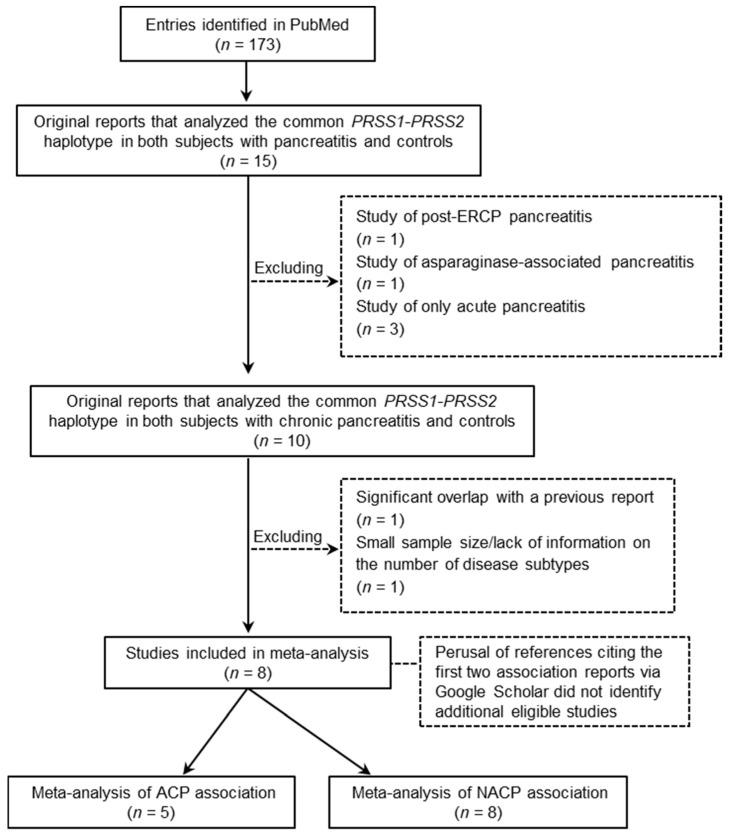
The association between a common haplotype and alcoholic chronic pancreatitis (ACP), which was revealed by the first genome-wide association study of chronic pancreatitis (CP), has been consistently replicated. However, the association with non-ACP (NACP) has been controversial. Herein, we sought to clarify this basic issue by means of an allele-based meta-analysis of currently available studies. We then used studies informative for genotype distribution to explore the biological mechanisms underlying the association data and to test for gene-environment interaction between the risk haplotype and alcohol consumption by means of a re-analysis. A literature search was conducted to identify eligible studies. A meta-analysis was performed using the Review Manager software. The association between the risk genotypes and NACP or ACP was tested for the best-fitting genetic model. Gene-environment interaction was estimated by both case-only and multinomial approaches. Five and eight studies were employed for the meta-analysis of ACP and NACP findings, respectively. The risk allele was significantly associated with both ACP (pooled odds ratio (OR) 1.67, 95% confidence interval (CI) 1.56-1.78; < 0.00001) and NACP (pooled OR 1.28, 95% CI 1.17-1.40; < 0.00001). Consistent with a dosage effect of the risk allele on / mRNA expression in human pancreatic tissue, both ACP and NACP association data were best explained by an additive genetic model. Finally, the risk haplotype was found to interact synergistically with alcohol consumption.
慢性胰腺炎(CP)的首个全基因组关联研究揭示了一种常见单倍型与酒精性慢性胰腺炎(ACP)之间的关联,该关联已得到一致验证。然而,其与非酒精性慢性胰腺炎(NACP)的关联一直存在争议。在此,我们试图通过对现有研究进行基于等位基因的荟萃分析来阐明这一基本问题。然后,我们利用提供基因型分布信息的研究来探索关联数据背后的生物学机制,并通过重新分析来检验风险单倍型与饮酒之间的基因-环境相互作用。我们进行了文献检索以确定符合条件的研究。使用Review Manager软件进行荟萃分析。针对最佳拟合遗传模型测试风险基因型与NACP或ACP之间的关联。通过病例对照法和多项分布法估计基因-环境相互作用。分别有5项和8项研究用于ACP和NACP研究结果的荟萃分析。风险等位基因与ACP(合并比值比(OR)1.67,95%置信区间(CI)1.56 - 1.78;P < 0.00001)和NACP(合并OR 1.28,95% CI 1.17 - 1.40;P < 0.00001)均显著相关。与风险等位基因对人胰腺组织中/ mRNA表达的剂量效应一致,ACP和NACP的关联数据均最好由加性遗传模型解释。最后,发现风险单倍型与饮酒之间存在协同相互作用。


 Zotero 插件