Yang Hee Won, Choi Sangchun, Song Hakyoon, Lee Min Ji, Kwon Ji Eun, Lee Han A Reum, Kim Kyuseok
Department of Emergency Medicine, Ajou University School of Medicine, Suwon 16499, Korea.
Department of Emergency Medicine, Seoul National University College of Medicine, Seoul 03080, Korea.
Life (Basel). 2020 Nov 15;10(11):283. doi: 10.3390/life10110283.
The effects of hyperbaric oxygen therapy (HBOT) in sepsis remain unclear. This study evaluated its effects on acute liver injury and survival in a rat model.
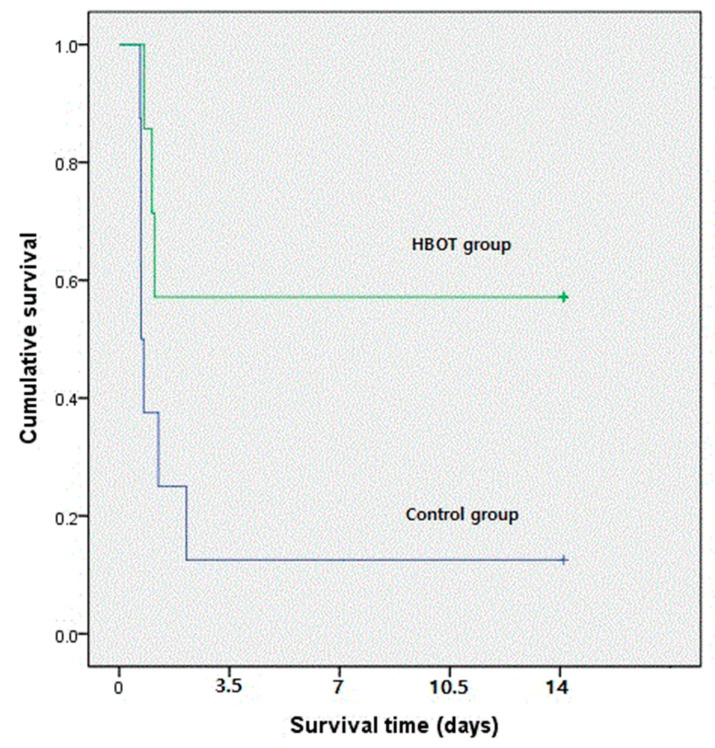
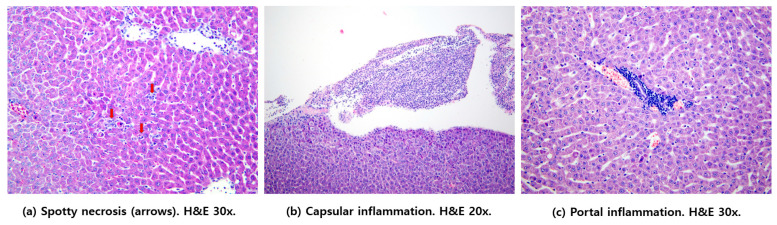
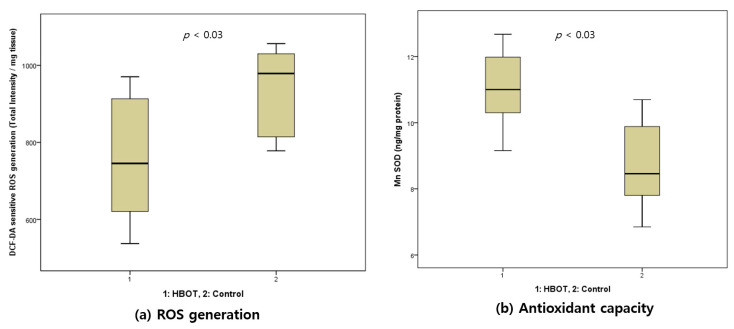
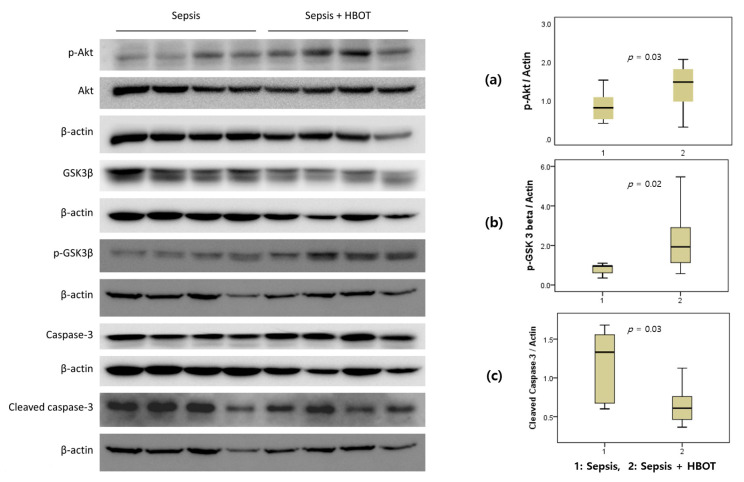
Cecal slurry peritonitis was induced in male rats, which were then randomly allocated into the HBOT and control groups. In the survival experiment, six 90 min HBOT sessions (2.6 atmospheres absolute 100% oxygen) were performed over 48 h; the survival rate was determined 14 days after sepsis induction. In the acute liver injury experiment, three HBOT sessions were performed, followed by liver and plasma harvesting, 24 h after sepsis induction. Serum levels of alanine aminotransferase (ALT), interleukin (IL)-6, and IL-10 were measured, and the hepatic injury scores were determined. Reactive oxygen species (ROS) generation was detected by 2',7'-dihydrodichlorofluorescein diacetate (H2DCF-DA) assay. Western blot assays assessed protein kinase B (Akt), phosphorylated-Akt (p-Akt), glycogen synthase kinase (GSK)-3β, phosphorylated-GSK-3β, and cleaved caspase-3 levels.
Survival in the HBOT group (57.1%) was significantly higher than that in the controls (12.5%, = 0.029), whereas IL-6, IL-10, and ALT levels were significantly lower in the HBOT group. The ROS generation was significantly inhibited to a greater extent in the HBOT group than in the control group. Additionally, in the HBOT group, the p-Akt and p-GSK-3β increased significantly and cleaved caspase-3 levels decreased significantly.
HBOT showed a beneficial effect on acute liver injury and rat survival by enhancing the Akt signaling pathway and decreasing apoptosis.
高压氧疗法(HBOT)在脓毒症中的作用仍不明确。本研究在大鼠模型中评估了其对急性肝损伤和生存的影响。
对雄性大鼠诱导盲肠粪便性腹膜炎,然后将其随机分为高压氧治疗组和对照组。在生存实验中,在48小时内进行6次90分钟的高压氧治疗(绝对压力2.6个大气压,100%氧气);在诱导脓毒症14天后测定生存率。在急性肝损伤实验中,诱导脓毒症24小时后进行3次高压氧治疗,随后采集肝脏和血浆。测定血清丙氨酸转氨酶(ALT)、白细胞介素(IL)-6和IL-10水平,并确定肝损伤评分。通过2',7'-二氢二氯荧光素二乙酸酯(H2DCF-DA)测定法检测活性氧(ROS)的产生。蛋白质印迹分析评估蛋白激酶B(Akt)、磷酸化Akt(p-Akt)、糖原合酶激酶(GSK)-3β、磷酸化GSK-3β和裂解的半胱天冬酶-3水平。
高压氧治疗组的生存率(57.1%)显著高于对照组(12.5%,P = 0.029),而高压氧治疗组的IL-6、IL-10和ALT水平显著较低。与对照组相比,高压氧治疗组的ROS产生受到更显著的抑制。此外,在高压氧治疗组中,p-Akt和p-GSK-3β显著增加,裂解的半胱天冬酶-3水平显著降低。
高压氧疗法通过增强Akt信号通路和减少细胞凋亡,对急性肝损伤和大鼠生存显示出有益作用。