Pedersen Casper Friis, Andersen Mikkel Østerheden, Carreon Leah Yacat, Eiskjær Søren
298597Lillebaelt Hospital, Middelfart, Denmark.
University of Southern Denmark, Odense, Denmark.
Global Spine J. 2022 Jun;12(5):866-876. doi: 10.1177/2192568220967643. Epub 2020 Nov 18.
Retrospective/prospective study.
Models based on preoperative factors can predict patients' outcome at 1-year follow-up. This study measures the performance of several machine learning (ML) models and compares the results with conventional methods.
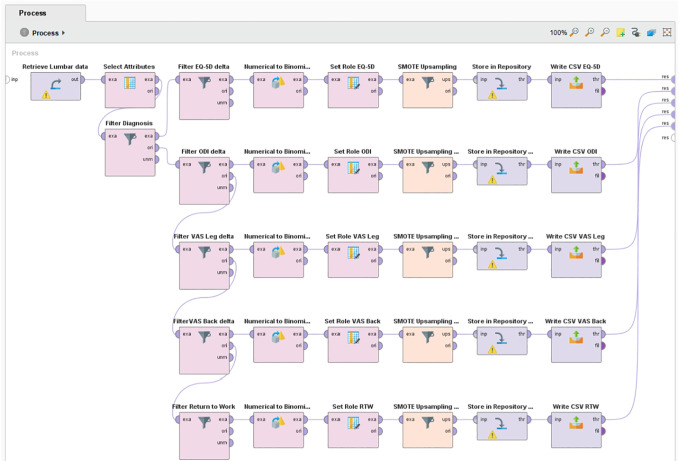
Inclusion criteria were patients who had lumbar disc herniation (LDH) surgery, identified in the Danish national registry for spine surgery. Initial training of models included 16 independent variables, including demographics and presurgical patient-reported measures. Patients were grouped by reaching minimal clinically important difference or not for EuroQol, Oswestry Disability Index, Visual Analog Scale (VAS) Leg, and VAS Back and by their ability to return to work at 1 year follow-up. Data were randomly split into training, validation, and test sets by 50%/35%/15%. Deep learning, decision trees, random forest, boosted trees, and support vector machines model were trained, and for comparison, multivariate adaptive regression splines (MARS) and logistic regression models were used. Model fit was evaluated by inspecting area under the curve curves and performance during validation.
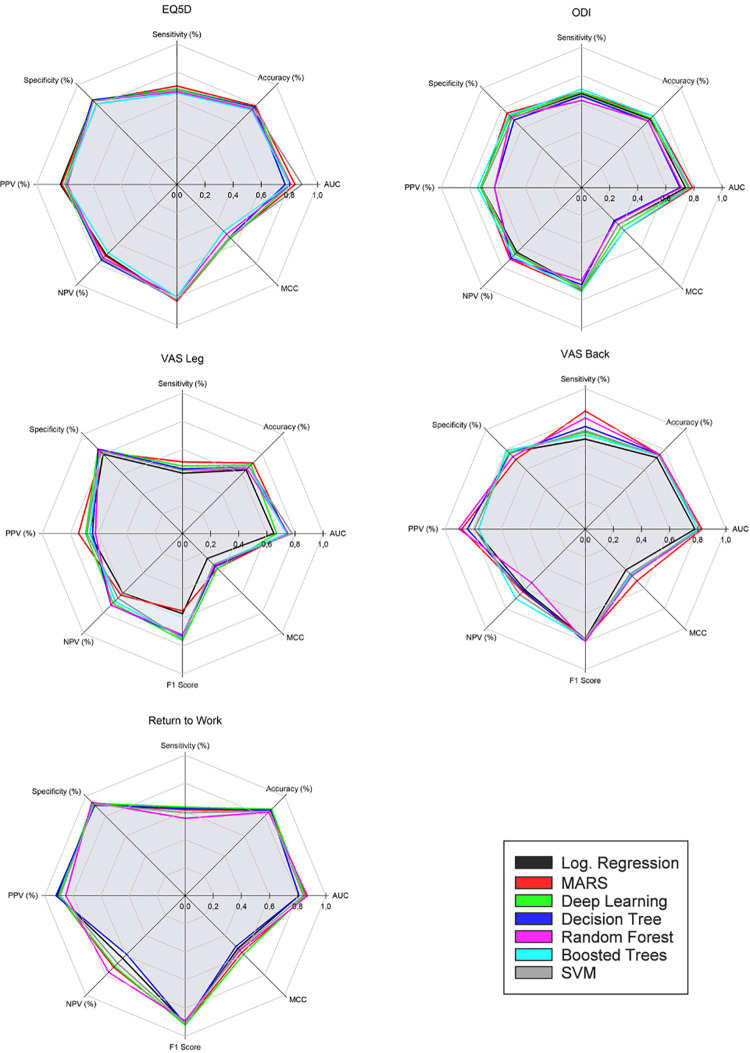
Seven models were arrived at. Classification errors were within ±1% to 4% SD across validation folds. ML did not yield superior performance compared with conventional models. MARS and deep learning performed consistently well. Discrepancy was greatest among VAS Leg models.
Five predictive ML and 2 conventional models were developed, predicting improvement for LDH patients at the 1-year follow-up. We demonstrate that it is possible to build an ensemble of models with little effort as a starting point for further model optimization and selection.
回顾性/前瞻性研究。
基于术前因素的模型可预测患者1年随访时的预后。本研究评估了几种机器学习(ML)模型的性能,并将结果与传统方法进行比较。
纳入标准为在丹麦国家脊柱手术登记处确定接受过腰椎间盘突出症(LDH)手术的患者。模型的初始训练包括16个自变量,包括人口统计学和术前患者报告的指标。患者根据是否达到欧洲生活质量量表(EuroQol)、奥斯威斯功能障碍指数、视觉模拟量表(VAS)腿部评分和VAS背部评分的最小临床重要差异,以及在1年随访时恢复工作的能力进行分组。数据按50%/35%/15%随机分为训练集、验证集和测试集。对深度学习、决策树、随机森林、增强树和支持向量机模型进行了训练,为作比较,还使用了多元自适应回归样条(MARS)和逻辑回归模型。通过检查曲线下面积和验证期间的性能来评估模型拟合。
得到了7个模型。各验证折的分类误差在±1%至4%标准差范围内。与传统模型相比,ML并未产生更优的性能。MARS和深度学习表现一直良好。VAS腿部模型之间的差异最大。
开发了5种预测性ML模型和2种传统模型,用于预测LDH患者1年随访时的改善情况。我们证明,作为进一步模型优化和选择的起点,可以轻松构建一组模型。