Gueriau Pierre, Lamsdell James C, Wogelius Roy A, Manning Phillip L, Egerton Victoria M, Bergmann Uwe, Bertrand Loïc, Denayer Julien
Institute of Earth Sciences, University of Lausanne, Géopolis, CH-1015 Lausanne, Switzerland.
Université Paris-Saclay, CNRS, ministère de la Culture, UVSQ, MNHN, Institut photonique d'analyse non-destructive européen des matériaux anciens, 91192, Saint-Aubin, France.
R Soc Open Sci. 2020 Oct 21;7(10):201037. doi: 10.1098/rsos.201037. eCollection 2020 Oct.
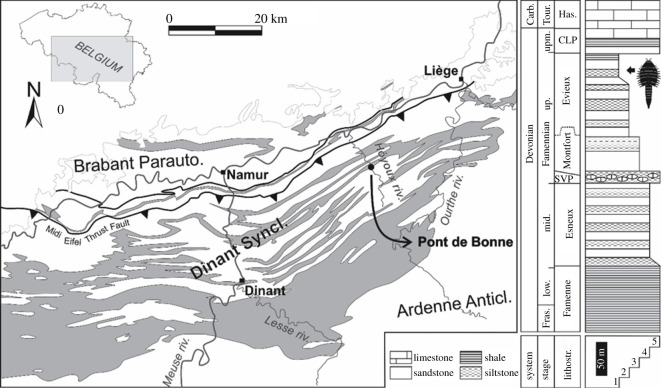
Myriapods were, together with arachnids, the earliest animals to occupy terrestrial ecosystems, by at least the Silurian. The origin of myriapods and their land colonization have long remained puzzling until euthycarcinoids, an extinct group of aquatic arthropods considered amphibious, were shown to be stem-group myriapods, extending the lineage to the Cambrian and evidencing a marine-to-terrestrial transition. Although possible respiratory structures comparable to the air-breathing tracheal system of myriapods are visible in several euthycarcinoids, little is known about the mechanism by which they respired. Here, we describe a new euthycarcinoid from Upper Devonian alluvio-lagoonal deposits of Belgium. Synchrotron-based elemental X-ray analyses were used to extract all available information from the only known specimen. Sulfur X-ray fluorescence (XRF) mapping and spectroscopy unveil sulfate evaporation stains, spread over the entire slab, suggestive of a very shallow-water to the terrestrial environment prior to burial consistent with an amphibious lifestyle. Trace metal XRF mapping reveals a pair of ventral spherical cavities or chambers on the second post-abdominal segment that do not compare to any known feature in aquatic arthropods, but might well play a part in air-breathing. Our data provide additional support for amphibious lifestyle in euthycarcinoids and show that different respiratory strategies were used during the marine-to-terrestrial transition in the myriapod lineage.
至少从志留纪起,多足动物就与蛛形纲动物一起,成为最早占据陆地生态系统的动物。多足动物的起源及其向陆地的殖民化长期以来一直令人困惑,直到类尤卡螃蟹(一种已灭绝的被认为是两栖的水生节肢动物群体)被证明是多足动物的干群,将谱系追溯到寒武纪,并证明了从海洋到陆地的转变。尽管在几种类尤卡螃蟹中可以看到与多足动物的空气呼吸气管系统类似的可能的呼吸结构,但对于它们的呼吸机制却知之甚少。在这里,我们描述了一种来自比利时上泥盆统冲积泻湖沉积物的新类尤卡螃蟹。基于同步加速器的元素X射线分析被用于从唯一已知的标本中提取所有可用信息。硫X射线荧光(XRF)映射和光谱分析揭示了遍布整个石板的硫酸盐蒸发痕迹,这表明在埋葬之前是从非常浅的水域到陆地环境,这与两栖生活方式一致。痕量金属XRF映射揭示了腹部后第二节上有一对腹侧球形腔或室,这与水生节肢动物的任何已知特征都不同,但很可能在空气呼吸中起作用。我们的数据为类尤卡螃蟹的两栖生活方式提供了额外的支持,并表明在多足动物谱系从海洋到陆地的转变过程中使用了不同的呼吸策略。