Lozano-Fernandez Jesus, Tanner Alastair R, Puttick Mark N, Vinther Jakob, Edgecombe Gregory D, Pisani Davide
School of Biological Sciences, University of Bristol, Bristol, United Kingdom.
School of Earth Sciences, University of Bristol, Bristol, United Kingdom.
Front Genet. 2020 Mar 11;11:182. doi: 10.3389/fgene.2020.00182. eCollection 2020.
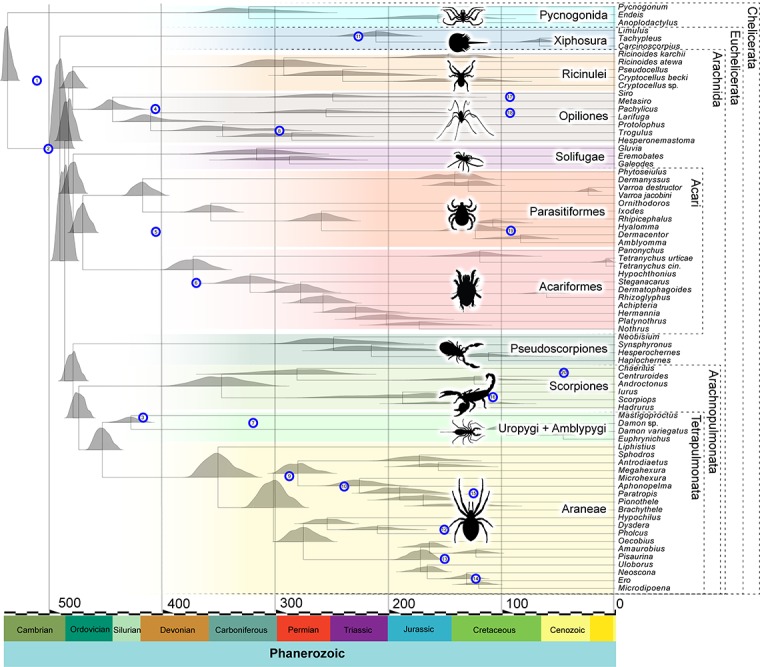
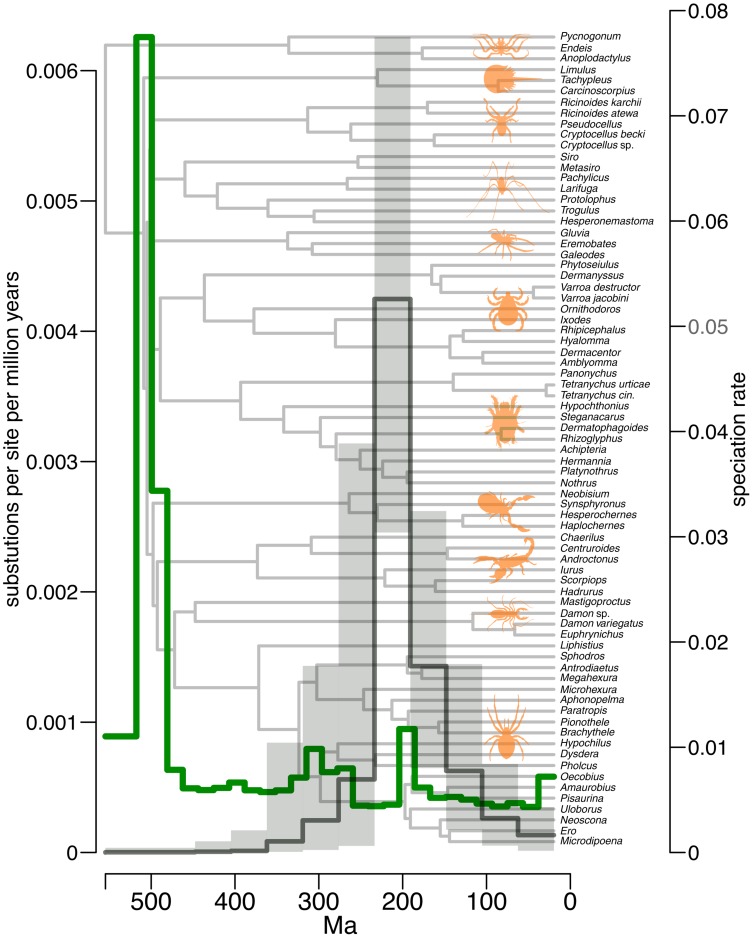
Understanding the temporal context of terrestrialization in chelicerates depends on whether terrestrial groups, the traditional Arachnida, have a single origin and whether or not horseshoe crabs are primitively or secondarily marine. Molecular dating on a phylogenomic tree that recovers arachnid monophyly, constrained by 27 rigorously vetted fossil calibrations, estimates that Arachnida originated during the Cambrian or Ordovician. After the common ancestor colonized the land, the main lineages appear to have rapidly radiated in the Cambrian-Ordovician boundary interval, coinciding with high rates of molecular evolution. The highest rates of arachnid diversification are detected between the Permian and Early Cretaceous. A pattern of ancient divergence estimates for terrestrial arthropod groups in the Cambrian while the oldest fossils are Silurian (seen in both myriapods and arachnids) is mirrored in the molecular and fossil records of land plants. We suggest the discrepancy between molecular and fossil evidence for terrestrialization is likely driven by the extreme sparseness of terrestrial sediments in the rock record before the late Silurian.
了解螯肢动物陆地化的时间背景取决于陆地类群(传统的蛛形纲)是否有单一的起源,以及鲎是原始海洋生物还是次生海洋生物。在一棵恢复蛛形纲单系性的系统发育树上进行分子定年,并受到27个经过严格审查的化石校准的约束,估计蛛形纲起源于寒武纪或奥陶纪。在共同祖先殖民陆地之后,主要谱系似乎在寒武纪 - 奥陶纪边界区间迅速辐射,这与分子进化的高速度相吻合。蛛形纲多样化的最高速率出现在二叠纪和早白垩世之间。寒武纪陆地节肢动物类群的古老分歧估计模式,而最古老的化石是志留纪的(在多足类和蛛形纲中都有),这在陆地植物的分子和化石记录中也有体现。我们认为,陆地化的分子证据和化石证据之间的差异可能是由志留纪晚期之前岩石记录中陆地沉积物的极度稀少所驱动的。