Hobusch Gerhard M, Döring Kevin, Brånemark Rickard, Windhager Reinhard
Medical University of Vienna, Department of Orthopaedics and Trauma Surgery, Vienna, Austria.
Gothenburg University, Gothenburg, Sweden.
EFORT Open Rev. 2020 Oct 26;5(10):724-741. doi: 10.1302/2058-5241.5.190070. eCollection 2020 Oct.
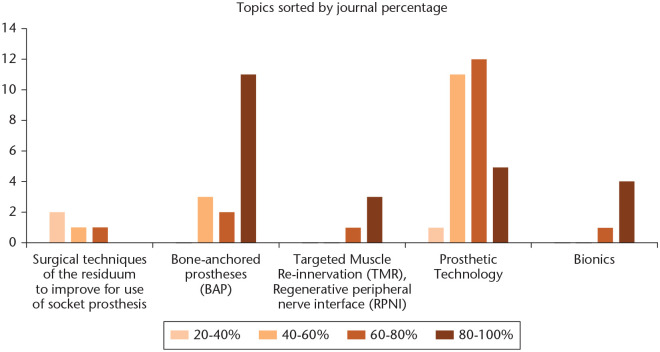
Bone-anchored implants give patients with unmanageable stump problems hope for drastic improvements in function and quality of life and are therefore increasingly considered a viable solution for lower-limb amputees and their orthopaedic surgeons, despite high infection rates.Regarding diversity and increasing numbers of implants worldwide, efforts are to be supported to arrange an international bone-anchored implant register to transparently overview pros and cons.Due to few, but high-quality, articles about the beneficial effects of targeted muscle innervation (TMR) and regenerative peripheral nerve interface (RPNI), these surgical techniques ought to be directly transferred into clinical protocols, observations and routines.Bionics of the lower extremity is an emerging cutting-edge technology. The main goal lies in the reduction of recognition and classification errors in changes of ambulant modes. Agonist-antagonist myoneuronal interfaces may be a most promising start in controlling of actively powered ankle joints.As advanced amputation surgical techniques are becoming part of clinical routine, the development of financing strategies besides medical strategies ought to be boosted, leading to cutting-edge technology at an affordable price.Microprocessor-controlled components are broadly available, and amputees do see benefits. Devices from different manufacturers differ in gait kinematics with huge inter-individual varieties between amputees that cannot be explained by age. Active microprocessor-controlled knees/ankles (A-MPK/As) might succeed in uneven ground-walking. Patients ought to be supported to receive appropriate prosthetic components to reach their everyday goals in a desirable way.Increased funding of research in the field of prosthetic technology could enhance more high-quality research in order to generate a high level of evidence and to identify individuals who can profit most from microprocessor-controlled prosthetic components. Cite this article: 2020;5:724-741. DOI: 10.1302/2058-5241.5.190070.
骨锚式植入物为残肢问题难以处理的患者带来了功能和生活质量大幅改善的希望,因此尽管感染率很高,但越来越被视为下肢截肢者及其整形外科医生的可行解决方案。鉴于全球植入物种类多样且数量不断增加,应支持 efforts 建立一个国际骨锚式植入物登记册,以透明地概述利弊。由于关于靶向肌肉神经支配(TMR)和再生外周神经接口(RPNI)的有益效果的文章虽少但质量高,这些手术技术应直接纳入临床方案、观察和常规操作中。下肢生物仿生学是一项新兴的前沿技术。主要目标在于减少步行模式变化中的识别和分类错误。激动剂 - 拮抗剂肌神经接口可能是控制主动动力踝关节最有前景的开端。随着先进的截肢手术技术成为临床常规操作的一部分,除了医疗策略外,还应推动融资策略的发展,以实现价格亲民的前沿技术。微处理器控制的组件广泛可得,截肢者也确实从中受益。不同制造商的设备在步态运动学方面存在差异,截肢者之间个体差异巨大,无法用年龄来解释。主动微处理器控制的膝盖/脚踝(A - MPK/As)在不平地面行走时可能会成功。应支持患者获得合适的假肢组件,以理想的方式实现日常目标。增加对假肢技术领域研究的资金投入可以加强更多高质量的研究,以产生高水平的证据,并确定能从微处理器控制的假肢组件中获益最大的个体。引用本文:2020;5:724 - 741。DOI: 10.1302/2058 - 5241.5.190070。
原文中“efforts”未明确含义,暂保留原文。