Sheehan Connor M, Walsemann Katrina M, Ailshire Jennifer A
T. Denny School of Social and Family Dynamics, Arizona State University, USA.
School of Public Policy, University of Maryland, College Park, USA.
SSM Popul Health. 2020 Nov 2;12:100685. doi: 10.1016/j.ssmph.2020.100685. eCollection 2020 Dec.
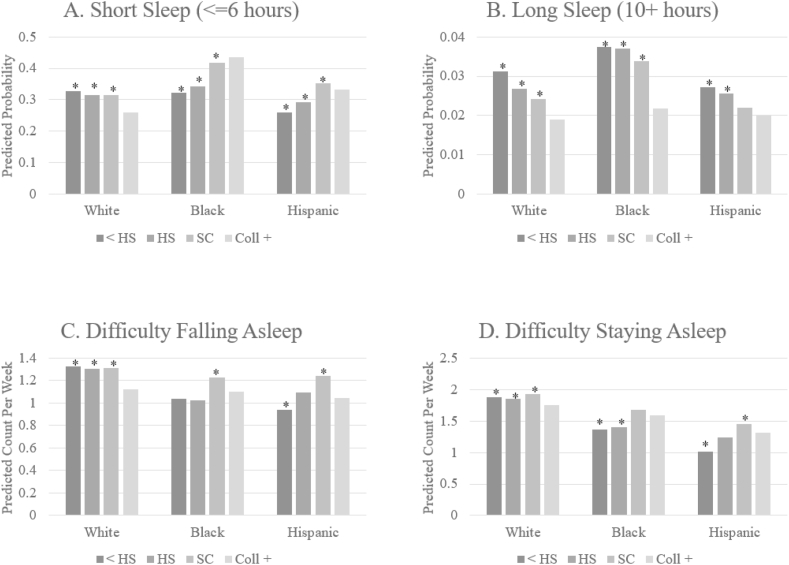
At the population level, those with more education tend to report better sleep, mirroring the education gradient found in other health outcomes. But research has shown that higher educational attainment does not always confer the same health benefits for Non-Hispanic Black (Black) and Hispanic adults as it does for Non-Hispanic White (White) adults. It is therefore possible that the educational gradient in sleep varies across racial/ethnic groups in the United States. Using the 2004-2018 National Health Interview Survey (N = 356,048), we examined differences in self-reported sleep duration and sleep quality by level of educational attainment and race/ethnicity. Utilizing multinomial (sleep duration) and negative binomial (times in the past week with difficulty falling asleep and staying asleep) regression models, we found that, compared to their less educated counterparts, college or more educated Whites were more likely to report ideal sleep compared to short or long sleep, and also reported fewer times with difficulty falling or staying asleep. The education-sleep association was generally reversed for Black and Hispanic adults, with the worst sleep being reported by those with college-level education. These patterns remained after adjusting for health behaviors, health outcomes, and socioeconomic status. Our study suggests that education does not yield the same protective benefit for sleep among Black and Hispanic adults as it does for White adults, and that highly educated Black and Hispanic adults in particular experience a sleep disadvantage. The differential education gradient in sleep may, therefore, be an important factor underlying current racial and ethnic health disparities.
在人群层面,受教育程度较高的人往往报告睡眠质量更好,这与在其他健康结果中发现的教育梯度情况相符。但研究表明,高等教育程度并不总能为非西班牙裔黑人(黑人)和西班牙裔成年人带来与非西班牙裔白人(白人)成年人相同的健康益处。因此,在美国,睡眠方面的教育梯度可能因种族/族裔群体而异。利用2004 - 2018年全国健康访谈调查(N = 356,048),我们研究了按教育程度和种族/族裔划分的自我报告睡眠时长和睡眠质量的差异。通过使用多项(睡眠时长)和负二项式(过去一周难以入睡和难以保持睡眠的次数)回归模型,我们发现,与受教育程度较低的同龄人相比,大学学历或更高学历的白人相比于睡眠过短或过长,更有可能报告理想睡眠,并且报告难以入睡或难以保持睡眠的次数也更少。对于黑人和西班牙裔成年人,教育与睡眠的关联通常相反,大学学历的人报告的睡眠最差。在对健康行为、健康结果和社会经济地位进行调整后,这些模式依然存在。我们的研究表明,教育对黑人和西班牙裔成年人睡眠的保护作用与对白人成年人的不同,尤其是高学历的黑人和西班牙裔成年人存在睡眠劣势。因此,睡眠方面的教育梯度差异可能是当前种族和族裔健康差距的一个重要潜在因素。