Carroll Christopher L, Szakmany Tamas, Dangayach Neha S, DePriest Ashley, Duprey Matthew S, Kaul Viren, Kleinpell Ruth, Tegtmeyer Ken, Kudchadkar Sapna R
Division of Critical Care, Connecticut Children's, Hartford, CT.
Critical Care Directorate, Aneurin Bevan University Health Board, Royal Gwent Hospital, Newport, Gwent, United Kingdom.
Crit Care Explor. 2020 Nov 12;2(11):e0252. doi: 10.1097/CCE.0000000000000252. eCollection 2020 Nov.
Since 2014, the Society of Critical Care Medicine has encouraged "live-tweeting" through the use of specific hashtags at each annual Critical Care Congress. We describe how the digital footprint of the Society of Critical Care Medicine Congress on Twitter has evolved at a time when social media use at conferences is becoming increasingly popular.
We used Symplur Signals (Symplur LLC, Pasadena, CA) to track all tweets containing the Society of Critical Care Medicine Congress hashtag for each annual meeting between 2014 and 2020. We collected data on the number of tweets, tweet characteristics, and impressions (i.e., potential views) for each year and data on the characteristics of the top 100 most actively tweeting users of that Congress.
Twitter.
Users tweeting with the Critical Care Congress hashtag.
Not applicable.
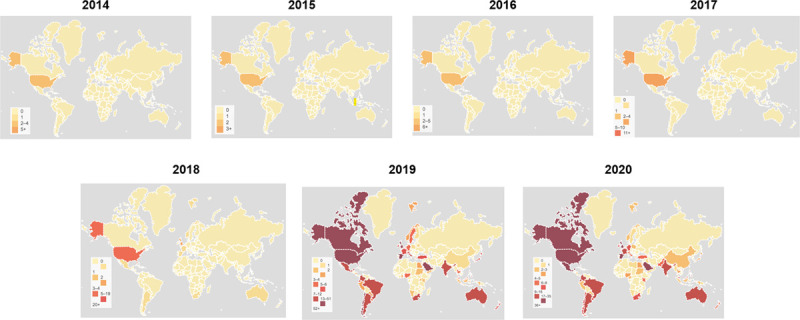
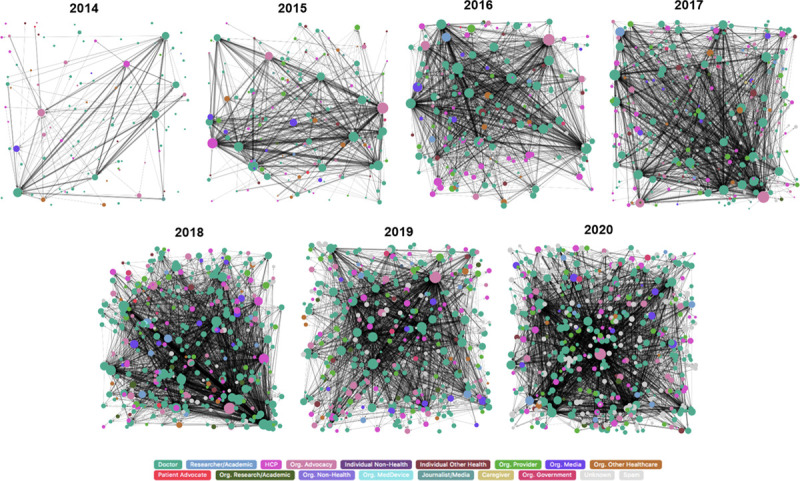
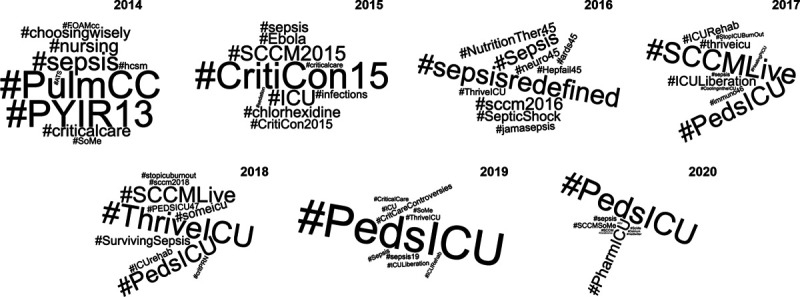
The Critical Care Congress digital footprint grew substantially from 2014 to 2020. The 2014 Critical Care Congress included 1,629 tweets by 266 users, compared with 29,657 tweets by 3,551 participants in 2020; average hourly tweets increased from 9.7 to 177. The percentage of tweets with mentions of other users and tweets with visual media increased. Users attending the conference were significantly more likely to compose original tweets, whereas those tweeting from afar were more likely to retweet Critical Care Congress content. There was a yearly increase in content-specific hashtags used in conjunction with Critical Care Congress hashtags ( = 429 in 2014 to = 22,272 in 2020), most commonly related to pediatrics (18% of all hashtags), mobility/rehab (9%), sepsis (7%) social media (6%), and ICU burnout (1%).
There has been significant growth in live-tweeting at the Critical Care Congress, along with the increased use of content-specific hashtags and visual media. This digital footprint is largely driven by a proportion of highly engaged users. As medical conferences transition to completely or partially online platforms, understanding of the digital footprint is crucial for success.
自2014年以来,危重病医学会鼓励在每年的危重病大会上通过使用特定的主题标签进行“现场发推”。我们描述了在会议上使用社交媒体越来越流行的时代,危重病医学会大会在推特上的数字足迹是如何演变的。
我们使用Symplur Signals(Symplur有限责任公司,加利福尼亚州帕萨迪纳)来追踪2014年至2020年期间每次年会中包含危重病医学会大会主题标签的所有推文。我们收集了每年推文数量、推文特征和展示量(即潜在浏览量)的数据,以及该大会最活跃的100名发推用户的特征数据。
推特。
使用危重病大会主题标签发推的用户。
不适用。
从2014年到2020年,危重病大会的数字足迹大幅增长。2014年的危重病大会有266名用户发布了1629条推文,而2020年有3551名参与者发布了29657条推文;平均每小时推文数量从9.7条增加到177条。提及其他用户的推文和带有视觉媒体的推文的比例有所增加。参会用户更有可能撰写原创推文,而那些远程发推的用户更有可能转发危重病大会的内容。与危重病大会主题标签一起使用的特定内容主题标签每年都在增加(从2014年的429个增加到2020年的22272个),最常见的与儿科(占所有主题标签的18%)、移动性/康复(9%)、脓毒症(7%)、社交媒体(6%)和重症监护室倦怠(1%)相关。
危重病大会上的现场发推有显著增长,同时特定内容主题标签和视觉媒体的使用也有所增加。这种数字足迹在很大程度上是由一部分高度参与的用户推动的。随着医学会议向完全或部分在线平台转变,了解数字足迹对会议成功至关重要。