Bristol Medical School, University of Bristol and NIHR Bristol Biomedical Research Centre, University Hospitals Bristol and Weston NHS Foundation Trust and the University of Bristol, Bristol, UK.
Bristol Medical School, University of Bristol, Bristol, UK.
Arthritis Care Res (Hoboken). 2022 May;74(5):790-798. doi: 10.1002/acr.24516. Epub 2022 Mar 16.
To describe the screening and recruitment process of a randomized trial and evaluate associations with knee pain and function 3 months after total knee replacement (TKR).
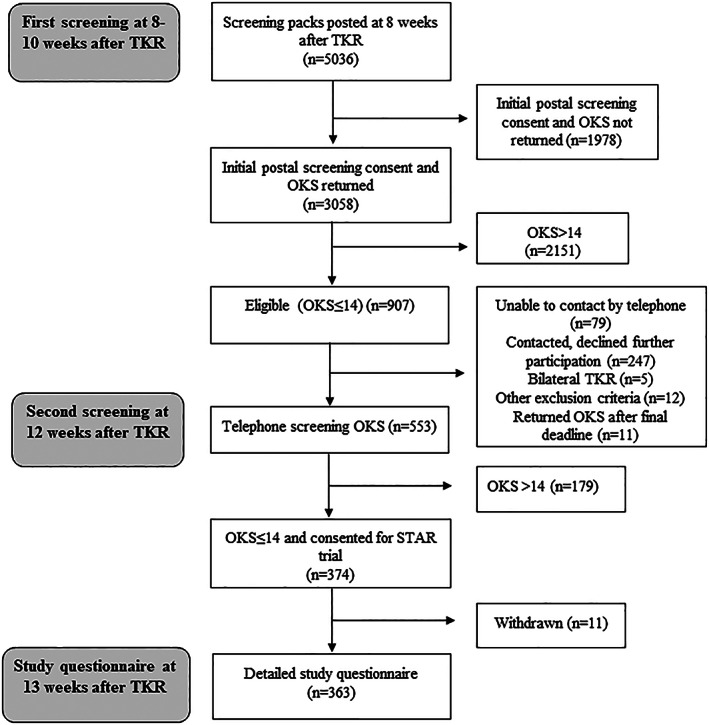
In order to screen for a multicenter trial, a total of 5,036 patients were sent the Oxford Knee Score (OKS) questionnaire 10 weeks post-TKR. Patients who reported pain in their replaced knee (score of ≤14 on the OKS pain component) completed a second OKS questionnaire 12 weeks post-TKR. Those patients who were still experiencing pain 12 weeks post-TKR completed a detailed questionnaire 13 weeks post-TKR. These data were used to characterize pain in a cross-sectional analysis. Multivariable regression was performed in order to identify factors associated with pain and function at 13 weeks post-TKR.
We received OKS questionnaires from 3,058 of 5,063 TKR patients (60%), and 907 of the 3,058 (30%) reported pain in their replaced knee 10 weeks post-TKR. By 12 weeks, 179 of 553 patients (32%) reported improved pain (score of >14 on the OKS pain component). At 13 weeks, 192 of 363 patients (53%) who completed a detailed questionnaire reported neuropathic pain, 94 of 362 (26%) reported depression symptoms, and 95 of 363 (26%) anxiety symptoms. More severe pain at 13 weeks postoperatively was associated with poorer general health, poorer physical health, more pain worry, and lower satisfaction with surgery outcome. More severe functional limitation was associated with higher levels of depression, more pain worry, lower satisfaction with surgery outcome, and higher pain acceptance.
Screening after TKR identified individuals with pain. We identified several potential targets (physical and mental health outcomes, acceptance of pain, and quality of life) for tailored intervention to improve outcomes for patients. Future trials of multidisciplinary interventions warranted.
描述一项随机试验的筛选和招募过程,并评估其与全膝关节置换术(TKR)后 3 个月膝关节疼痛和功能的关系。
为了筛选一项多中心试验,共向 5036 例 TKR 患者发送了牛津膝关节评分(OKS)问卷,在 TKR 后 10 周。报告更换膝关节疼痛(OKS 疼痛部分评分≤14)的患者在 TKR 后 12 周完成第二次 OKS 问卷。在 TKR 后 12 周仍有疼痛的患者在 TKR 后 13 周完成详细问卷。这些数据用于横断面分析疼痛特征。进行多变量回归以确定与 TKR 后 13 周疼痛和功能相关的因素。
我们收到了 5063 例 TKR 患者中的 3058 例(60%)的 OKS 问卷,其中 3058 例中的 907 例(30%)在 TKR 后 10 周报告更换膝关节疼痛。到 12 周时,553 例患者中有 179 例(32%)报告疼痛改善(OKS 疼痛部分评分>14)。在 13 周时,完成详细问卷的 363 例患者中有 192 例(53%)报告有神经病理性疼痛,362 例中有 94 例(26%)报告有抑郁症状,363 例中有 95 例(26%)报告有焦虑症状。术后 13 周疼痛更严重与一般健康状况较差、身体健康状况较差、更多疼痛担忧以及对手术结果的满意度较低有关。功能限制更严重与更高水平的抑郁、更多的疼痛担忧、对手术结果的满意度较低以及更高的疼痛接受度有关。
TKR 后筛查确定了有疼痛的个体。我们确定了一些潜在的目标(身体和心理健康结果、对疼痛的接受度和生活质量),以便为患者提供有针对性的干预措施,改善他们的结局。需要进行多学科干预的未来试验。