Graduate Program in Rehabilitation Sciences, School of Physical Education, Physical Therapy and Occupational Therapy, Universidade Federal de Minas Gerais (UFMG), Avenida Antônio Carlos, 6627, Pampulha, Belo Horizonte, MG, 31270-010, Brazil.
Department of Occupational Therapy, Universidade Federal do Triângulo Mineiro (UFTM), Avenida Getúlio Guaritá, 159, Nossa Senhora da Abadia, Uberaba, MG, 38025-440, Brazil.
Health Qual Life Outcomes. 2020 Nov 18;18(1):369. doi: 10.1186/s12955-020-01624-5.
People with cerebral palsy experience limitations in performing activities of daily living. Rehabilitation practitioners seek valid instruments to measure changes in the performance of those activities. The Pediatric Evaluation of Disability Inventory Computer Adaptive Test (PEDI-CAT) is a new tool to assess functioning in children and youth with various health conditions. Its validity needs to be evaluated in a way that is consistent with the theoretical model on which it was based. We aimed to evaluate the fit of daily activity and mobility items and children with CP to the Rasch model and to compare the performance in daily activities and mobility of older children, adolescents, and young adults with CP based on manual function and gross motor function limitations.
Eighty-three parents of children and youth of 8-20 years old (mean age: 11.6) with different severity levels of cerebral palsy participated in this study. Ninety-one items of the PEDI-CAT Daily Activities and Mobility domains were analyzed through Rasch analysis to evaluate relative item difficulty and participant ability. Participants were described according to the Manual Ability (MACS) (level I: 21.7%; II: 32.5%; III: 24.1%; IV: 7.2% and V: 3.6%) and the Gross Motor Function (GMFCS) (level I: 37.3%; II: 26.5%; III: 6%; IV: 18.1%; and V: 7.2%) classification systems levels.
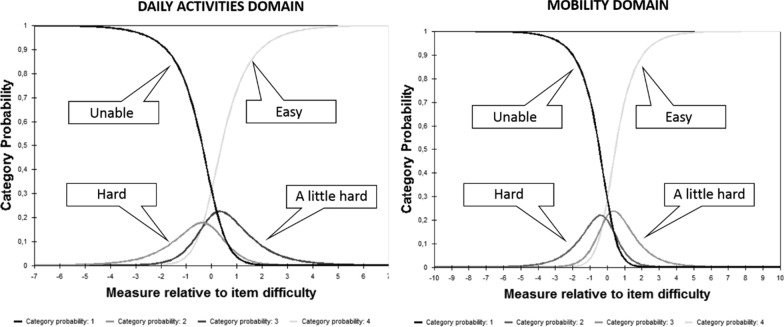
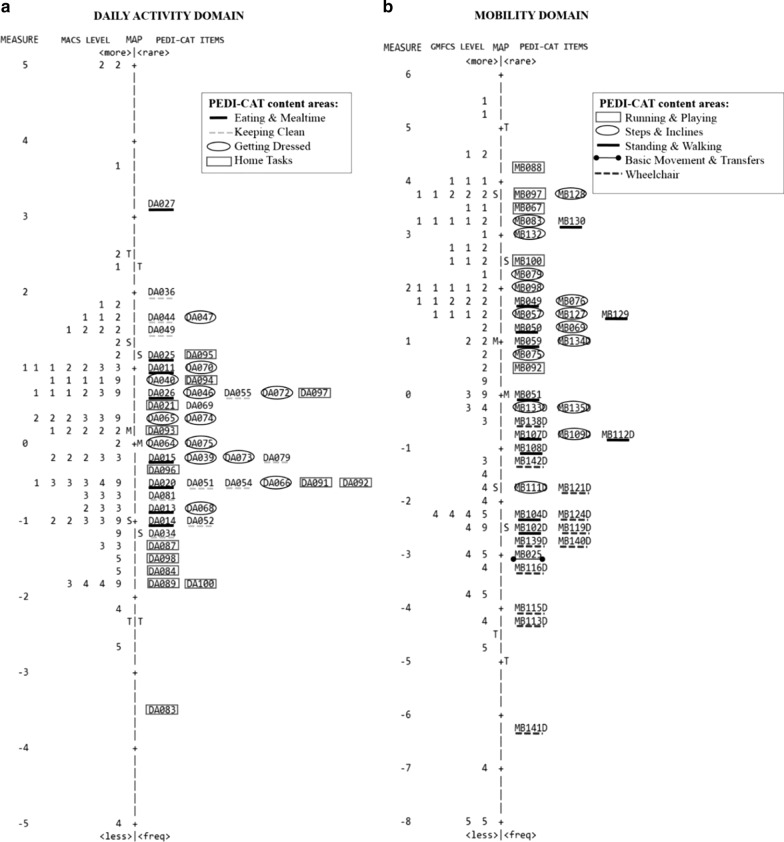
Our data fit the Rasch Model. Parents had difficulty distinguishing some PEDI-CAT response categories. Participants from MACS and GMFCS levels IV and V showed lower ability to perform relatively more difficult items. There was a floor effect in both domains. Only 7.7% of the items presented differential item functioning when individuals with mild MACS and GMFCS levels (I, II) and moderate level (III) and individuals with moderate (III) and severe levels (IV, V) were compared.
PEDI-CAT daily activities and mobility domains are valid to evaluate children, adolescents and youth with CP of different severities, but the addition of items to these domains is recommended in order to address their floor effect.
脑瘫患者在日常生活活动中存在活动受限。康复从业者寻求有效的工具来衡量这些活动表现的变化。儿科残疾评估量表计算机自适应测试(PEDI-CAT)是一种新的工具,用于评估各种健康状况的儿童和青少年的功能。它的有效性需要根据其理论模型进行评估。我们旨在评估日常活动和移动项目与脑瘫儿童的适配性,并根据手动功能和粗大运动功能限制,比较不同严重程度脑瘫儿童、青少年和年轻成人在日常活动和移动方面的表现。
83 名 8-20 岁脑瘫儿童和青少年的家长(平均年龄:11.6 岁)参与了本研究。通过 Rasch 分析对 PEDI-CAT 日常活动和移动领域的 91 个项目进行了分析,以评估相对项目难度和参与者能力。参与者根据手动能力(MACS)(水平 I:21.7%;II:32.5%;III:24.1%;IV:7.2%和 V:3.6%)和粗大运动功能(GMFCS)(水平 I:37.3%;II:26.5%;III:6%;IV:18.1%和 V:7.2%)分类系统进行描述。
我们的数据符合 Rasch 模型。家长在区分一些 PEDI-CAT 反应类别方面有困难。来自 MACS 和 GMFCS 水平 IV 和 V 的参与者在执行相对较难项目的能力较低。两个领域都存在地板效应。只有 7.7%的项目在比较轻度 MACS 和 GMFCS 水平(I、II)和中度水平(III)以及中度(III)和严重水平(IV、V)的个体时表现出不同的项目功能。
PEDI-CAT 日常活动和移动领域可用于评估不同严重程度的脑瘫儿童、青少年和青年,但建议在这些领域增加项目,以解决其地板效应。