
约束诱导的瑞利-泰勒不稳定性的稳定化及向无约束极限的转变。
Confinement-induced stabilization of the Rayleigh-Taylor instability and transition to the unconfined limit.
作者信息
Alqatari Samar, Videbæk Thomas E, Nagel Sidney R, Hosoi A E, Bischofberger Irmgard
机构信息
Department of Physics and The James Franck and Enrico Fermi Institutes, University of Chicago, Chicago, IL 60637, USA.
Department of Mechanical Engineering, Massachusetts Institute of Technology, Cambridge, MA 02139, USA.
出版信息
Sci Adv. 2020 Nov 18;6(47). doi: 10.1126/sciadv.abd6605. Print 2020 Nov.
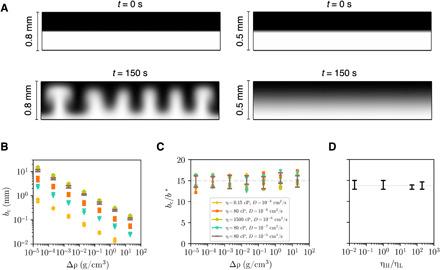
The prevention of hydrodynamic instabilities can lead to important insights for understanding the instabilities' underlying dynamics. The Rayleigh-Taylor instability that arises when a dense fluid sinks into and displaces a lighter one is particularly difficult to arrest. By preparing a density inversion between two miscible fluids inside the thin gap separating two flat plates, we create a clean initial stationary interface. Under these conditions, we find that the instability is suppressed below a critical plate spacing. With increasing spacing, the system transitions from the limit of stability where mass diffusion dominates over buoyant forces, through a regime where the gap sets the wavelength of the instability, to the unconfined regime governed by the competition between buoyancy and momentum diffusion. Our study, including experiment, simulation, and linear stability analysis, characterizes all three regimes of confinement and opens new routes for controlling mixing processes.
防止流体动力学不稳定性可为理解这些不稳定性的潜在动力学提供重要见解。当一种密度较大的流体下沉并取代较轻的流体时出现的瑞利 - 泰勒不稳定性尤其难以抑制。通过在分隔两个平板的狭窄间隙内的两种可混溶流体之间形成密度反转,我们创建了一个干净的初始静止界面。在这些条件下,我们发现当平板间距低于临界值时不稳定性会受到抑制。随着间距增加,系统从质量扩散主导浮力的稳定极限状态转变,经过一个间隙设定不稳定性波长的区域,再到由浮力和动量扩散竞争主导的无限制状态。我们的研究,包括实验、模拟和线性稳定性分析,刻画了所有三种限制状态,并为控制混合过程开辟了新途径。



 Zotero 插件