Department of Pathology, School of Medicine, Johns Hopkins University, Baltimore, Maryland, USA.
Department of Medicine, School of Medicine, Johns Hopkins University, Baltimore, Maryland, USA.
J Clin Microbiol. 2021 Jan 21;59(2). doi: 10.1128/JCM.02020-20.
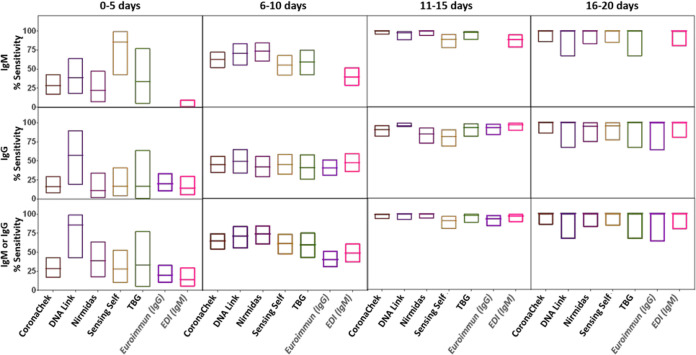
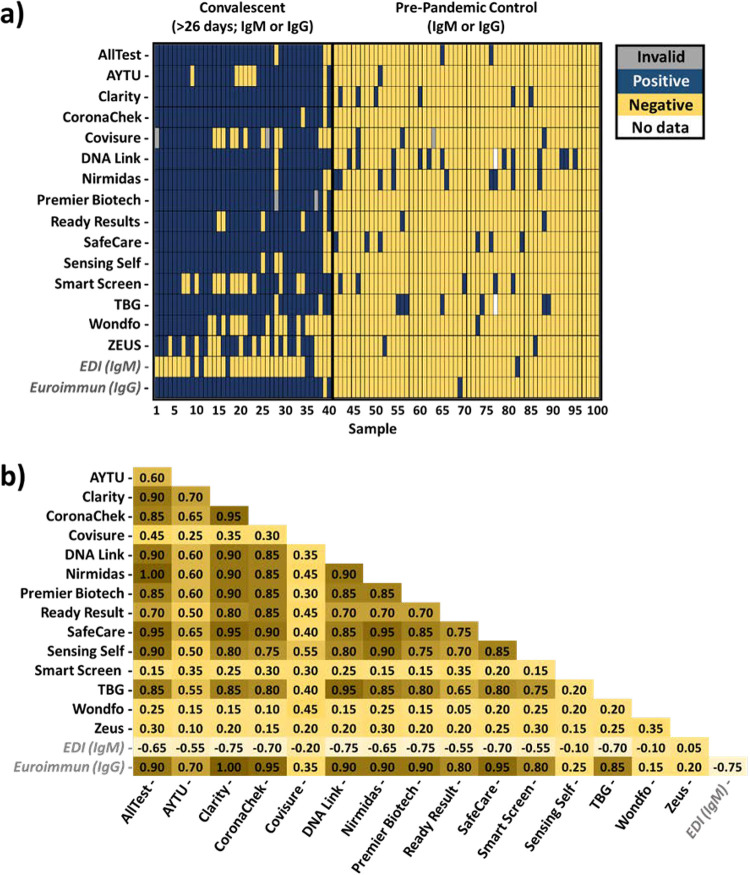
Rapid point-of-care tests (POCTs) for detection of severe acute respiratory syndrome coronavirus 2 (SARS-CoV-2)-specific antibodies vary in performance. A critical need exists to perform head-to-head comparisons of these assays. The performances of 15 different lateral flow POCTs for the detection of SARS-CoV-2-specific antibodies were compared on a well-characterized set of 100 samples. Of these, 40 samples from known SARS-CoV-2-infected, convalescent individuals (collected an average of 45 days after symptom onset) were used to assess sensitivity. Sixty samples from the prepandemic era (negative control) that were known to represent infections with other respiratory viruses (rhinoviruses A, B, and C and/or coronavirus 229E, HKU1, and NL63 OC43) were used to assess specificity. The timing of seroconversion was assessed using five lateral flow assays (LFAs) and a panel of 272 longitudinal samples from 47 patients for whom the time since symptom onset was known. Among the assays that were evaluated, the sensitivity and specificity for any reactive band ranged from 55% to 97% and from 78% to 100%, respectively. Assessing the performance of the IgM and the IgG bands alone, sensitivity and specificity ranged from 0% to 88% and 80% to 100% for IgM and from 25% to 95% and 90% to 100% for IgG, respectively. Longitudinal testing revealed that the median times after symptom onset to a positive result were 7 days (interquartile range [IQR], 5.4 to 9.8) for IgM and 8.2 days (IQR, 6.3 to 11.3) for IgG. The testing performances differed widely among LFAs, with greatest amount of variation related to the sensitivity of the assays. The IgM band was the band most likely to misclassify prepandemic samples. The appearances of IgM and IgG bands occurred almost simultaneously.
快速床边检测(POCT)用于检测严重急性呼吸综合征冠状病毒 2(SARS-CoV-2)特异性抗体,其性能各异。目前迫切需要对头对头比较这些检测方法。本研究对 100 份经充分特征鉴定样本的 15 种不同侧向流动 POCT 检测 SARS-CoV-2 特异性抗体的性能进行了比较。其中,40 份样本来自已知 SARS-CoV-2 感染的恢复期个体(平均在症状出现后 45 天采集),用于评估敏感性。60 份样本来自大流行前时代(阴性对照),已知代表其他呼吸道病毒(鼻病毒 A、B 和 C 以及/或冠状病毒 229E、HKU1 和 NL63 OC43)的感染,用于评估特异性。使用五种侧向流动检测法(LFAs)和 47 名患者的 272 份纵向样本对血清转换时间进行评估,这些患者的症状出现时间已知。在所评估的检测法中,任何阳性带的敏感性和特异性范围分别为 55%至 97%和 78%至 100%。单独评估 IgM 和 IgG 带的性能,敏感性和特异性范围分别为 IgM 的 0%至 88%和 80%至 100%,以及 IgG 的 25%至 95%和 90%至 100%。纵向检测结果显示,症状出现后出现阳性结果的中位数时间分别为 IgM 为 7 天(四分位距[IQR],5.4 至 9.8)和 IgG 为 8.2 天(IQR,6.3 至 11.3)。LFAs 之间的检测性能差异很大,最大的差异与检测方法的敏感性有关。IgM 带最有可能错误分类大流行前样本。IgM 和 IgG 带的出现几乎同时发生。