Global Public Health Impact Center, RTI International, Research Triangle Park, North Carolina, USA (formerly with FHI 360)
Mailman School of Public Health, Columbia University, New York, New York, USA.
Sex Transm Infect. 2021 Jun;97(4):249-255. doi: 10.1136/sextrans-2020-054590. Epub 2020 Nov 18.
Reproductive aged women are at risk of pregnancy and sexually transmitted infections (STI). Understanding drivers of STI acquisition, including any association with widely used contraceptives, could help us to reduce STI prevalence and comorbidities. We compared the risk of STI among women randomised to three contraceptive methods.
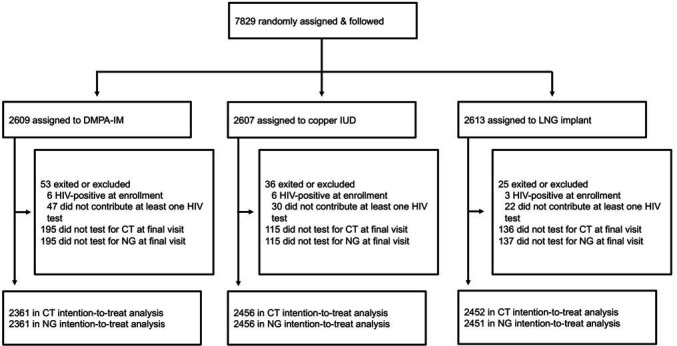
We conducted a secondary analysis to assess the risk of chlamydia and gonorrhoea in a clinical trial evaluating HIV risk among 7829 women aged 16-35 randomised to intramuscular depot medroxyprogesterone acetate (DMPA-IM), a copper intrauterine device (IUD) or a levonorgestrel (LNG) implant. We estimated chlamydia and gonorrhoea prevalences by contraceptive group and prevalence ratios (PR) using log-binomial regression.
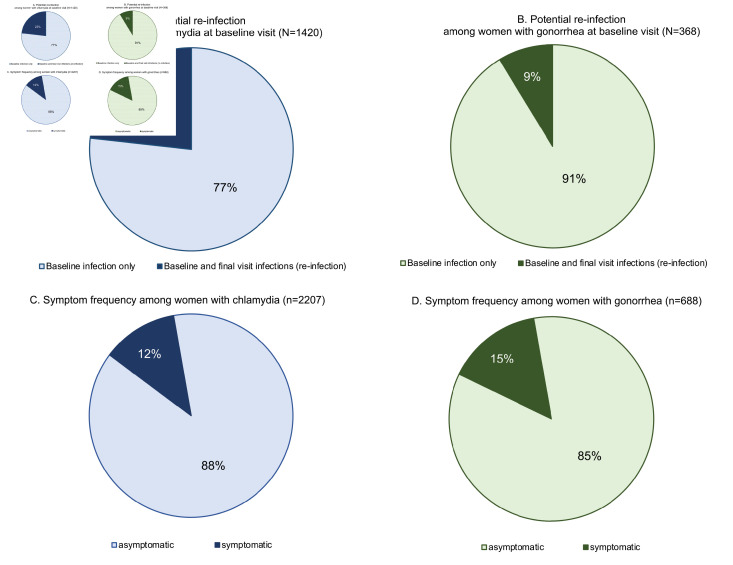
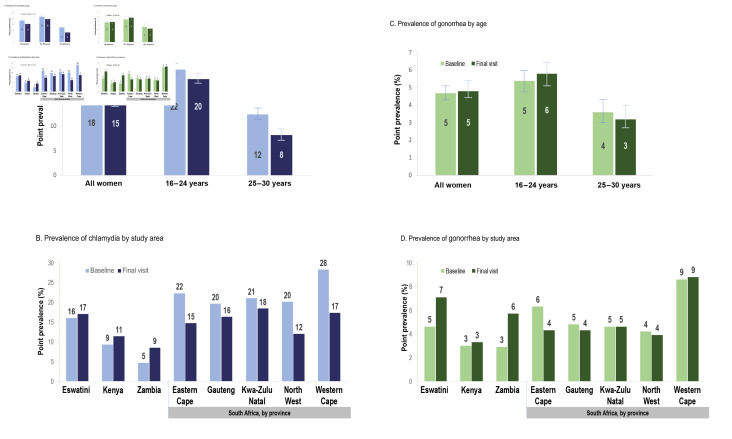
At baseline, chlamydia and gonorrhoea prevalences were 18% and 5%, respectively. Final visit chlamydia prevalence did not differ significantly between DMPA-IM and copper IUD groups or between copper IUD and LNG implant groups. The DMPA-IM group had significantly lower risk of chlamydia compared with the LNG implant group (PR 0.83, 95% CI 0.72 to 0.95). Final visit gonorrhoea prevalence differed significantly only between the DMPA-IM and the copper IUD groups (PR 0.67, 95% CI 0.52 to 0.87).
The findings suggest that chlamydia and gonorrhoea risk may vary with contraceptive method use. Further investigation is warranted to better understand the mechanisms of chlamydia and gonorrhoea susceptibility in the context of contraceptive use.
育龄妇女有怀孕和感染性传播疾病(STI)的风险。了解 STI 感染的驱动因素,包括与广泛使用的避孕方法的任何关联,可能有助于我们降低 STI 的流行率和合并症。我们比较了三种避孕方法随机分组的女性感染 STI 的风险。
我们对一项评估 7829 名 16-35 岁女性中 HIV 风险的临床试验进行了二次分析,这些女性被随机分配到肌肉内注射 depot 醋酸甲羟孕酮(DMPA-IM)、铜宫内节育器(IUD)或左炔诺孕酮(LNG)植入物。我们根据避孕方法组估算了衣原体和淋病的患病率,并使用对数二项式回归估计了患病率比(PR)。
在基线时,衣原体和淋病的患病率分别为 18%和 5%。最后一次就诊时,DMPA-IM 和铜 IUD 组之间或铜 IUD 和 LNG 植入物组之间的衣原体患病率没有显著差异。与 LNG 植入物组相比,DMPA-IM 组感染衣原体的风险显著降低(PR 0.83,95%CI 0.72-0.95)。最后一次就诊时,只有 DMPA-IM 和铜 IUD 组之间的淋病患病率存在显著差异(PR 0.67,95%CI 0.52-0.87)。
研究结果表明,衣原体和淋病的风险可能因避孕方法的使用而有所不同。需要进一步研究以更好地了解在避孕措施的背景下,衣原体和淋病易感性的机制。