Cunha Ana Maria, Loja João Tiago, Torrão Luís, Moreira Raúl, Pinheiro Dolores, Falcão-Reis Fernando, Pinheiro-Costa João
Department of Ophthalmology, Centro Hospitalar Universitário São João, Porto, Portugal.
Faculty of Medicine, University of Porto, Porto, Portugal.
Clin Ophthalmol. 2020 Nov 12;14:3833-3839. doi: 10.2147/OPTH.S268327. eCollection 2020.
To determine the microbiological profile, risk factors, treatment and surgical intervention rates of fungal keratitis at a tertiary referral centre.
A retrospective review of microbiological and medical records from hospitalised patients treated for fungal keratitis at Centro Hospitalar Universitário de São João from 2009 to 2019 was conducted.
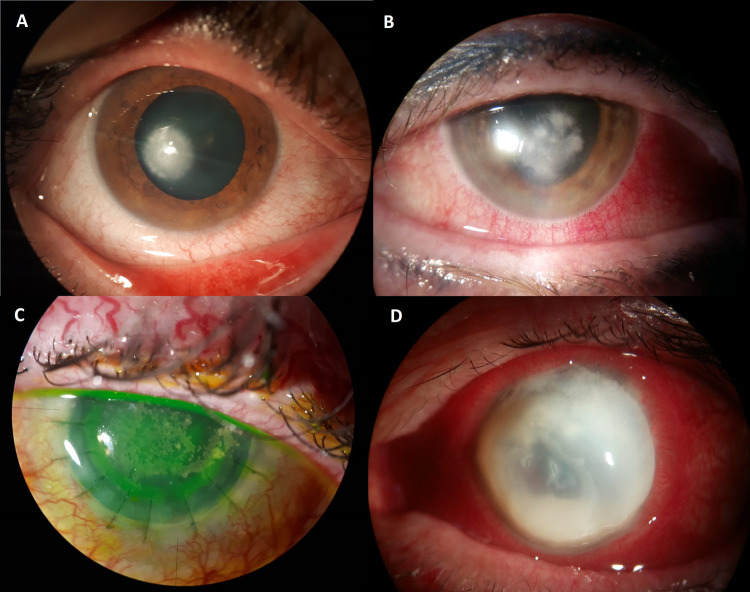
Overall, 43 patients were included in our study. The mean age of patients was 63.7 years and 46.5% were men. In culture were isolated 22 (51.2%) filamentous fungi and 21 (48.8%) yeast. species (n = 20, 46.5%), species (n = 10, 23.4%) and species (n = 4, 9.3%) were the most common isolated species. Important risk factors were contact lens use (n = 24, 55.8%), long-term users of topical corticosteroids (n = 19, 44.2%) and previous keratitis (n = 19, 44.2%). Yeast isolates had a statistically significant higher prevalence in long-term users of topical corticosteroids compared to filamentous ones (p = 0.043). Twenty-four cases (55.8%) required surgical intervention, of which 23 cases underwent therapeutic penetrating keratoplasty. Ocular complications, such as evisceration was noted in 12 patients (27.9%) and endophthalmitis in 5 (11.6%). No statistically significant changes of best corrected visual acuity (BCVA) were found after treatment (p = 0.687).
Most patients with fungal keratitis have associated risk factors. Filamentous and yeast species have equally prevalent etiologies. In general, our results mirror how difficult and challenging the approach and treatment of fungal keratitis could be.
确定一家三级转诊中心真菌性角膜炎的微生物学特征、危险因素、治疗方法及手术干预率。
对2009年至2019年在圣若昂大学医院中心接受治疗的真菌性角膜炎住院患者的微生物学和医疗记录进行回顾性研究。
总体而言,我们的研究纳入了43例患者。患者的平均年龄为63.7岁,男性占46.5%。在培养物中分离出22株(51.2%)丝状真菌和21株(48.8%)酵母菌。 种(n = 20,46.5%)、 种(n = 10,23.4%)和 种(n = 4,9.3%)是最常见的分离菌种。重要的危险因素包括使用隐形眼镜(n = 24,55.8%)、长期使用局部皮质类固醇(n = 19,44.2%)和既往有角膜炎(n = 19,44.2%)。与丝状真菌相比,长期使用局部皮质类固醇的患者中酵母菌分离株的患病率在统计学上显著更高(p = 0.043)。24例(55.8%)患者需要手术干预,其中23例接受了治疗性穿透性角膜移植术。12例患者(27.9%)出现眼球摘除等眼部并发症,5例(11.6%)出现眼内炎。治疗后最佳矫正视力(BCVA)无统计学显著变化(p = 0.687)。
大多数真菌性角膜炎患者有相关危险因素。丝状真菌和酵母菌的病因同样普遍。总体而言,我们的结果反映了真菌性角膜炎的治疗方法和治疗可能有多困难和具有挑战性。