Zhang Yaru, Ma Yunlong, Huang Yukuan, Zhang Yan, Jiang Qi, Zhou Meng, Su Jianzhong
Institute of Biomedical Big Data, School of Biomedical Engineering, School of Ophthalmology & Optometry and Eye Hospital, Wenzhou Medical University, Wenzhou 325027, China.
Wenzhou Institute, University of Chinese Academy of Sciences, Wenzhou 325011, China.
Comput Struct Biotechnol J. 2020 Oct 15;18:2953-2961. doi: 10.1016/j.csbj.2020.10.007. eCollection 2020.
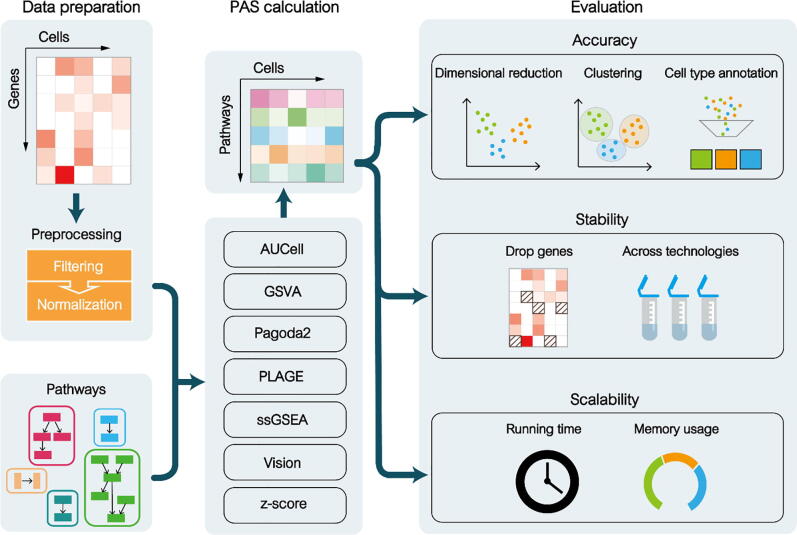
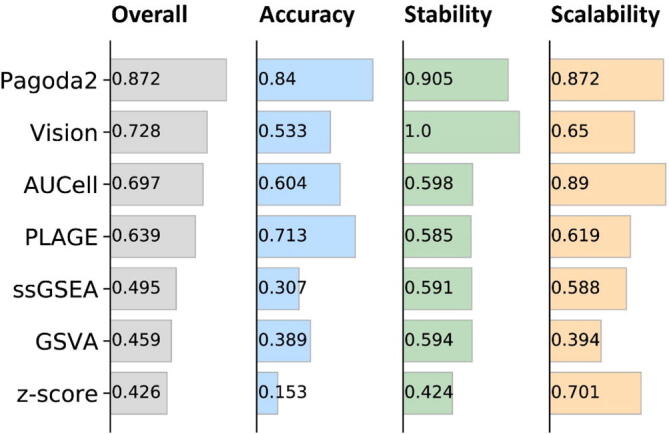
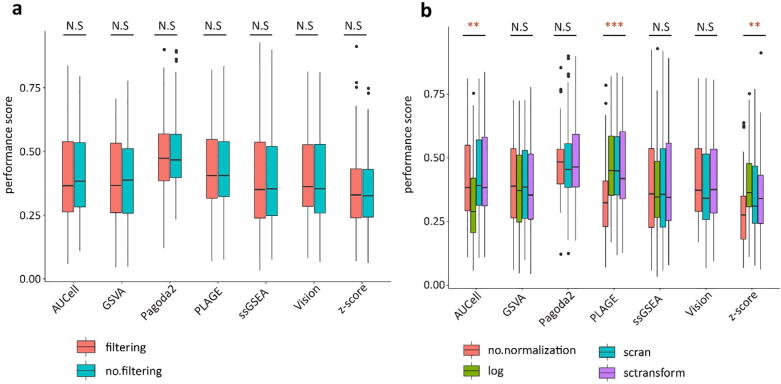
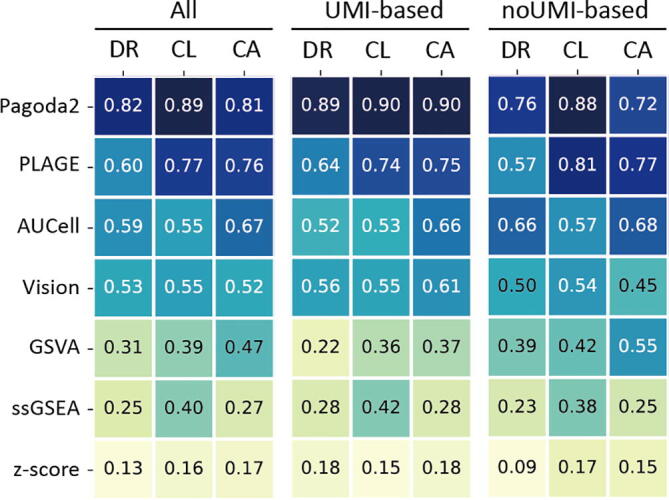
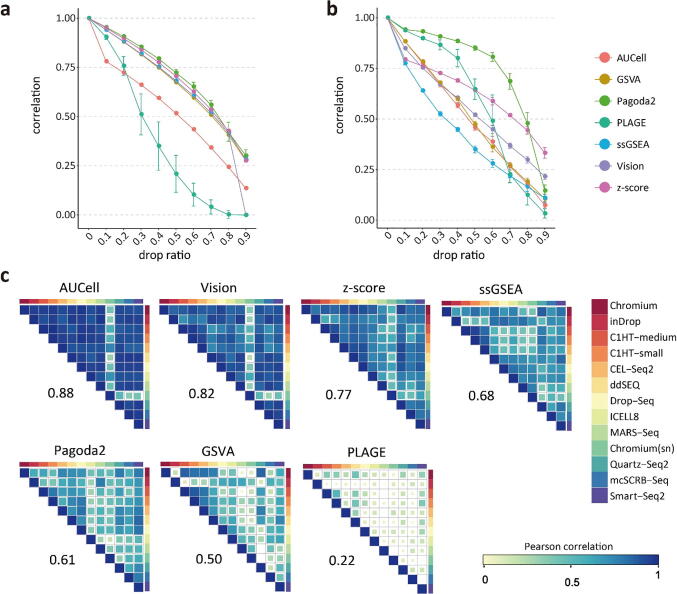
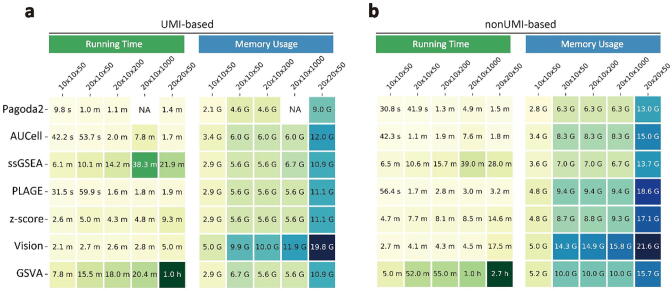
Biological pathway analysis provides new insights for cell clustering and functional annotation from single-cell RNA sequencing (scRNA-seq) data. Many pathway analysis algorithms have been developed to transform gene-level scRNA-seq data into functional gene sets representing pathways or biological processes. Here, we collected seven widely-used pathway activity transformation algorithms and 32 available datasets based on 16 scRNA-seq techniques. We proposed a comprehensive framework to evaluate their accuracy, stability and scalability. The assessment of scRNA-seq preprocessing showed that cell filtering had the less impact on scRNA-seq pathway analysis, while data normalization of sctransform and scran had a consistent well impact across all tools. We found that Pagoda2 yielded the best overall performance with the highest accuracy, scalability, and stability. Meanwhile, the tool PLAGE exhibited the highest stability, as well as moderate accuracy and scalability.
生物通路分析为从单细胞RNA测序(scRNA-seq)数据进行细胞聚类和功能注释提供了新的见解。已经开发了许多通路分析算法,将基因水平的scRNA-seq数据转化为代表通路或生物过程的功能基因集。在此,我们收集了基于16种scRNA-seq技术的7种广泛使用的通路活性转化算法和32个可用数据集。我们提出了一个综合框架来评估它们的准确性、稳定性和可扩展性。对scRNA-seq预处理的评估表明,细胞过滤对scRNA-seq通路分析的影响较小,而sctransform和scran的数据归一化对所有工具都有一致的良好影响。我们发现Pagoda2在准确性、可扩展性和稳定性方面表现最佳,总体性能最好。同时,工具PLAGE表现出最高的稳定性,以及中等的准确性和可扩展性。