Rodríguez-Núñez Nuria, Ruano-Raviña Alberto, Lama Adriana, Ferreiro Lucía, Ricoy Jorge, Álvarez-Dobaño José M, Suárez-Antelo Juan, Toubes M Elena, Rábade Carlos, Golpe Antonio, Lourido Tamara, González-Barcala Francisco Javier, Valdés Luis
Department of Pulmonology, Complejo Hospitalario Universitario de Santiago, Santiago de Compostela, Spain.
Department of Preventive Medicine and Public Health, Universidad de Santiago de Compostela, Santiago de Compostela, Spain.
J Thorac Dis. 2020 Oct;12(10):5411-5419. doi: 10.21037/jtd-20-1634.
The nature of pulmonary embolism (PE) without identifiable risk factor (IRF) remains unclear. The objective of this study is to investigate the potential relationship between cardiovascular risk factors (CVRFs) and PE without IRF (unprovoked) and assess their role as markers of disease severity and prognosis.
A case-control study was performed of patients with PE admitted to our hospital [2010-2019]. Subjects with PE without IRF were included in the cohort of cases, whereas patients with PE with IRF were allocated to the control group. Variables of interest included age, active smoking, obesity, and diagnosis of arterial hypertension, dyslipidemia or diabetes mellitus.
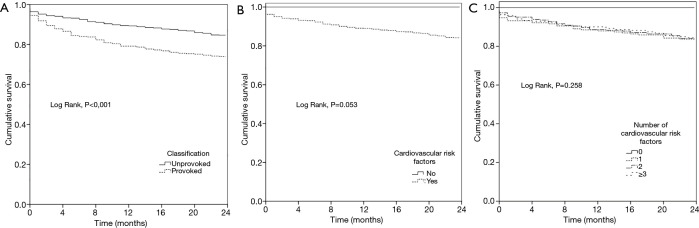
A total of 1,166 patients were included in the study, of whom 64.2% had PE without IRF. The risk for PE without IRF increased with age [odds ratio (OR): 2.68; 95% confidence interval (CI): 1.95-3.68], arterial hypertension (OR: 1.63; 95% CI: 1.27-2.07), and dyslipidemia (OR: 1.63; 95% CI: 1.24-2.15). The risk for PE without IRF was higher as the number of CVRF increased, being 3.99 (95% CI: 2.02-7.90) for subjects with ≥3 CVRF. The percentage of high-risk unprovoked PE increased significantly as the number of CVRF rose [0.6% for no CVRF; 23.8% for a CRF, P<0.001 (OR: 9.92; 95% CI: 2.82-34.9); 37.5% for two CRFs, P<0.001 (OR: 14.8; 95% CI: 4.25-51.85); and 38.1% for ≥3, P<0.001 (OR: 14.1; 95% CI: 4.06-49.4)]. No significant differences were observed in 1-month survival between cases and controls, whereas differences in 24-month survival reached significance.
A relationship was observed between CVRF and PE without IRF, as the risk for unprovoked PE increased with the number of CVRF. In addition, the number of CVRF was associated with PE without IRF severity, but not with prognosis.
无明确危险因素(IRF)的肺栓塞(PE)的本质仍不清楚。本研究的目的是调查心血管危险因素(CVRF)与无IRF的PE(特发性)之间的潜在关系,并评估它们作为疾病严重程度和预后标志物的作用。
对我院[2010 - 2019年]收治的PE患者进行病例对照研究。无IRF的PE患者纳入病例组,有IRF的PE患者分配到对照组。感兴趣的变量包括年龄、当前吸烟、肥胖以及动脉高血压、血脂异常或糖尿病的诊断。
本研究共纳入1166例患者,其中64.2%为无IRF的PE。无IRF的PE风险随年龄增加而增加[比值比(OR):2.68;95%置信区间(CI):1.95 - 3.68]、动脉高血压(OR:1.63;95%CI:1.27 - 2.07)和血脂异常(OR:1.63;95%CI:1.24 - 2.15)。无IRF的PE风险随着CVRF数量的增加而升高,≥3个CVRF的受试者的风险为3.99(95%CI:2.02 - 7.90)。随着CVRF数量的增加,特发性高危PE的百分比显著增加[无CVRF者为0.6%;1个CVRF者为23.8%,P<0.001(OR:9.92;95%CI:2.82 - 34.9);2个CVRF者为37.5%,P<0.001(OR:14.8;95%CI:4.25 - 51.85);≥3个CVRF者为38.1%,P<0.001(OR:14.1;95%CI:4.06 - 49.4)]。病例组和对照组在1个月生存率方面未观察到显著差异,而在24个月生存率方面差异显著。
观察到CVRF与无IRF的PE之间存在关联,因为特发性PE的风险随着CVRF数量的增加而增加。此外,CVRF数量与无IRF的PE严重程度相关,但与预后无关。